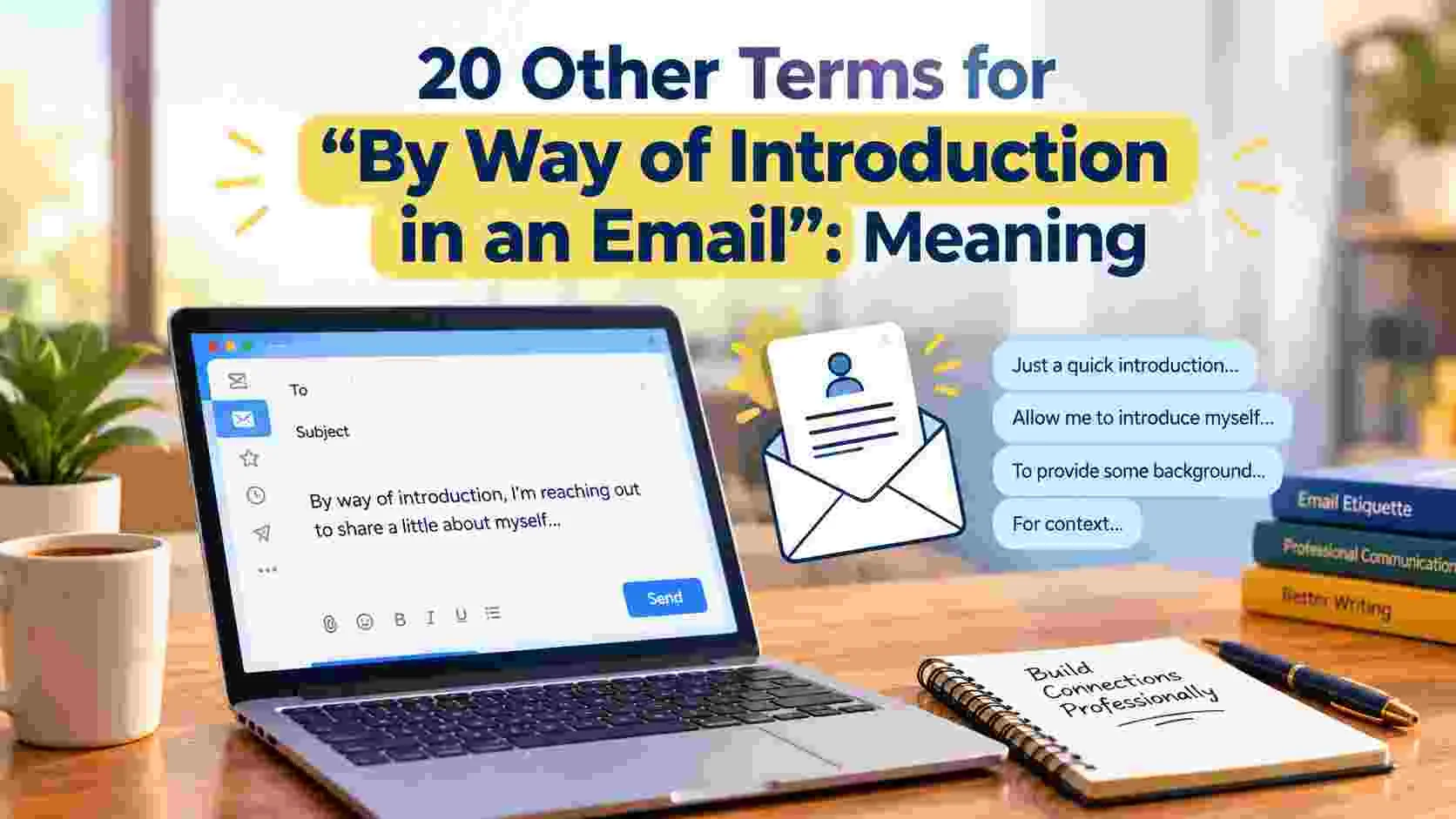
Imagine receiving an email from someone you have never met. They briefly explain who they are, why they are contacting you, and how they are connected to your work. They might begin with “By way of introduction, I’m…” before moving directly to the purpose of the message. The wording is clear, courteous, and professional, but it can sound somewhat formal depending on the audience.
The phrase “by way of introduction in an email” refers to language used to introduce yourself, another person, or some relevant background before getting to the main point of a message. It is particularly useful when the recipient does not already know the sender or when some context is needed before a request, proposal, update, or conversation.
Choosing the right alternative matters because introductory language establishes the relationship before the main message begins. A formal expression can create professionalism and distance, while a simpler phrase can feel more natural and approachable. Understanding these differences helps professionals, students, ESL learners, and content writers choose wording that is clear, appropriate, and suited to the situation.
What Does “By Way of Introduction in an Email” Mean?
“By way of introduction in an email” means using a brief introductory statement to identify yourself, another person, or relevant background before discussing the main purpose of the message. It is commonly used in professional emails, networking messages, business correspondence, introductions between colleagues, and situations where the recipient needs context before responding.
In everyday use, the more natural form is usually “by way of introduction” rather than “by way of introduction in an email.” The added words simply describe the communication setting.
For example:
By way of introduction, I’m Sarah, the new project coordinator for the marketing team.
Here, the phrase signals that the next information is introductory rather than the main request.
Origin & History of “By Way of Introduction”
The expression “by way of” has a long history in English. The word “way” originally referred to a route, path, or means of reaching a destination. Over time, expressions using “by way of” developed broader meanings, including “through,” “by means of,” “for,” or “as a form of.”
“By way of introduction” follows this broader construction. It essentially presents something as an introductory means or preliminary statement before the main subject.
The wording became particularly comfortable in formal written English because it allows writers to signal a transition without abruptly moving from one topic to another. Business letters, formal correspondence, speeches, reports, and professional introductions have traditionally favored this type of framing language.
Modern email has changed how frequently the expression is needed. Email encourages shorter, more direct messages, so many writers now choose simpler alternatives such as “I’d like to introduce myself,” “To introduce myself,” or “A quick introduction.”
The original sense of presenting something as a means or route remains recognizable, but its modern communicative function is mainly organizational: it tells the reader that introductory information is coming before the main message.
Synonyms & Alternatives by Tone
Professional & Neutral Alternatives
- I’d like to introduce myself
- Allow me to introduce myself
- To introduce myself
- I’m reaching out to introduce myself
- I wanted to introduce myself
- Let me introduce myself
- As an introduction
- A brief introduction
- For context
- To provide some background
Polite & Supportive Alternatives
- I’d like to briefly introduce myself
- I thought I’d introduce myself
- I wanted to give you a little background
- I’d like to share a little about my role
- Just to introduce myself
- I wanted to provide some context
- By way of a brief introduction
- For a little background
Encouraging & Reassuring Alternatives
- To give you some context
- To help put this in context
- I’d like to give you a little background
- For some helpful background
- To give you a quick overview
- Before we get started, a little about me
- Here’s a little background on my role
Casual, Playful & Idiomatic Alternatives
- A quick introduction
- A little about me
- Just a quick intro
- A quick note about who I am
- Let me give you some background
- A bit about my role
- Just to give you some context
- A quick word about me
When Should You Use “By Way of Introduction”?
“By way of introduction” works best when you need to establish identity, role, or context before moving into the main subject. It is especially useful when the recipient may not immediately recognize your name or understand why you are contacting them.
Professional settings
The phrase can work well in:
- First-contact business emails
- Networking correspondence
- Client introductions
- Introductions between departments
- Partnership discussions
- Vendor or supplier communication
- Professional introductions
- Messages from a new employee or manager
For example:
By way of introduction, I’m Daniel Lee, and I recently joined the operations team as regional manager.
Casual conversations
The phrase is less necessary in casual communication. If you are messaging a friend of a friend or someone in an informal online group, “Hi, I’m Daniel” or “Just a quick intro—I’m Daniel” may sound more natural.
Writing, presentations, and digital communication
The expression is also useful outside email. A speaker might say:
By way of introduction, I’ve worked in renewable energy for the past decade.
In a written article, however, “to introduce myself” or “a little about my background” may feel more conversational.
When it is especially effective
Use it when:
- The recipient does not know you.
- Your role needs clarification.
- The relationship is professional.
- You need to establish context before making a request.
- The introduction is short and directly relevant to the message.
The key is proportion. An introduction should provide enough context to make the rest of the message understandable without delaying the actual purpose of the email.
When Should You Avoid “By Way of Introduction”?
Although the phrase is grammatically correct, it is not appropriate for every situation.
Overly formal situations
The expression can sound unnecessarily formal when writing to someone you communicate with regularly.
Instead of:
By way of introduction, I’m checking whether you received the report.
A more natural version might be:
I wanted to check whether you received the report.
Legal, academic, or sensitive contexts
In highly precise communication, introductory wording should not obscure the purpose of the message. Legal, compliance, medical, or sensitive workplace communication may benefit from direct language and clearly defined facts.
Situations where nuance may be lost
Avoid using the phrase if the real purpose is not simply to introduce yourself. If you are making a request, explaining a problem, or addressing a sensitive issue, state that purpose clearly.
For example, instead of spending several lines introducing yourself, you might write:
I’m the new account manager for your team, and I’m contacting you about the renewal scheduled for October.
This provides identification and purpose in one sentence.
Is “By Way of Introduction” Professional, Polite, or Casual?
“By way of introduction” is generally professional, polite, and moderately formal. It is not normally perceived as rude or unfriendly, but it can sound more traditional than everyday email language.
Tone analysis
The expression tends to communicate:
- Professionalism
- Courtesy
- Structure
- Formality
- Deliberateness
- Respect for the recipient
It does not usually communicate urgency or strong emotion.
Formality level
A useful way to think about its register is:
Casual: “Hi, I’m Alex.”
Neutral: “I’d like to introduce myself.”
Professional: “I’m reaching out to introduce myself.”
More formal: “By way of introduction, I’m Alex.”
The appropriate choice depends on the relationship rather than on grammar alone.
Emotional subtext
The phrase can subtly create professional distance. That is not necessarily negative; in a business setting, some distance can help establish boundaries and credibility.
However, if your goal is to sound warm and approachable, a simpler alternative may work better.
Pros and Cons of Using “By Way of Introduction”
Advantages
- Clarity: It immediately signals that introductory information is coming.
- Efficiency: It creates a clear transition into background information.
- Accessibility: Most professional readers can understand the intended meaning immediately.
- Professional tone: It suits formal correspondence and first-contact situations.
- Structure: It helps separate introductory information from the main purpose of an email.
Potential Drawbacks
- Oversimplification: The phrase may not explain why the introduction matters.
- Tone mismatch: It can sound too formal for familiar colleagues or casual contacts.
- Repetition: Frequent use can make emails feel formulaic.
- Indirectness: A more direct sentence may communicate the same information faster.
- Old-fashioned feel: Some readers may perceive it as more traditional than contemporary email language.
Real-Life Examples of “By Way of Introduction” by Context
By way of introduction, I’m Priya Shah, the new customer success manager assigned to your account. I’m looking forward to working with you and wanted to introduce myself before our call next Tuesday.
Meeting
By way of introduction, I’ve been working with the product team for the past three years and will be supporting this project from the customer research side.
Presentation
By way of introduction, I’m an environmental consultant specializing in sustainable building projects.
Conversation
By way of introduction, I’m Mark. I work with the design team and have been helping with the new website.
Social media
By way of introduction, I’m a freelance editor focusing on business and educational content. I’m looking forward to connecting with other writers here.
In casual social media communication, however, “Hi, I’m…” or “A little about me…” will usually feel more natural.
“By Way of Introduction” vs Similar Expressions: Key Differences
| Phrase | Meaning Difference | Tone Difference | Best Use Scenario |
| I’d like to introduce myself | Directly states the intention to introduce yourself. | Professional and natural. | First-contact emails and networking. |
| Allow me to introduce myself | Offers a formal introduction, often with a courteous feel. | More formal and traditional. | Formal correspondence or professional events. |
| I’m reaching out to introduce myself | Combines the act of contacting someone with the introduction. | Modern, professional, slightly indirect. | Business outreach and networking. |
| A quick introduction | Signals that the introduction will be brief. | Friendly and concise. | Modern workplace emails and messages. |
| For context | Provides background rather than necessarily introducing the sender. | Neutral and efficient. | Explanations, project updates, and workplace communication. |
| A little about me | Provides personal or professional background in a relaxed way. | Casual and approachable. | Social media, informal introductions, and community groups. |
The main difference is that “by way of introduction” specifically frames information as an introduction, while expressions such as “for context” can introduce background without necessarily identifying who the speaker is.
Common Mistakes & Misuse of “By Way of Introduction”
Overuse
Using the expression in every new email can make your writing sound repetitive. If the recipient already knows you, there may be no reason to introduce yourself again.
Incorrect context
Do not use the phrase simply because an email is formal. Formality alone does not make an introduction necessary.
Contradictory usage
Avoid using a formal introductory phrase followed by extremely casual wording if the contrast feels accidental.
For example:
By way of introduction, I am the director of operations. Hey, just wanted to know what’s up with the project.
The ideas can be expressed more consistently.
Cultural misunderstandings
English varies across regions, industries, generations, and professional cultures. A phrase that sounds polished to one reader may sound overly formal to another. International professionals should focus on clarity rather than trying to make every email sound highly formal.
Psychological Reasons People Prefer “By Way of Introduction”
Language choices often reflect how people process information, not just grammar.
Cognitive load reduction
An introductory phrase tells readers what to expect. When the recipient sees “by way of introduction,” they know the next sentence will probably explain who the sender is or provide relevant background.
Trust and authority signals
Formal language can sometimes signal that the writer is taking the communication seriously. However, authority is usually established more effectively through clear information and relevant credentials than through formal wording alone.
Attention economy
Modern readers often scan emails rather than reading every sentence carefully. A short introductory signal can help readers understand the structure quickly.
Modern communication habits
Email has increasingly moved toward concise writing. As a result, expressions such as “A quick introduction” and “I’d like to introduce myself” are often preferred because they communicate the same function with fewer words.
US vs UK Usage of “By Way of Introduction”
There is no major difference in the basic meaning of “by way of introduction” between American and British English. Speakers in both varieties can understand and use it.
Popularity
The expression belongs to standard English rather than being exclusively American or British. It is more strongly associated with formal or professional writing than with everyday conversation in either variety.
Tone perception
American readers may sometimes prefer a more direct email style, particularly in fast-moving workplace communication. British professional writing can also use the phrase, although contemporary British business communication frequently favors simpler wording as well.
These are broad tendencies rather than strict rules. Industry, age, organization, and individual writing style can have a greater effect than nationality.
Regional preferences
For international communication, alternatives such as “I’d like to introduce myself” are often safer when you want a straightforward, widely understood expression.
“By Way of Introduction” in Digital & Modern Communication
Emails
Email remains the most natural setting for the expression. It can introduce a sender before a meeting, request, proposal, or business discussion.
Slack and WhatsApp
In fast-moving messaging environments, the phrase may feel unnecessarily formal. A message such as “Hi, I’m Alex from the product team” is usually more efficient.
Social media
On professional platforms, the expression can work, but shorter wording often creates better readability.
AI-generated summaries
When emails are summarized by AI tools, concise introductions are easier to interpret when the sender, role, purpose, and relevant context are explicitly stated. This makes direct language such as “I’m the new account manager” particularly useful.
Linguistic & Communication Insight
Emotional weight & subtext
The literal meaning of “by way of introduction” is straightforward, but readers may perceive additional signals from its formality. It can suggest that the writer is being deliberate, respectful, and organized.
It does not normally carry a strong emotional message. The emotional effect comes primarily from the surrounding language.
Compare:
By way of introduction, I’m contacting you regarding the partnership proposal.
with:
Hi Maya, I’m Daniel. I recently joined the partnerships team and wanted to introduce myself.
The second version feels warmer because the vocabulary and sentence structure are simpler.
Direct vs indirect phrasing
“By way of introduction” is somewhat indirect because it does not immediately say “I am…” or “I want to introduce myself.”
That indirectness can be useful when you want a measured professional tone. However, direct alternatives can be more efficient when the recipient is busy.
Professional communication perspective
In workplace communication, the strongest introduction usually answers three questions:
- Who are you?
- Why are you contacting this person?
- Why does the information matter?
A polished phrase cannot compensate for missing context. Good professional communication combines appropriate tone with useful information.
Pragmatic reasons for alternatives
Experienced communicators often choose alternatives because they want to adjust the relationship being created by the message.
“Allow me to introduce myself” creates greater formality.
“A quick introduction” creates efficiency.
“A little about me” creates warmth.
“For context” emphasizes information rather than personal identity.
These choices help writers reduce unnecessary distance, encourage collaboration, or establish authority without sounding overly formal.
Social signaling
Word choice tells readers something about how the writer views the interaction. Highly formal language can signal professional distance, while conversational language can signal openness.
Neither is automatically better. The important question is whether the signal matches the relationship.
Tone & context guidance
Use “by way of introduction” when the audience expects professional or formal communication and a short introduction genuinely helps the reader.
Choose a simpler alternative when the audience is familiar, the communication is fast-paced, or warmth is more important than formality.
Meaning, Usage & Examples for Each Alternative
I’d Like to Introduce Myself
Meaning: “I’d like to introduce myself” directly tells the reader that you are about to provide your name, role, or relevant background.
Why This Phrase Works: It is clear without being stiff. The reader immediately understands why the next sentence is about you.
Real-World Usage Insight: This is one of the most versatile alternatives for professional email because it sounds natural in both formal and moderately relaxed workplaces.
Best Use: First-contact emails, networking, client communication, and introductions to new colleagues.
Avoid When: You have already introduced yourself and the recipient clearly knows who you are.
Tone: Professional, polite, direct, and approachable.
US vs UK Usage: Common and natural in both American and British English.
Example (Email / Message / Meeting):
I’d like to introduce myself. I’m Nina Patel, and I’ll be your main contact for the account going forward.
Allow Me to Introduce Myself
Meaning: “Allow me to introduce myself” is a formal way of announcing an introduction.
Why This Phrase Works: It shows courtesy and gives the introduction a deliberate, respectful tone.
Real-World Usage Insight: It is more formal than most everyday business-email alternatives, so it works best when the relationship or setting calls for additional formality.
Best Use: Formal correspondence, professional events, speeches, and traditional business communication.
Avoid When: Writing to close colleagues or sending a quick informal message.
Tone: Formal, courteous, traditional.
US vs UK Usage: Understood in both varieties, although contemporary workplace communication may favor simpler alternatives.
Example (Email / Message / Meeting):
Allow me to introduce myself. I’m James Carter, the regional director responsible for the new partnership.
To Introduce Myself
Meaning: “To introduce myself” presents the introduction as the reason or purpose for the next statement.
Why This Phrase Works: It is concise and fits naturally into an email without adding unnecessary formality.
Real-World Usage Insight: This construction works especially well when combined with an action or reason for contacting someone.
Best Use: Business emails, networking messages, professional profiles, and introductions.
Avoid When: A simple “Hi, I’m…” would be more natural.
Tone: Neutral, professional, concise.
US vs UK Usage: Widely understood and used in both US and UK English.
Example (Email / Message / Meeting):
I’m writing to introduce myself. I recently joined the finance team and will be supporting your department this quarter.
I’m Reaching Out to Introduce Myself
Meaning: This phrase combines the act of contacting someone to introduce yourself.
Why This Phrase Works: It explains both why you are writing and what the reader should expect.
Real-World Usage Insight: It is particularly common in networking and business-development emails.
Best Use: Networking, client outreach, partnerships, and professional introductions.
Avoid When: Writing very formal legal or highly concise technical correspondence.
Tone: Modern, professional, polite.
US vs UK Usage: Common in American business English and increasingly familiar in international and British professional communication.
Example (Email / Message / Meeting):
I’m reaching out to introduce myself before our meeting next week. I’m the new project lead on the implementation team.
I Wanted to Introduce Myself
Meaning: This expression explains that introducing yourself is the reason for contacting the recipient.
Why This Phrase Works: “I wanted to” softens the statement and can make the message feel less abrupt.
Real-World Usage Insight: It is useful when you want to sound professional without making the email feel overly formal.
Best Use: Colleague introductions, client emails, networking, and follow-up communication.
Avoid When: You need to communicate an urgent matter immediately.
Tone: Warm, professional, moderately indirect.
US vs UK Usage: Natural in both American and British English.
Example (Email / Message / Meeting):
I wanted to introduce myself before we begin working together. I’m covering the account while Emma is on leave.
Let Me Introduce Myself
Meaning: “Let me introduce myself” is a direct invitation to allow the speaker to provide identifying information.
Why This Phrase Works: It is short and immediately establishes the purpose of the following statement.
Real-World Usage Insight: It works particularly well when speaking or when writing in a conversational professional style.
Best Use: Meetings, presentations, informal professional emails, and networking.
Avoid When: The context requires highly formal correspondence.
Tone: Direct, friendly, professional.
US vs UK Usage: Widely understood in both varieties.
Example (Email / Message / Meeting):
Let me introduce myself before we get started. I’m Omar, and I’ll be coordinating the research portion of the project.
As an Introduction
Meaning: “As an introduction” signals that the following information is intended to provide introductory context.
Why This Phrase Works: It is brief and flexible, especially when introducing a person, topic, or background rather than only yourself.
Real-World Usage Insight: It works best when the introduction is closely connected to the information that follows.
Best Use: Articles, presentations, reports, professional writing, and formal emails.
Avoid When: A direct introduction would be clearer.
Tone: Neutral to formal.
US vs UK Usage: Recognized in both US and UK English.
Example (Email / Message / Meeting):
As an introduction, I’ve included a short overview of my role and how I’ll be supporting the project.
A Brief Introduction
Meaning: “A brief introduction” tells the reader that a short amount of background information will follow.
Why This Phrase Works: The word “brief” reassures readers that the introduction will be concise.
Real-World Usage Insight: It is particularly useful when readers are busy, and you want to make the structure of your message obvious.
Best Use: Professional emails, presentations, reports, and networking.
Avoid When: You need to provide extensive personal or organizational background.
Tone: Professional, concise, organized.
US vs UK Usage: Natural in both American and British English.
Example (Email / Message / Meeting):
A brief introduction: I’m the new content manager, and I’ll be reviewing the website copy with your team this month.
For Context
Meaning: “For context” introduces background information that helps the reader understand the main point.
Why This Phrase Works: It focuses on relevance rather than formality and does not require the information to be a personal introduction.
Real-World Usage Insight: This is often more useful than “by way of introduction” when the reader already knows who you are.
Best Use: Workplace updates, explanations, project discussions, and problem-solving emails.
Avoid When: You are actually introducing yourself to someone who has never heard of you.
Tone: Neutral, direct, efficient.
US vs UK Usage: Common and natural in both varieties.
Example (Email / Message / Meeting):
For context, the client requested this change during yesterday’s review, which is why the deadline has moved.
To Provide Some Background
Meaning: This phrase introduces information that explains the history, circumstances, or context behind a subject.
Why This Phrase Works: It clearly tells the reader that the following details are intended to improve understanding.
Real-World Usage Insight: It is particularly valuable when a reader needs context before making a decision.
Best Use: Reports, workplace emails, project discussions, academic communication.
Avoid When: The background information is unnecessary to the immediate purpose.
Tone: Professional, explanatory, neutral.
US vs UK Usage: Common in both American and British professional English.
Example (Email / Message / Meeting):
To provide some background, the team originally planned to launch in June, but the testing phase took longer than expected.
I’d Like to Briefly Introduce Myself
Meaning: This phrase introduces the sender while emphasizing that the introduction will be short.
Why This Phrase Works: It combines politeness with efficiency.
Real-World Usage Insight: The word “briefly” is useful when writing to someone likely to receive many messages.
Best Use: First-contact business emails, networking, and professional introductions.
Avoid When: You actually need several paragraphs of background.
Tone: Polite, professional, efficient.
US vs UK Usage: Natural in both US and UK English.
Example (Email / Message / Meeting):
I’d like to briefly introduce myself. I’m Farah, the new communications specialist working with your department.
I Thought I’d Introduce Myself
Meaning: This phrase presents the introduction as a natural decision to contact the recipient.
Why This Phrase Works: “I thought I’d” softens the message and creates a conversational tone.
Real-World Usage Insight: It can make a professional introduction feel less scripted, especially when the relationship is friendly.
Best Use: Informal professional relationships, internal emails, networking, and community communication.
Avoid When: The setting requires strict formality.
Tone: Friendly, conversational, polite.
US vs UK Usage: Used in both varieties; the exact frequency varies by individual and workplace.
Example (Email / Message / Meeting):
I thought I’d introduce myself since we’ll be working together on the new campaign. I’m Tom from the creative team.
I Wanted to Give You Some Background
Meaning: This phrase introduces relevant information about a situation, project, or person.
Why This Phrase Works: It makes the purpose of the background explicit and focuses on usefulness.
Real-World Usage Insight: It is often better than a personal-introduction phrase when the main objective is explaining circumstances.
Best Use: Project updates, problem explanations, client communication, and workplace discussions.
Avoid When: The recipient simply needs your name and role.
Tone: Helpful, professional, conversational.
US vs UK Usage: Widely used in both American and British English.
Example (Email / Message / Meeting):
I wanted to give you some background before tomorrow’s call. The current proposal is based on feedback from three customer interviews.
To Give You Some Context
Meaning: “To give you some context” signals that the following information is intended to help the recipient understand the main issue.
Why This Phrase Works: It is direct and highly useful when the recipient lacks background information.
Real-World Usage Insight: This expression is particularly common in modern workplace communication because it explains why background information is relevant.
Best Use: Emails, meetings, project updates, explanations, and collaborative discussions.
Avoid When: No additional context is actually needed.
Tone: Neutral, professional, collaborative.
US vs UK Usage: Common in both US and UK professional English.
Example (Email / Message / Meeting):
To give you some context, we started reviewing the supplier options last month after the original contract terms changed.
A Quick Introduction
Meaning: “A quick introduction” indicates that a short introduction will follow.
Why This Phrase Works: It is concise, reader-friendly, and suited to modern communication.
Real-World Usage Insight: This is often a stronger choice than a more formal expression when you want to respect the reader’s time.
Best Use: Emails, networking, Slack, professional communities, and presentations.
Avoid When: The introduction needs detailed explanation or formal ceremonial language.
Tone: Friendly, concise, modern, professional.
US vs UK Usage: Widely understood in both varieties.
Example (Email / Message / Meeting):
A quick introduction: I’m Lena, the designer who’ll be working with your team on the website refresh.
A Little About Me
Meaning: “A little about me” introduces personal, professional, or background information in a relaxed way.
Why This Phrase Works: It creates a warmer and more personal tone than formal introductory expressions.
Real-World Usage Insight: It is particularly effective when the goal is relationship-building rather than purely formal identification.
Best Use: Social media, informal networking, community groups, personal websites, and friendly professional introductions.
Avoid When: Writing highly formal business, legal, or regulatory correspondence.
Tone: Casual, warm, approachable.
US vs UK Usage: Natural in both US and UK English.
Example (Email / Message / Meeting):
A little about me: I’ve spent the past eight years working in educational publishing, and I’m excited to collaborate with your editorial team.
Comparison Table of 10 Best Alternatives
The following comparison focuses on alternatives that cover different communication needs, from formal introductions to concise modern workplace language. The best choice depends on the relationship, purpose, and level of formality required.
| Phrase | Meaning | Best Use | Worst Use | Tone | US vs UK Usage |
| I’d like to introduce myself | Directly announces a personal introduction. | First-contact emails and networking. | Reintroducing yourself to someone who knows you well. | Professional and approachable. | Common in both. |
| Allow me to introduce myself | Formally requests attention for an introduction. | Formal correspondence and events. | Casual chats or quick workplace messages. | Formal and courteous. | Common in both, more formal in feel. |
| To introduce myself | States the purpose of the introduction. | Professional emails and writing. | Very casual conversations. | Neutral and professional. | Common in both. |
| I’m reaching out to introduce myself | Combines contacting someone with introducing yourself. | Networking and business outreach. | Highly formal legal communication. | Modern and professional. | Particularly common in US business English; widely understood in UK English. |
| I wanted to introduce myself | Gives a softer reason for contacting someone. | Colleague and client communication. | Urgent messages where the main issue should come first. | Warm and polite. | Common in both. |
| A brief introduction | Signals a short introduction. | Emails, presentations, and reports. | Situations requiring extensive background. | Concise and professional. | Common in both. |
| For context | Provides information needed to understand the main point. | Project updates and explanations. | Introducing yourself to a new person. | Neutral and direct. | Common in both. |
| To provide some background | Introduces explanatory background. | Reports, projects, and workplace emails. | Simple first-name introductions. | Professional and explanatory. | Common in both. |
| To give you some context | Gives relevant information before the main point. | Collaborative workplace communication. | Messages where no background is necessary. | Neutral and collaborative. | Common in both. |
| A quick introduction | Promises a short introduction. | Modern emails, networking, and messaging. | Highly ceremonial or formal writing. | Friendly and efficient. | Common in both. |
How to Choose the Right Alternative
The most effective alternative depends on what you are actually trying to accomplish.
If your primary goal is to introduce yourself, consider “I’d like to introduce myself” or “I wanted to introduce myself.
“Allow me to introduce myself” is a better choice, especially in professional emails, business meetings, or formal introductions.
When the recipient already knows you but needs additional background information, phrases such as “For context,” “To provide some background,” or “To give you some context” help clarify the situation without repeating your introduction.
For a modern, concise workplace tone, “A quick introduction” is an effective option, particularly in emails, team messages, and professional networking conversations.
If warmth is important, “A little about me” can create a more personal connection.
The important principle is simple: choose the phrase according to the communication purpose, not simply because it sounds formal or professional.
Conclusion
Understanding “by way of introduction in an email” helps you choose language that matches your audience, purpose, and level of formality. The phrase is grammatically correct and useful when you need to introduce yourself, explain your role, or provide relevant background before discussing the main subject. However, it can sound more formal than necessary in modern workplace communication.
For most professional emails, alternatives such as “I’d like to introduce myself,” “I wanted to introduce myself,” “A quick introduction,” or “I’m reaching out to introduce myself” can sound more natural and direct. When the recipient already knows who you are, phrases such as “For context” or “To give you some context” may be more appropriate.
The most effective wording is not necessarily the most formal. It is the wording that communicates your purpose clearly while creating the right level of warmth, professionalism, and confidence. By considering the relationship, audience, and context, you can make your email introductions more natural, precise, and effective.
FAQs
What does “by way of introduction” mean in an email?
“By way of introduction” means that you are about to provide introductory information before discussing the main purpose of an email. This may include your name, job title, organization, experience, or connection to the recipient. It is generally used in professional or formal communication when the reader needs context about who you are.
Is “by way of introduction” professional?
Yes, “by way of introduction” is professional, polite, and somewhat formal. It works well in business correspondence, networking emails, client introductions, and formal presentations. However, it may sound more traditional than necessary in casual workplace communication. A phrase such as “I’d like to introduce myself” can provide the same meaning with a more conversational tone.
What is another way to say “by way of introduction” in an email?
Useful alternatives include “I’d like to introduce myself,” “I wanted to introduce myself,” “A quick introduction,” “To introduce myself,” and “I’m reaching out to introduce myself.” If you are providing background rather than introducing yourself, alternatives such as “For context” or “To give you some context” may be more precise.
Is “by way of introduction” too formal?
It can be, depending on the situation. The phrase is not excessively formal, but it has a polished and traditional quality. It may work well when contacting a new client or professional connection but feel unnecessary when writing to a colleague you know well. In informal communication, “Hi, I’m…” is usually simpler and more natural.
How do you introduce yourself professionally in an email?
A professional email introduction should normally include your name, role, reason for contacting the recipient, and relevant context. For example: “I’m David, the new project coordinator for your account. I wanted to introduce myself before our meeting next week.” Keep the introduction concise and connect it naturally to the purpose of the email.
Can “by way of introduction” be used in business emails?
Yes. “By way of introduction” is appropriate for business emails when the recipient may not know you or when your role needs clarification. It can introduce a new employee, client representative, project manager, consultant, or business contact. The introduction should remain relevant and brief so that the main purpose of the email is not delayed.
What is the difference between “by way of introduction” and “for context”?
“By way of introduction” usually signals information that introduces a person or establishes an introductory background. “For context” is broader and introduces information that helps the reader understand the main subject. If the recipient already knows who you are, “for context” may be more appropriate than a personal introduction.
Is “by way of introduction” common in American English?
Yes, American English speakers understand and use “by way of introduction,” particularly in formal or professional settings. However, contemporary American business writing often favors direct expressions such as “I’d like to introduce myself” or “A quick introduction.” The difference is mainly stylistic; the underlying meaning remains the same.
Is “by way of introduction” used in British English?
Yes. The phrase is established in British English and can be used in professional correspondence, presentations, and formal introductions. Its meaning is broadly the same as in American English. British writers may also choose simpler alternatives depending on the workplace, audience, and degree of formality required.
What is the most natural alternative to “by way of introduction”?
For most professional emails, “I’d like to introduce myself” is a natural and versatile alternative. It is direct, polite, and easy to understand. For a more modern and concise style, “A quick introduction” works well. If the purpose is to explain background rather than introduce yourself, “For context” may be a better choice.

Leave a Reply