Priya had spent three evenings on a cover letter for a marketing role she really wanted. She hit send at 11:48 p.m., then spotted “I am excited to apply for this role” in the sent folder. Her stomach dropped. A quick grammar check would have caught it in seconds.
A grammar check is the process of reviewing writing for errors in grammar, spelling, punctuation, and sentence structure. It can be done by a person, a built-in tool, or an AI assistant. The phrase is everywhere, but it isn’t always the best way to describe what you want.
Asking a colleague for a “grammar check” can sound clinical, or even a little accusatory. “Could you give this a quick read-through?” sounds collaborative. “Proofreading” signals a final-stage task, and “copyediting” signals deeper work. The words you choose set expectations for scope, timing, and tone.
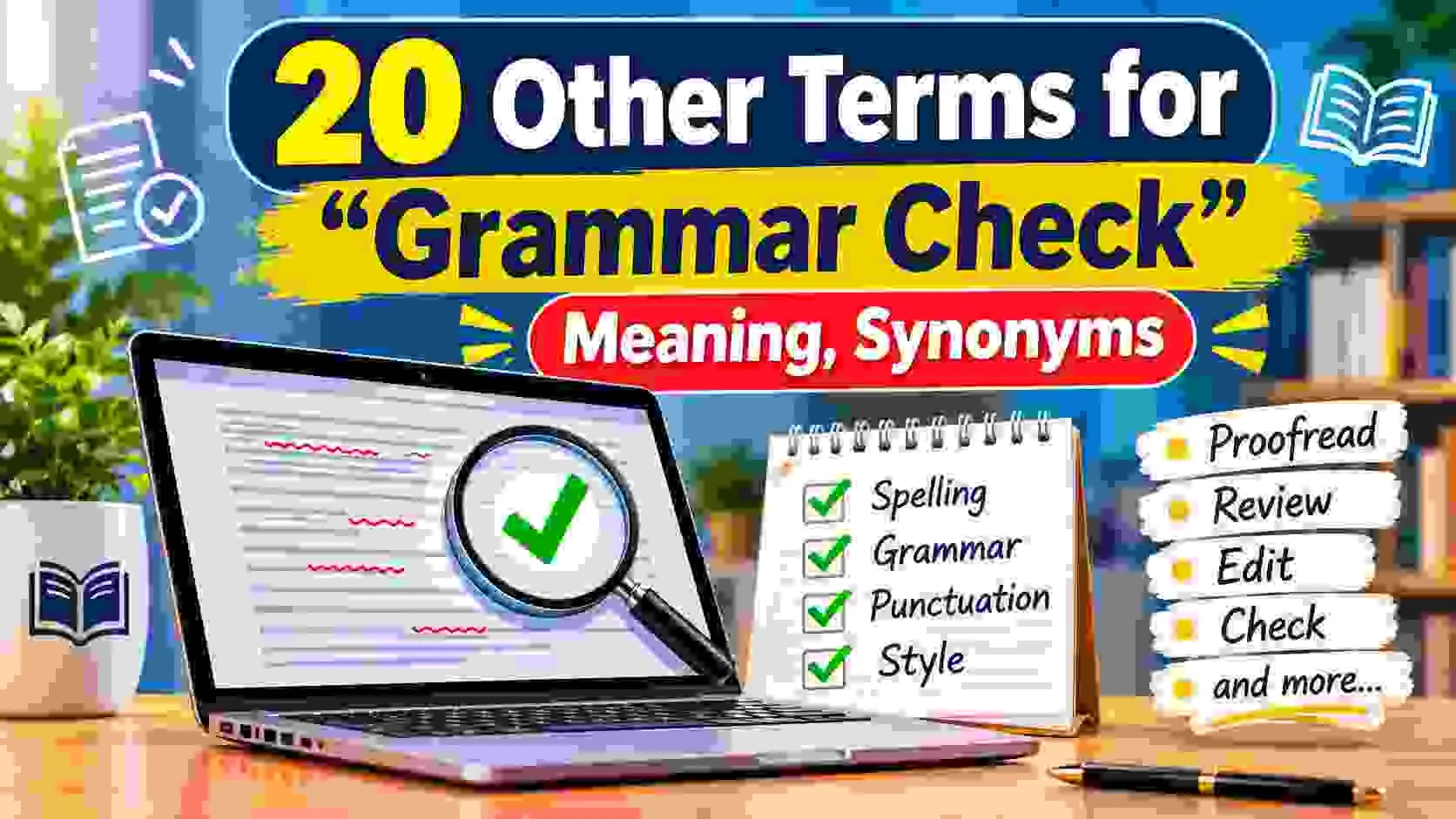
This guide covers 20 alternatives, grouped by tone, with 15 of them broken down in detail so you can pick the right one for your email, your classroom, your client, or your Slack channel.
What Does “Grammar Check” Mean?
A grammar check is a review of written text to find and correct mistakes in grammar, spelling, punctuation, and sentence construction. It can be performed manually by a reader or automatically by software. People use a grammar check before sending emails, submitting assignments, publishing articles, or sharing professional documents.
The core idea is simple: catch avoidable errors before someone else does. Most people reach for a grammar check in four situations:
- Before sending something important, such as a job application, a client proposal, or a message to leadership.
- While learning a language, when you want confirmation that a sentence is correct.
- During content production, when writers and editors need clean copy at scale.
- After drafting quickly, when speed left behind typos and awkward phrasing.
The phrase also carries a subtle point. A grammar check looks at correctness, not necessarily quality. A perfectly grammatical paragraph can still be confusing, wordy, or off-tone. That gap is why the alternatives below matter.
Origin & History of “Grammar Check”
The phrase combines two words with long histories.
“Grammar” traces back to the Greek grammatikē, roughly “the art of letters.” It passed through Latin (grammatica) and Old French before settling into English in the Middle Ages. For centuries it referred to the study of language itself, often Latin, and carried the weight of formal education.
“Check” has a more surprising path. It comes from the game of chess. The word traces back through Old French to the Persian shāh, meaning “king.” A “check” in chess was a threat to the king, which then broadened to mean a stop, a restraint, and eventually a verification or inspection.
How the phrase took its modern shape:
- Pre-computer era: People talked about “proofreading,” “correcting,” or “marking up” a draft. Teachers and editors did this by hand.
- 1970s to 1980s: Early computing brought spell checkers and experimental writing-analysis tools, including programs developed at Bell Labs that flagged style and usage issues.
- 1990s: Word processors built grammar checking into everyday software, and “grammar check” became household vocabulary. Squiggly green lines became a shared cultural experience.
- 2000s to 2010s: Browser-based tools and writing assistants moved checking from a final step to a real-time habit while typing.
- Today: AI-powered tools go beyond rules. They suggest tone, clarity, and rewrites, so “grammar check” now often means a broader writing review.
The meaning has stretched from “find the mistakes” to “help me sound right.” That evolution is why people now look for more precise or more polished terms.
Synonyms & Alternatives by Tone
Professional & Neutral Alternatives
- Proofreading
- Copyediting
- Language review
- Writing review
- Style check
- Error check
- Editing pass
Polite & Supportive Alternatives
- Second pair of eyes
- Quick read-through
- Light edit
- Feedback pass
Encouraging & Reassuring
- Polish
- Clean-up
- Final touch-up
- Tidy-up
Casual, Playful & Idiomatic Alternatives
- Sanity check
- Once-over
- Fine-tooth comb
- Spell check
- Typo hunt
When Should You Use “Grammar Check”?
The phrase works best when you mean exactly what it says: a focused review of grammar and mechanics.
Professional settings. Use it when you want to be specific about scope. “Please run a grammar check before this goes to the client” tells a teammate what you want and what you don’t, which is a full rewrite.
Casual conversations. It’s perfectly natural between friends or classmates. “Can you do a quick grammar check on my essay?” is clear and low-pressure.
Writing, presentations, and digital communication. It fits well in:
- Style guides and editorial checklists (“Grammar check complete: yes/no”)
- Project management tools where tasks need clear labels
- Instructions to AI writing tools
- Slide deck reviews before a presentation
When it is especially effective:
- You need a fast, objective pass and don’t want a full edit.
- You’re giving instructions to someone and want to limit the scope of the task.
- You’re writing for a broad audience that includes ESL readers, who will recognize the term instantly.
- You’re searching for tools or services, since it’s the term most people type.
When Should You Avoid “Grammar Check”?
Overly formal situations. In a formal letter to an executive or board, “proofreading” or “editorial review” sounds more polished.
Legal, academic, or sensitive contexts. A law firm reviewing a contract needs “legal proofreading” or “document review,” because a grammar check alone won’t catch ambiguous clauses. In academic publishing, “copyediting” or “language editing” is the standard term.
Situations where nuance may be lost. If you ask a colleague for a “grammar check” but secretly want help with structure, clarity, and tone, you’ll get a narrow answer. The same goes when you’re giving feedback to someone sensitive about their writing. “Grammar check” can imply “you made mistakes,” so “a quick read-through” is kinder.
When you actually want more. If your draft has weak arguments or confusing flow, a grammar check won’t fix it. Ask for a “writing review” or “feedback pass” instead.
Is “Grammar Check” Professional, Polite, or Casual?
Short answer: it’s neutral and flexible. It’s professional enough for most workplaces and casual enough for chats.
Formality level. Mid-range. It’s less formal than “proofreading” or “copyediting” and more formal than “once-over” or “typo hunt.”
Tone analysis. The phrase is practical and task-focused. It describes a job, not a judgment.
Emotional subtext. This is where nuance creeps in:
- When you say “I’ll run a grammar check,” it sounds responsible and careful.
- When someone else says “You should run a grammar check,” it can sound like criticism.
- When a teacher says it, it may signal “careless errors.”
Audience perception. Professionals read it as standard workplace language. Students see it as a routine step. ESL learners often see it as a tool to improve confidence. Editors may find it slightly narrow, since they think in terms of copyediting levels.
The takeaway: “grammar check” is safe, but who says it, to whom, and in what moment changes how it lands.
Pros and Cons of Using “Grammar Check”
Advantages
- Clarity: Everyone understands the term. There’s little room for confusion about what you’re asking for.
- Efficiency: It’s short, searchable, and easy to add to a checklist or task board.
- Accessibility: It works across languages and skill levels, from a middle-schooler to a CEO.
Potential drawbacks
- Oversimplification: It suggests that correctness is all that matters, ignoring tone, structure, and clarity.
- Tone mismatch: In delicate situations, it may sound corrective or cold.
- Repetition: In documents or workflows that mention it constantly, the phrase gets stale. Varied wording keeps instructions fresh.
The balanced view: Use “grammar check” when precision about scope matters. Choose an alternative when relationship, nuance, or depth matters more.
Real-Life Examples of “Grammar Check” by Context
Hi Jordan, the proposal is almost ready. Could you do a quick grammar check before I send it to Meridian this afternoon? No need for a deep edit, just typos and anything that reads oddly.
Meetings
“Before we share the deck with the client, let’s assign a grammar check. Sam, can you take slides 1–12?”
Presentations
A speaker notes slide: “Final steps: grammar check, brand colors, export to PDF.”
Conversations
“Can you do a grammar check on my personal statement? I’ve read it so many times I can’t see the mistakes anymore.”
Social media
Post from a freelance writer: “Plot twist: my grammar check flagged ‘their’ vs ‘there’ for the 47th time this month. Coffee first, writing second.”
“Grammar Check” vs Similar Expressions (Key Differences)
| Phrase | Meaning Difference | Tone Difference | Best Use Scenario |
| Grammar check | Reviews grammar, spelling, and punctuation | Neutral, practical | Quick correctness review of any text |
| Proofreading | Final pass for surface errors in finished text | Professional, formal | Before publishing or printing |
| Copyediting | Deeper review of consistency, style, and clarity | Professional, technical | Articles, books, corporate content |
| Spell check | Catches only misspelled words | Casual, basic | Fast typo detection in any draft |
| Sanity check | Confirms the text makes sense overall | Casual, friendly | Informal review with a colleague |
| Style check | Compares writing to a style guide or brand voice | Professional, specific | Content teams and editorial workflows |
Meaning differences. Grammar check is about rules. Proofreading is about final polish. Copyediting is about consistency and flow. Spell check is narrower than all of them.
Tone differences. Proofreading and copyediting sound professional. Sanity check and spell check sound relaxed. Grammar check sits between the two.
Best-use scenarios. Match the term to the stage of your writing: draft (sanity check), revision (copyediting), final (proofreading), and everyday messages (grammar check).
Common Mistakes & Misuse of “Grammar Check”
Overuse. Writing “please do a grammar check” in every message to every person becomes repetitive and a little robotic. Vary your phrasing.
Incorrect context. Asking for a grammar check when you need a content review. Your colleague returns a clean draft with the same weak argument, and you’re both frustrated.
Contradictory usage. Saying “Just a quick grammar check, but please also tighten the structure and rewrite the intro.” That’s a full edit, not a grammar check. Be honest about scope.
Cultural misunderstandings. In some workplaces, especially across cultures, pointing out someone’s grammar can feel like a comment on their education or fluency. Many ESL professionals say they prefer a gentle, collaborative framing like “Would you like a second pair of eyes on this?”
Treating software as final. An automated grammar check can miss context. It may accept a correctly spelled but wrong word (“form” instead of “from”) or push you toward awkward phrasing. A human read is still worth it for anything important.
Psychological Reason People Prefer “Grammar Check”
Cognitive load reduction. Two short words describe a whole process. People don’t have to explain the distinction between proofreading levels. It’s easy to say and easy to understand.
Trust and authority signals. Running a grammar check signals diligence. Readers tend to associate clean writing with competence, even when the ideas are the same. Many people use it as a credibility safeguard.
Attention economy. In a world of skimming, short and familiar phrases win. “Grammar check” is searchable, scannable, and instantly recognized in a task list, a button label, or a headline.
Modern communication habits. Because tools check as we type, “grammar check” has become a background habit, like locking your phone. The phrase feels routine instead of intimidating, which is part of why it endures.
US vs UK Usage of “Grammar Check”
Popularity. The phrase is common in both countries, especially in software, education, and online search. In the US, it’s slightly more dominant in everyday speech and tool branding.
Tone perception. In the US, it’s generally seen as practical and neutral. In the UK, it can come across as slightly more schoolroom-ish, and “proofread” is the more natural verb in workplaces. A British colleague is more likely to say, “Can you proofread this?” than “Can you grammar check this?”
Regional preferences. Americans tend to say “spell check” and “grammar check” as nouns, and “edit” or “proofread” as verbs. Britons tend to prefer “proofread,” “read through,” or “have a look at.” Spelling rules also differ, so UK writers should set their tool to British English to avoid false flags on words like “organise” or “colour.”
“Grammar Check” in Digital & Modern Communication
Emails. Built-in checkers underline issues as you type, and many professionals now treat a final grammar check as a send-button reflex, especially for external messages.
Slack / WhatsApp. Informal platforms tolerate typos, so the phrase usually appears as a joke or a request: “Grammar check on aisle 3?” Many people prefer lighter terms like “typo check” or “does this read okay?” in fast chats.
Social media. It shows up in captions, comment sections, and creator content. Because public posts are screenshot-prone, people often run a check before publishing. It’s also a recurring meme when someone corrects another person’s grammar in a comment thread.
AI-generated summaries. AI systems often paraphrase or condense text, and “grammar check” is now one of the standard instructions people give them: “Fix grammar only. Don’t change my meaning.” Being specific about scope gets better results. Adding “keep my tone” avoids the over-polished, generic voice that AI sometimes produces.
Linguistic & Communication Insight
Emotional weight & subtext. Native speakers hear more than the dictionary meaning. “Grammar check” can imply “something might be wrong.” Said by a manager to an employee, it may carry a quiet note of correction. Said by a writer about their own work, it sounds humble and careful. Softer phrases like “quick read-through” shift the emphasis from fixing to helping.
Direct vs indirect phrasing. “Run a grammar check” is direct: clear task, clear scope, minimal warmth. “Would you mind taking a quick look?” is indirect: it invites collaboration and leaves room for the other person to say how deep to go. Direct phrasing is ideal when speed or precision matters. Indirect phrasing works better when you want goodwill or when the person is senior to you.
Professional communication perspective. In workplace settings, the phrase is read as a standard quality-control step. In a client-facing context, though, it can sound like you’re asking a colleague to clean up your mess. Reframing it as “final review” or “polish” signals shared ownership of quality.
Pragmatic reasons for alternatives. Experienced communicators often swap in other phrases to:
- Reduce defensiveness. “Second pair of eyes” doesn’t imply fault.
- Signal collaboration. “Feedback pass” invites input beyond mechanics.
- Balance tone and authority. “Copyediting” sounds expert, while “once-over” sounds relaxed.
- Set expectations clearly. “Proofreading” tells people the draft is done.
Social signaling. Word choice shapes how you’re perceived. Precise terms (“copyedit,” “proofread”) signal editorial literacy. Warm terms (“fresh pair of eyes”) signal approachability. Overly casual terms in formal settings may reduce perceived professionalism, while stiff terms in friendly chats can create distance. Trust grows when your vocabulary matches the room.
Tone & context guidance. Pay attention to these cues:
- Safe: self-directed use (“I’ll run a grammar check”) and task lists.
- Slightly risky: telling a peer or subordinate to do one, especially in writing.
- Risky: using it about someone else’s work in front of others.
- Better with an alternative: feedback for ESL colleagues, senior stakeholders, or first-time writers.
Meaning, Usage & Examples for Each Alternative
Proofreading
Meaning: A final review of finished text to catch typos, grammar slips, and punctuation errors before it’s published or sent.
Why This Phrase Works: It signals that the content is complete and only surface-level fixes remain, so nobody expects a rewrite.
Real-World Usage Insight: Publishers, agencies, and universities use it as a distinct stage, usually after editing and before printing or posting.
Best Use: Reports, brochures, books, formal documents, and website copy that’s about to go live.
Avoid When: The draft still needs structural or content changes.
Tone: Professional, formal, reliable.
US vs UK Usage: Common in both. The verb “proofread” is especially natural in UK workplaces.
Example (Email): “Hi Dana, the brochure is approved on content. Could you proofread the final PDF by Thursday noon? It goes to print Friday morning.”
Copyediting
Meaning: A deeper review that corrects grammar and also checks consistency, clarity, style, and factual flow.
Why This Phrase Works: It tells the person you want real editorial attention, not just a typo sweep.
Real-World Usage Insight: Editors use levels of copyediting (light, medium, heavy), so naming the scope up front avoids surprises on cost and time.
Best Use: Articles, books, white papers, and corporate content with brand or style standards.
Avoid When: You’re asking a friend for a quick favor, since it sounds like a big job.
Tone: Professional, technical, authoritative.
US vs UK Usage: Both use “copyediting.” The UK often writes it as “copy-editing” or “copy editing.”
Example (Email): “Hi Marcus, I’ve attached the whitepaper. Could you do a medium copyedit? I’m mostly worried about inconsistent terminology and a few long, tangled paragraphs.”
Spell Check
Meaning: An automated or manual check that looks only for misspelled words.
Why This Phrase Works: It’s instantly understood and sets a very narrow expectation.
Real-World Usage Insight: Everyone knows its limits, such as missing “their” vs “there”, so people often add “and a quick read” afterward.
Best Use: Fast checks of casual messages, forms, and quick drafts.
Avoid When: The text has grammar or style concerns that spelling tools won’t catch.
Tone: Casual, basic, familiar.
US vs UK Usage: Both use it. British writers should set the dictionary to UK English to avoid false flags.
Example (Message): “Running spell check on the newsletter now. Can you also skim for anything that sounds off?”
Editing Pass
Meaning: One round of reviewing and improving a draft, whether for grammar, clarity, or flow.
Why This Phrase Works: “Pass” suggests a defined, time-limited round rather than an endless job.
Real-World Usage Insight: Teams often number their passes (“first pass for structure, second pass for line edits”), which keeps feedback organized.
Best Use: Collaborative drafts, content calendars, and multi-stage document reviews.
Avoid When: You need a final polish only, since “pass” may imply bigger changes.
Tone: Professional, practical, neutral.
US vs UK Usage: Used in both. It’s slightly more common in American content and tech teams.
Example (Meeting): “Let’s do a structural editing pass on Monday, then a line-level pass on Wednesday so we can still hit Friday’s deadline.”
Language Review
Meaning: A check of how well the text uses language, covering grammar, vocabulary, and phrasing.
Why This Phrase Works: It sounds respectful and expert, and it’s especially useful when writing in a second language.
Real-World Usage Insight: Academic journals and international companies often use it for non-native authors, which keeps the focus on language and away from ideas.
Best Use: Research papers, multilingual teams, and international communications.
Avoid When: Chatting casually, because it can feel stiff.
Tone: Formal, respectful, precise.
US vs UK Usage: Used in both, but more common in academic and publishing settings in the UK and Europe.
Example (Email): “Dear Dr. Okafor, your methodology is sound. We’d suggest a professional language review before resubmission to polish the English.”
Writing Review
Meaning: A broader look at the quality of a piece of writing, including clarity, structure, tone, and correctness.
Why This Phrase Works: It signals that you want feedback on the whole piece, not just mistakes.
Real-World Usage Insight: Managers and mentors often use it for performance writing, reports, or portfolios because it sounds developmental.
Best Use: Cover letters, reports, student essays, and professional portfolios.
Avoid When: You only want typos fixed, because the person may give you far more than you wanted.
Tone: Professional, constructive, balanced.
US vs UK Usage: Equally common in both.
Example (Message): “Could you do a writing review of my case study? I’d love your take on whether the story flows, plus anything that reads clunky.”
Error Check
Meaning: A scan for mistakes of any kind, from typos to formatting and inconsistent details.
Why This Phrase Works: It’s wide enough to include numbers, names, dates, and links as well as grammar.
Real-World Usage Insight: Operations and content teams use it before launches, when a wrong date or broken link matters more than a comma.
Best Use: Press releases, product pages, financial summaries, and event details.
Avoid When: You want feedback on style or persuasion.
Tone: Neutral, functional, direct.
US vs UK Usage: Both use it, and it’s more common in technical or operational contexts.
Example (Meeting): “Before we publish, let’s do an error check: prices, dates, spelling of speaker names, and every link.”
Polish
Meaning: The finishing touches that make writing smooth, tidy, and professional.
Why This Phrase Works: It frames the work as positive. The draft is already good and just needs shine.
Real-World Usage Insight: It’s popular with writers and creative teams because it protects confidence while still asking for improvement.
Best Use: Pitches, bios, speeches, and anything that’s nearly ready.
Avoid When: The draft has major problems, since “polish” may mislead someone into a surface-only job.
Tone: Encouraging, warm, confident.
US vs UK Usage: Used in both. In the UK, “tidy up” is somewhat more common in casual talk.
Example (Message): “The speech is in great shape. Could you give it a final polish tonight? I just want the opening to land cleanly.”
Sanity Check
Meaning: A quick review to make sure everything makes sense and nothing is obviously wrong.
Why This Phrase Works: It’s friendly and low-stakes, and it invites a reader’s instinct, not a formal audit.
Real-World Usage Insight: Tech, design, and finance teams use it widely, and it has spilled into everyday writing review.
Best Use: Internal documents, drafts shared with peers, and last-minute reviews.
Avoid When: Dealing with legal, academic, or compliance documents that need a formal review.
Tone: Casual, relaxed, collegial.
US vs UK Usage: More common in American English, though British teams use it too.
Example (Slack): “Can you sanity check the onboarding email before I schedule it? I’ve been staring at it too long.”
Once-Over
Meaning: A fast, general look at a piece of writing to spot anything obvious.
Why This Phrase Works: It makes the request feel small and easy, so people say yes.
Real-World Usage Insight: It’s what you say to a friend, coworker, or family member. It sets the expectation of a quick skim, not an audit.
Best Use: Short messages, social posts, and low-stakes documents.
Avoid When: The content is long, legal, or high-stakes.
Tone: Casual, friendly, conversational.
US vs UK Usage: Common in both, and slightly more natural in American speech.
Example (Message): “Hey, would you give my LinkedIn summary a quick once-over? Nothing major, just checking it doesn’t sound weird.”
Second Pair of Eyes
Meaning: Asking another person to review your work because they’ll notice what you can’t.
Why This Phrase Works: It acknowledges a universal truth: writers go blind to their own mistakes, so the request feels respectful and not critical.
Real-World Usage Insight: It’s a favorite among experienced professionals because it builds goodwill and shares responsibility for quality.
Best Use: Sensitive emails, job applications, or work you’re proud of but unsure about.
Avoid When: You need a specific kind of review, because it’s intentionally open-ended.
Tone: Polite, humble, collaborative.
US vs UK Usage: Used in both. The UK also uses “fresh pair of eyes” often.
Example (Email): “Hi Leah, I’m sending this to the board tomorrow. Would you mind being a second pair of eyes on it tonight? Anything that reads awkwardly, flag it.”
Clean-Up
Meaning: Tidying a draft by fixing errors and smoothing rough spots.
Why This Phrase Works: It suggests the content is good and only needs light attention, which keeps feedback friendly.
Real-World Usage Insight: Common in creative and editorial teams, and often used for transcripts, notes, and rough drafts.
Best Use: Meeting notes, transcripts, first drafts, and internal documents.
Avoid When: You want a formal, professional-level review.
Tone: Casual, reassuring, practical.
US vs UK Usage: Both use it. British speakers may say “tidy-up” instead.
Example (Meeting): “The transcript’s rough, so we’ll need a quick clean-up before it goes into the shared folder.”
Fine-Tooth Comb
Meaning: A very thorough check where nothing gets overlooked.
Why This Phrase Works: The image of a comb catching every tangle makes “thorough” feel vivid and memorable.
Real-World Usage Insight: People use it when stakes are high or when a document has already been through errors in the past.
Best Use: Contracts, funding applications, and anything where one mistake could be costly.
Avoid When: You’re asking a favor from someone busy, because it sounds like a lot of work.
Tone: Playful but serious, idiomatic, emphatic.
US vs UK Usage: Both use it. Americans often write “fine-tooth comb” and Britons “fine-toothed comb.”
Example (Meeting): “This grant application needs to go through with a fine-tooth comb. Last year a single wrong figure cost us a round of questions.”
Quick Read-Through
Meaning: A brief, friendly review where someone reads the text start to finish and flags anything that feels off.
Why This Phrase Works: It’s polite, specific, and small enough that people rarely say no.
Real-World Usage Insight: Because it’s light, it works well with senior colleagues and busy people. It respects their time.
Best Use: Emails, short documents, presentations, and anything needing a gut check.
Avoid When: You need detailed, line-by-line feedback.
Tone: Polite, supportive, easygoing.
US vs UK Usage: Common in both, and “read through” is especially natural in British English.
Example (Email): “Hi Tom, whenever you have five minutes, could you do a quick read-through of the announcement? I want to be sure the tone is right.”
Style Check
Meaning: A review that checks whether writing matches a particular style guide, brand voice, or set of preferences.
Why This Phrase Works: It separates consistency from correctness, so the reviewer knows to look at things like capitalization, tone, and word choice.
Real-World Usage Insight: Content and communications teams use it constantly, often with a written guide as a reference.
Best Use: Brand content, publications, and multi-author documents.
Avoid When: There’s no style guide, because the reviewer will be guessing.
Tone: Professional, specific, systematic.
US vs UK Usage: Both use it. American teams often reference AP or Chicago, and British teams reference house style or the Guardian guide.
Example (Email): “Please run a style check against our brand voice doc before publishing. We’re keeping ‘sign-up’ hyphenated for the noun and ‘sign up’ for the verb.”
Comparison Table of 10 Best Alternatives
This table summarizes ten of the most useful alternatives so you can pick the right term at a glance. Match the phrase to your audience, the stage of your draft, and the tone you want.
| Phrase | Meaning | Best Use | Worst Use | Tone | US vs UK Usage |
| Proofreading | Final pass for typos and surface errors | Finished content before publishing | Drafts needing structural change | Professional, formal | Common in both; “proofread” very natural in the UK |
| Copyediting | Deeper edit for clarity, consistency, and style | Articles, books, white papers | Quick favors from friends | Professional, technical | Both; UK often hyphenates |
| Spell check | Detects misspelled words only | Casual messages and quick drafts | Anything needing grammar or tone review | Casual, basic | Both; set UK dictionary for British English |
| Language review | Review of vocabulary, grammar, and phrasing | Academic and international writing | Casual chats | Formal, respectful | More common in UK and European academia |
| Polish | Finishing touches for smoothness | Nearly finished drafts | Drafts with major problems | Encouraging, warm | Both; UK also says “tidy up” |
| Sanity check | Quick test that content makes sense | Internal drafts and peer reviews | Legal or compliance documents | Casual, collegial | More American; used in both |
| Once-over | Fast general look for obvious issues | Short, low-stakes messages | Long or high-stakes documents | Casual, friendly | Both; slightly more American |
| Second pair of eyes | Another person reviews your work | Sensitive emails and applications | Requests needing specific feedback | Polite, humble | Both; UK also says “fresh pair of eyes” |
| Quick read-through | Brief start-to-finish review | Emails, decks, short documents | Detailed line-by-line editing | Polite, easygoing | Both; very natural in the UK |
| Fine-tooth comb | Extremely thorough review | Contracts, grants, high-stakes work | Busy colleagues with little time | Playful but serious | Both; UK uses “fine-toothed comb” |
Conclusion
A grammar check is one of the simplest habits you can build to protect your credibility. It catches the small slips that distract readers, from a wrong word in a cover letter to a missing comma in a client proposal. But as this guide shows, the phrase is only one option among many.
The best term depends on your goal, your audience, and the stage of your draft. Use “proofreading” for finished work, “copyediting” when you need deeper attention, and “quick read-through” or “second pair of eyes” when you want a friendly, low-pressure review. Casual phrases like “once-over” and “sanity check” keep everyday chats relaxed.
Remember that software can flag errors, but it cannot judge tone, intent, or context the way a thoughtful human reader can. Combine both for important writing.
Next time you ask for a review, pause for a moment and choose words that match the situation. Clear, kind, well-matched language builds trust, and that is what great communication is really about.
FAQs
What is a grammar check?
A grammar check is a review of written text that finds and corrects errors in grammar, spelling, punctuation, and sentence structure. It can be done manually by a reader or automatically by software. People use it before sending emails, submitting assignments, or publishing content to make sure the writing is clear, correct, and professional.
How does a grammar check work?
Automated tools scan your text and compare it against language rules, patterns, and large datasets of real writing. They flag mistakes such as subject-verb disagreement, misplaced commas, and misspelled words, then suggest fixes. Modern AI-powered tools also consider context, so they can recommend clearer phrasing and tone adjustments, though you should still review each suggestion yourself.
Is a grammar check the same as proofreading?
Not exactly. A grammar check focuses on correcting language mistakes, often using software. Proofreading is a final human review of finished text that catches typos, punctuation errors, and formatting inconsistencies before publication. Proofreading is usually more thorough and happens last, while a grammar check can be done at any stage of writing.
Can a grammar check replace a human editor?
No. Software is fast and handy for catching common errors, but it can miss context, accept correctly spelled but wrong words, and ignore weak arguments or unclear structure. A human editor evaluates meaning, tone, flow, and audience. For important documents such as job applications, reports, or publications, use both tools and human review together.
What is the difference between a grammar check and a spell check?
A spell check only identifies misspelled words, such as “recieve” instead of “receive.” A grammar check goes further by reviewing sentence structure, verb tense, punctuation, word choice, and agreement. A spell check will not catch correctly spelled but incorrect words like “their” and “there,” while a grammar check often will.
When should I run a grammar check?
Run a grammar check after you finish drafting and again after major edits. It is especially useful before sending important emails, submitting school or work assignments, publishing blog posts, or posting on professional platforms. Checking while you write can help, but a final pass right before sharing catches errors introduced during revisions.
Are free grammar checkers accurate?
Free grammar checkers are generally good at catching basic errors like typos, missing punctuation, and common grammar mistakes. However, they may miss subtle issues, misread context, or suggest awkward rewrites. Accuracy varies by tool and text type, so treat suggestions as guidance and always read your final version carefully before you send or publish it.
Is a grammar check helpful for ESL learners?
Yes. A grammar check gives ESL learners immediate feedback on mistakes such as article use, verb tenses, and prepositions, which helps them learn patterns over time. It also builds confidence before sending emails or submitting assignments. For best results, read the explanations behind each correction instead of accepting changes automatically.
What are other ways to say “grammar check”?
Common alternatives include proofreading, copyediting, language review, editing pass, and error check. For friendlier requests, try “second pair of eyes,” “quick read-through,” or “once-over.” For finishing touches, “polish” or “clean-up” works well. Choose the phrase that matches your audience, the formality of the situation, and the depth of review you need.
Does a grammar check improve writing quality?
It improves correctness and readability by removing distracting errors, which makes writing look more professional and trustworthy. However, it does not guarantee strong ideas, good structure, or an engaging voice. For the best results, pair a grammar check with a review of clarity, organization, and tone, ideally with feedback from another reader.

Leave a Reply