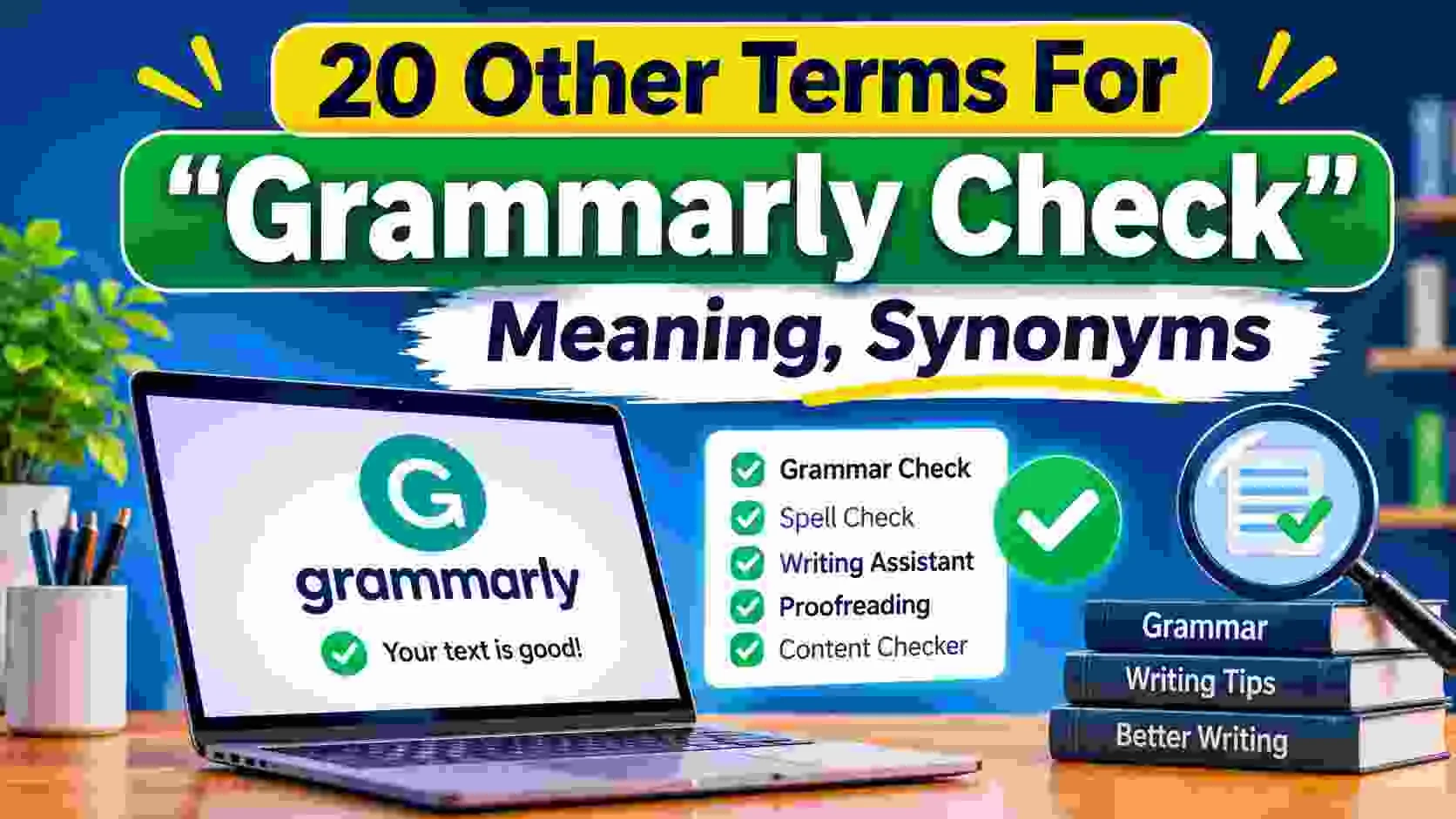
It’s 4:45 p.m., and your manager has just asked for the client proposal “before you log off.” You’ve read it three times, and every sentence now looks suspicious. Is it “affect” or “effect”? Does that comma belong there? So you paste it into your editor and run a Grammarly check. Thirty seconds later, you catch a missing word, a clumsy sentence, and one phrase that sounds blunter than you intended.
Millions of people do this every day. “Grammarly check” has become everyday shorthand for a quick, automated review of your writing before you hit send. But the phrase isn’t always the right one to say out loud. Telling a professor “I did a Grammarly check” lands differently than “I proofread it twice.” Asking a colleague for a “Grammarly check” can sound like you’re handing off the work. Sometimes you want something warmer, more formal, or more specific.
This guide explains what the phrase means, where it comes from, and 20 alternatives sorted by tone. It also covers when each one works best, so your wording always matches the moment.
What Does “Grammarly Check” Mean?
A “Grammarly check” is the process of running a piece of writing through Grammarly, an AI-powered writing assistant, to find spelling, grammar, punctuation, clarity, and tone issues. People use a Grammarly check on emails, essays, reports, and web content before sending or publishing, and also use the phrase informally to mean any quick automated proofread.
The core idea behind it
The idea is simple: catch avoidable mistakes before someone else sees them. It’s a safety net, not a replacement for thinking. The tool flags problems, and you decide which suggestions to accept.
Where you’ll hear it
- Students checking essays before submitting them
- Professionals reviewing emails, proposals, and reports
- ESL learners confirming that their sentences sound natural
- Content writers and editors doing a first cleanup pass before a human edit
- Job seekers polishing résumés and cover letters
Origin & History of “Grammarly Check”
A brand name that became a verb-like phrase
“Grammarly check” isn’t an old idiom with centuries of history. It’s a modern, product-based phrase, and its origin is tied to the company itself. Grammarly was founded in 2009 by Max Lytvyn, Alex Shevchenko, and Dmytro Lider. It began as a tool to help students improve their writing and has since grown into a general writing assistant used in browsers, apps, and word processors. The company later became part of a larger business under the Superhuman name, while the product itself is still called Grammarly.
How the phrase spread
Two things pushed the phrase into everyday speech:
- The free browser extension. Once a grammar checker sat inside Gmail, Google Docs, and social media boxes, people started saying “let me Grammarly this” without thinking twice.
- Brand-as-action language. English has a long habit of turning product names into everyday actions. We “google” a question, “photoshop” an image, and “venmo” a friend. “Grammarly check” follows that pattern, though it hasn’t fully become a verb the way those have.
How the meaning has shifted
At first, a Grammarly check meant fixing basic errors like typos and subject-verb agreement. Today it often covers tone, clarity, and style, and AI-generated rewrites too. So the phrase now stretches from “I caught my typos” to “I had software polish the whole draft.” That wider meaning is exactly why choosing alternatives matters.
Synonyms & Alternatives by Tone
Professional & Neutral Alternatives
- Proofread
- Grammar check
- Copyedit
- Final review
- Editorial review
Polite & Supportive Alternatives
- A fresh pair of eyes
- A quick second look
- A friendly read-through
- Could you take a look?
- A gentle edit
Encouraging & Reassuring Alternatives
- Polish it up
- Tidy it up
- Smooth it out
- Fine-tune
- Tighten it up
Casual, Playful & Idiomatic Alternatives
- Once-over
- Sanity check
- Double-check
- Clean it up
- Run it through the spell-checker
When Should You Use “Grammarly Check”?
Professional settings
The phrase works well in informal workplace talk, especially among teams that already use the tool. “I’ll do a Grammarly check and send it over” is clear, honest, and efficient. It also tells your colleague what kind of review to expect: surface-level, not a deep rewrite.
Casual conversations
Among friends, classmates, or online communities, it’s natural and relatable. “Give me a sec, doing a Grammarly check on this text” is something many people say without a second thought.
Writing, presentations, and digital communication
It’s useful when you want to be transparent about your process. Content teams often note “Grammarly check done” on a task card so editors know the basic cleanup is complete.
When it’s especially effective
- When you need to set expectations about how much checking has happened
- When you’re explaining your workflow to a team or client
- When searching for tools, tutorials, or help (it’s also the phrase most people type into Google)
How to run a Grammarly check in 5 steps
- Open your document or paste your text into the editor.
- Set your goals, such as audience, formality, and English variety (American, British, Canadian, or Australian).
- Review each suggestion instead of accepting everything at once.
- Read the text aloud to confirm it sounds like you.
- Do a final human read for facts, names, and numbers the tool can’t verify.
When Should You Avoid “Grammarly Check”?
Overly formal situations
In a formal letter, a board report, or a message to a senior executive, “I’ve proofread this carefully” sounds more polished than naming a software product.
Legal, academic, or sensitive contexts
- Legal documents: Contracts need professional human review. A software pass can’t judge legal meaning.
- Academic work: Some courses and journals have rules about AI-assisted editing. Saying “I ran a Grammarly check” without knowing the policy can raise questions. Check your institution’s guidelines first.
- Sensitive messages: Condolence notes, apologies, or difficult feedback shouldn’t feel machine-polished.
Situations where nuance gets lost
The phrase doesn’t say what was checked: spelling only, or full tone and style changes? If precision matters, say “I proofread for spelling and punctuation” or “I edited for clarity and tone.” Also, a Grammarly check can’t confirm that your facts, citations, or arguments are correct.
Is “Grammarly Check” Professional, Polite, or Casual?
Short answer: it’s neutral to casual. It’s a practical, workplace-friendly phrase, but it isn’t formal.
- Formality level: Low to medium. Fine in a Slack message, less ideal in a formal report.
- Emotional subtext: Mostly neutral. It can hint at care and effort (“I double-checked”) or, in some contexts, uncertainty (“I’m not confident in my writing”).
- Audience perception: Younger and tech-comfortable audiences see it as normal. More traditional editors or professors may read it as relying too heavily on software, especially if the writing still has problems.
- Balanced judgment: Mentioning it signals diligence when the audience welcomes tools. It can also invite skepticism when the audience values human craftsmanship.
A useful rule: the more formal or high-stakes the setting, the more you should describe what you did instead of which tool you used.
Pros and Cons of Using “Grammarly Check”
Advantages
- Clarity: Everyone immediately understands what you mean.
- Efficiency: It’s short and saves explanation.
- Accessibility: It’s friendly to non-native English speakers, students, and anyone building confidence in their writing.
- Searchability: People looking for tools or help actually use this phrase.
Potential drawbacks
- Oversimplification: It doesn’t tell the listener what kind of review happened.
- Tone mismatch: It can feel too casual in formal settings.
- Repetition: In a long document or conversation, repeating it can sound mechanical.
- Brand dependence: If you use a different tool, the phrase can confuse people.
The balanced takeaway
It’s a handy shorthand, not a universal answer. Used with awareness of your audience, it works. Used by default, it can undersell your own effort.
Real-Life Examples of “Grammarly Check” by Context
“Hi Dana, I’ve attached the updated brief. I ran a Grammarly check, but could you skim the pricing section? I’m not sure the wording is clear.”
Meeting
“Before we send this to the client, can someone do a quick Grammarly check on slide 6? I think I introduced a typo when I rewrote it.”
Presentation
“I always do a Grammarly check on my slide titles. Short text hides sneaky mistakes.”
Conversation
“Wait, let me do a Grammarly check on that text before I send it. I don’t want to say ‘their’ when I mean ‘there’ again.”
Social media
“Pro tip for new bloggers: do a Grammarly check, then read your post out loud. The tool catches errors, but your ear catches awkward sentences.”
“Grammarly Check” vs Similar Expressions (Key Differences)
| Phrase | Meaning Difference | Tone Difference | Best Use Scenario |
| Spell-check | Looks only for spelling errors | Casual, basic | Quick typo fixes in texts or notes |
| Proofread | Careful human review of a final draft | Professional, traditional | Documents going to clients, teachers, or publishers |
| Copyedit | Deeper edit of grammar, consistency, and style | Formal, editorial | Articles, books, and reports before publication |
| AI rewrite | The tool changes wording or structure for you | Modern, sometimes uncertain | Drafting help, not final polish |
| Plagiarism check | Compares text against other sources for copied content | Serious, academic | Essays, research, and original-content reviews |
The key difference: a Grammarly check sits in the middle. It’s more thorough than a spell-check but lighter than a human copyedit.
Common Mistakes & Misuse of “Grammarly Check”
Overuse
Saying “I did a Grammarly check” about every message makes it sound like a ritual instead of a real review. Vary your wording.
Incorrect context
Using it for something the tool didn’t actually do is misleading. A Grammarly check won’t verify facts, sources, or logic.
Contradictory usage
Saying “I did a Grammarly check” and then sending a draft full of obvious errors damages credibility. Either the check was incomplete, or the suggestions were ignored. The tool is only as good as the person reviewing its feedback.
Cultural misunderstandings
- In some workplaces, naming a software tool sounds unprofessional.
- Some educators associate it with over-reliance on AI.
- Non-English speakers may not realize it’s a brand name, so the capital G and the context matter.
Psychological Reason People Prefer “Grammarly Check”
- Less mental effort: One short phrase replaces a longer explanation. Our brains like that.
- Trust and authority: Naming a known tool signals that you used a recognized, structured process.
- Attention economy: In busy inboxes and chat threads, short, familiar phrases are easier to process.
- Modern habits: Writers increasingly expect an automated safety net. Saying it out loud confirms you followed the usual routine.
- Confidence boost: For ESL learners and students especially, running a check reduces the fear of being judged on small errors.
US vs UK Usage of “Grammarly Check”
- Popularity: It’s used widely in both regions, particularly among students and remote workers. It’s slightly more common in American English, partly because the tool began in an English-speaking, US-focused market.
- Tone perception: Americans tend to hear it as practical and neutral. British speakers may find naming a tool a little too casual in formal writing and may lean toward “proofread” or “have a look over.”
- Regional preferences: Grammarly lets you choose American, British, Canadian, or Australian English, so a “Grammarly check” may change spellings like color/colour or organize/organise. Always set the correct variety before you check.
“Grammarly Check” in Digital & Modern Communication
- Emails: Often used internally (“ran it through Grammarly”) but rarely in client-facing emails, where the finished quality speaks for itself.
- Slack / WhatsApp: Short, casual, and common. “Grammarly check done, ready for review” is typical in team chats.
- Social media: Creators use it to describe their editing habits or recommend tools. It’s also used jokingly after a typo.
- AI-generated summaries: Search tools and AI assistants often use “Grammarly check” as a shorthand for automated grammar review. Clear, plain definitions of the phrase make it easier for them to understand and quote accurately.
Linguistic & Communication Insight
Emotional weight & subtext
Native speakers hear more than the literal meaning. “Grammarly check” can suggest diligence (“I took care”) or, depending on tone, insecurity (“I’m not sure my English is right”). Context decides which one comes across.
Direct vs indirect phrasing
“Grammarly check” is direct and task-focused. It signals a defined, mechanical step. Softer alternatives like “could you take a fresh look?” feel collaborative and invite opinions, not just error-spotting. When urgency matters, the direct phrase is efficient. When you want input, the indirect version works better.
Professional communication perspective
In the workplace, how you describe your review shapes how people judge your work. “I proofread this” sounds like ownership. “I ran a Grammarly check” sounds like process. Neither is wrong, but ownership language tends to feel more confident in senior-level communication.
Pragmatic reasons for alternatives
Experienced communicators often choose different wording to:
- Reduce defensiveness. “Could you give this a quick look?” feels gentler than “Grammarly check this.”
- Signal collaboration. “Fresh pair of eyes” invites a partner instead of assigning a chore.
- Balance tone and authority. “Final review” sounds more official, which suits formal approvals.
Social signaling
Word choice shapes trust. Mentioning a tool can signal transparency and modernity. Describing a human-style review can signal care and expertise. Strong communicators match the signal to what the audience values.
Tone & context guidance
- Safe: Team chats, student groups, informal updates, tool tutorials
- Use with care: Client emails, academic submissions, performance reviews
- Risky: Legal, medical, or highly formal documents, or anywhere AI-use rules apply
Meaning, Usage & Examples for Each Alternative
Proofread
Meaning: To read a finished draft carefully to catch spelling, punctuation, and grammar errors.
Why This Phrase Works: It’s universally understood and signals human attention and responsibility.
Real-World Usage Insight: Editors, teachers, and managers use it for the last step before something goes out.
Best Use: Final drafts, résumés, client documents, and formal emails.
Avoid When: You need a deep rewrite. Proofreading fixes surface errors, not weak structure.
Tone: Professional, neutral.
US vs UK Usage: Common in both. Written as one word in both regions.
Example (Email): “Thanks for the draft, Priya. I’ll proofread it tonight and send it back before the 9 a.m. call.”
Grammar Check
Meaning: A review focused on grammar rules, sentence structure, and punctuation.
Why This Phrase Works: It’s brand-neutral, so it works whichever tool you use, or if you check by hand.
Real-World Usage Insight: It’s the standard term in school settings and software menus.
Best Use: Assignments, reports, and quick editing tasks.
Avoid When: You also want feedback on style, tone, or clarity, since the phrase sounds narrower.
Tone: Neutral, practical.
US vs UK Usage: Equally common in both.
Example (Meeting): “Let’s do a grammar check on the slides before we share them with the client. A couple of titles look off.”
Copyedit
Meaning: A deeper edit that fixes grammar and also improves consistency, wording, and style.
Why This Phrase Works: It tells people exactly how thorough the review is.
Real-World Usage Insight: Publishers, agencies, and content teams use it to separate light cleanup from heavy rewriting.
Best Use: Articles, reports, books, and website content.
Avoid When: Talking casually with friends. It can sound too technical.
Tone: Professional, editorial.
US vs UK Usage: “Copyedit” is typical in American English. British writers often prefer “copy-edit” and may say “sub-edit” in newsroom settings.
Example (Message): “Draft’s in the shared folder. Can you copyedit the intro and the case study? Keep the voice, but tighten anything clunky.”
Final Review
Meaning: The last check before approval, sending, or publishing.
Why This Phrase Works: It signals authority and a defined stage in the process.
Real-World Usage Insight: Common in project management and approval workflows.
Best Use: Formal sign-offs, reports, and team workflows.
Avoid When: You mean a quick spelling check. It sounds heavier than it is.
Tone: Formal, professional.
US vs UK Usage: Common in both.
Example (Meeting): “Legal is doing the final review on Thursday, so please get any edits in by Wednesday afternoon.”
Fresh Pair of Eyes
Meaning: Someone new reviews your work and spots what you’ve stopped noticing.
Why This Phrase Works: It’s kind and collaborative. It admits that anyone gets blind to their own writing.
Real-World Usage Insight: Writers and designers use it when they’ve stared at something too long.
Best Use: Asking a colleague, friend, or mentor for help.
Avoid When: The reviewer won’t actually have time to read carefully.
Tone: Warm, friendly.
US vs UK Usage: Widely used in both.
Example (Message): “Hey Marcus, I’ve read this cover letter so many times I can’t see it anymore. Could you be a fresh pair of eyes?”
Quick Second Look
Meaning: A short, informal review by another person.
Why This Phrase Works: It sounds low-pressure and respectful of the other person’s time.
Real-World Usage Insight: It lowers the chance of a “no” because the request feels small.
Best Use: Asking a coworker or classmate for light feedback.
Avoid When: The task is large or high-stakes. Be honest about the time needed.
Tone: Polite, friendly.
US vs UK Usage: Common in both. Brits may add “would you mind” for extra politeness.
Example (Email): “Hi Sam, would you mind giving the proposal a quick second look? I mainly want to be sure the budget section reads clearly.”
Friendly Read-Through
Meaning: A supportive review where the reader looks for clarity and flow, not just errors.
Why This Phrase Works: “Friendly” removes the fear of harsh criticism.
Real-World Usage Insight: Great for people who feel nervous about sharing early drafts.
Best Use: Sharing drafts with teammates, writing groups, or mentors.
Avoid When: You need strict, formal feedback on accuracy or compliance.
Tone: Warm, supportive.
US vs UK Usage: Used in both, a bit more common in conversational American English.
Example (Message): “Would you be up for a friendly read-through of my application essay? I mostly want to know if it sounds like me.”
Polish It Up
Meaning: Improve a piece of writing so it feels smoother and more professional.
Why This Phrase Works: It frames editing as improvement, not error-hunting.
Real-World Usage Insight: Managers use it to encourage without implying the draft was bad.
Best Use: Giving or receiving feedback on near-final drafts.
Avoid When: The draft needs major restructuring. “Polish” suggests small fixes only.
Tone: Encouraging, positive.
US vs UK Usage: Common in both.
Example (Meeting): “The content’s solid. Let’s polish it up this afternoon and send it out by five.”
Tidy It Up
Meaning: Fix small messy details like extra spaces, awkward phrasing, and inconsistent formatting.
Why This Phrase Works: It’s gentle and makes the task sound manageable.
Real-World Usage Insight: It suits tasks that feel more like housekeeping than real editing.
Best Use: Light cleanup of notes, emails, and short documents.
Avoid When: The writing has serious problems that “tidying” won’t solve.
Tone: Soft, reassuring.
US vs UK Usage: Slightly more British in feel, though understood everywhere.
Example (Message): “I’ll tidy up the meeting notes and send them round once I’ve fixed the headings.”
Smooth It Out
Meaning: Improve the flow so sentences connect naturally and read well.
Why This Phrase Works: It focuses on how the writing feels to a reader, which matters beyond correctness.
Real-World Usage Insight: Editors use it when the grammar is fine, but the draft feels choppy.
Best Use: Blog posts, speeches, and presentations.
Avoid When: You’re checking for factual or technical accuracy. Flow and facts are different jobs.
Tone: Supportive, creative.
US vs UK Usage: Common in both.
Example (Blog): “My second draft was accurate but stiff. I read it aloud and smoothed out the transitions until it sounded like a real conversation.”
Fine-Tune
Meaning: Make small, precise adjustments to wording, tone, or detail.
Why This Phrase Works: It signals skill and attention to detail without suggesting the work is weak.
Real-World Usage Insight: Often used for important messages where one word can change the tone.
Best Use: Pitches, executive emails, and brand copy.
Avoid When: The task is simply catching typos. “Fine-tune” suggests more nuanced edits.
Tone: Professional, thoughtful.
US vs UK Usage: Used in both, written with a hyphen or as two words.
Example (Email): “The draft is strong. I’m going to fine-tune the opening paragraph so the request is clearer.”
Once-Over
Meaning: A quick, general look to catch anything obvious.
Why This Phrase Works: It’s relaxed and honest about how deep the check will be.
Real-World Usage Insight: People use it when they trust the work but want a final glance.
Best Use: Informal reviews among colleagues, friends, or classmates.
Avoid When: The document is high-stakes and needs a careful read.
Tone: Casual, relaxed.
US vs UK Usage: Common in both. Brits might also say “a once-over” or “a look over.”
Example (Message): “Give this a once-over before I send it? Nothing major, I just want to be sure I haven’t missed anything dumb.”
Sanity Check
Meaning: A quick review to confirm that something makes sense and nothing is obviously wrong.
Why This Phrase Works: It focuses on logic and reasonableness, not just grammar.
Real-World Usage Insight: Common in tech, finance, and project teams for numbers, plans, and messages alike.
Best Use: Checking that a message, plan, or document is coherent before sharing.
Avoid When: You need detailed editing. A sanity check won’t catch every small error.
Tone: Casual, practical.
US vs UK Usage: More widespread in American workplaces, but understood in the UK.
Example (Slack): “Can you sanity check this announcement before I post it to the whole company? I want to make sure the dates are right.”
Double-Check
Meaning: Review something again to make sure it’s correct.
Why This Phrase Works: It communicates care and responsibility in two simple words.
Real-World Usage Insight: It covers spelling, facts, names, and numbers, which makes it broader than a grammar tool.
Best Use: Names, dates, figures, and anything where mistakes are costly.
Avoid When: You want to specify what kind of check you mean.
Tone: Neutral, reassuring.
US vs UK Usage: Equally common in both.
Example (Meeting): “Before we send the invoice, let’s double-check the client’s name and the total. Last time we had a typo.”
Clean It Up
Meaning: Remove errors, clutter, or awkward wording to make writing clearer.
Why This Phrase Works: It’s direct and easy to picture, and it sets a clear expectation.
Real-World Usage Insight: People use it for rough drafts, transcripts, and notes.
Best Use: Informal editing of messy text or first drafts.
Avoid When: Giving feedback to someone sensitive about their writing, since “clean up” can imply a mess.
Tone: Casual, direct.
US vs UK Usage: More typical in American English. British speakers often prefer “tidy up.”
Example (Message): “I recorded the call and the transcript’s rough. Can you clean it up so the quotes read properly?”
Comparison Table of 10 Best Alternatives
Choosing the right phrase comes down to how deep the review is, how formal the setting feels, and who’s listening. This table lets you compare ten of the strongest options at a glance.
| Phrase | Meaning | Best Use | Worst Use | Tone | US vs UK Usage |
| Proofread | Careful check for surface errors | Final drafts, résumés, client documents | Major rewrites | Professional | Common in both |
| Grammar check | Review of grammar and punctuation | School work, quick edits | Feedback on tone or style | Neutral | Common in both |
| Copyedit | Deeper edit for style and consistency | Articles, reports, books | Casual chats | Formal | “Copyedit” in the US; “copy-edit” or “sub-edit” in the UK |
| Final review | Last check before approval | Sign-offs, formal workflows | Quick typo fixes | Formal | Common in both |
| Fresh pair of eyes | New reader spots hidden issues | Asking for friendly help | When no one has time to read carefully | Warm | Common in both |
| Polish it up | Improve a near-final draft | Encouraging feedback | Drafts needing heavy restructuring | Encouraging | Common in both |
| Fine-tune | Small, precise improvements | Pitches, executive emails | Simple typo checks | Professional | Common in both |
| Once-over | Quick general look | Informal reviews | High-stakes documents | Casual | Common in both |
| Sanity check | Confirm it makes sense | Plans, announcements, numbers | Detailed editing | Casual | More common in the US |
| Double-check | Verify again for accuracy | Names, dates, figures | When you need to name the type of check | Neutral | Common in both |
Conclusion
A Grammarly check is one of the easiest ways to catch small mistakes before they reach your reader. It saves time, builds confidence, and helps students, professionals, and ESL learners send clearer writing. But the phrase itself is only shorthand, and the words you choose to describe your review say something about you.
Sometimes “I ran a Grammarly check” is exactly right: quick, honest, and easy to understand. Other times, “I proofread it carefully” or “could you give this a fresh look?” sounds more confident, more collaborative, or more suited to a formal setting. The 20 alternatives in this guide give you that flexibility.
Remember that no tool replaces your own judgment. Software can flag errors, but only you can confirm facts, tone, and intent. Match your wording to your audience, keep your reading skills sharp, and let technology support your voice instead of replacing it. Do that, and every message you send will feel clearer, kinder, and more professional.
FAQs
What is a Grammarly check?
A Grammarly check is the process of running text through Grammarly, an AI writing assistant, to detect spelling, grammar, punctuation, clarity, and tone issues. Users review the suggestions and accept or ignore them. People use it for emails, essays, reports, and web content before sending or publishing their work.
Is a Grammarly check free to use?
Yes, Grammarly offers a free plan that covers basic spelling, grammar, and punctuation checks. Paid plans add advanced features such as tone adjustments, clarity rewrites, and plagiarism detection. Plans and pricing change over time, so check Grammarly’s official website for the current options before deciding whether to upgrade.
How do I do a Grammarly check on a document?
Open Grammarly in your browser, desktop app, or Google Docs, then paste or type your text. Set your goals, such as audience and formality, then review each highlighted suggestion. Accept the changes that fit your meaning, ignore the rest, and finish with a quick human read for facts and names.
Does a Grammarly check catch every mistake?
No. Grammarly catches many common errors, but it can miss context-based mistakes, incorrect facts, wrong names, and unusual phrasing. It may also suggest changes that alter your meaning. Treat it as a helpful first pass, then read your work aloud or ask another person to review important documents.
Is using a Grammarly check considered cheating?
It depends on the rules. Many schools allow basic grammar tools, while some restrict AI-generated rewrites in graded assignments. Workplaces usually accept it as normal. When in doubt, read your institution’s academic integrity policy or ask your instructor before submitting work that was edited with an AI tool.
What is the difference between a Grammarly check and proofreading?
A Grammarly check is automated and fast, scanning text for rule-based errors. Proofreading is a careful human review that also catches context, tone, and factual problems. The two work well together: run the tool first for quick fixes, then proofread manually for meaning, consistency, and anything the software could not judge.
Can ESL learners benefit from a Grammarly check?
Yes. ESL learners can use a Grammarly check to spot grammar errors, confusing word choices, and unnatural phrasing. The explanations behind each suggestion also teach rules over time. To get the most value, read why each change is suggested instead of accepting everything automatically, so your own English improves.
Does a Grammarly check work for British English?
Yes. Grammarly lets you choose American, British, Canadian, or Australian English in its settings. Selecting British English makes the tool flag American spellings like “color” and suggest “colour” instead. Set your preferred variety before checking so your spelling and punctuation stay consistent throughout the document.
Is my writing safe when I run a Grammarly check?
Grammarly states that it uses encryption and privacy controls, but your text is still processed by an online service. Avoid pasting confidential, legal, medical, or client-sensitive material unless your organization approves it. Review Grammarly’s current privacy policy and your workplace rules before checking sensitive documents.
What can I say instead of “Grammarly check”?
Good alternatives include “proofread,” “grammar check,” “copyedit,” “final review,” “fresh pair of eyes,” “polish it up,” “fine-tune,” “once-over,” “sanity check,” and “double-check.” Choose based on formality and depth. Formal settings suit “proofread” or “final review,” while casual chats suit “once-over” or “sanity check.”

Leave a Reply