Picture the end of a webinar: the slides are finished, questions have been answered, and you are about to send the follow-up email. You want to sound warm without sounding overly familiar, so you type, “I hope you enjoyed the session.” It is natural, polite, and widely understood, but it is not always the most precise choice.
The phrase “hope you enjoyed” expresses a wish that someone had a pleasant or positive experience. Depending on the situation, however, enjoyed may be too general. A client may have found a presentation valuable, a student may have found a lesson helpful, and a customer may simply want to know whether a service met expectations.
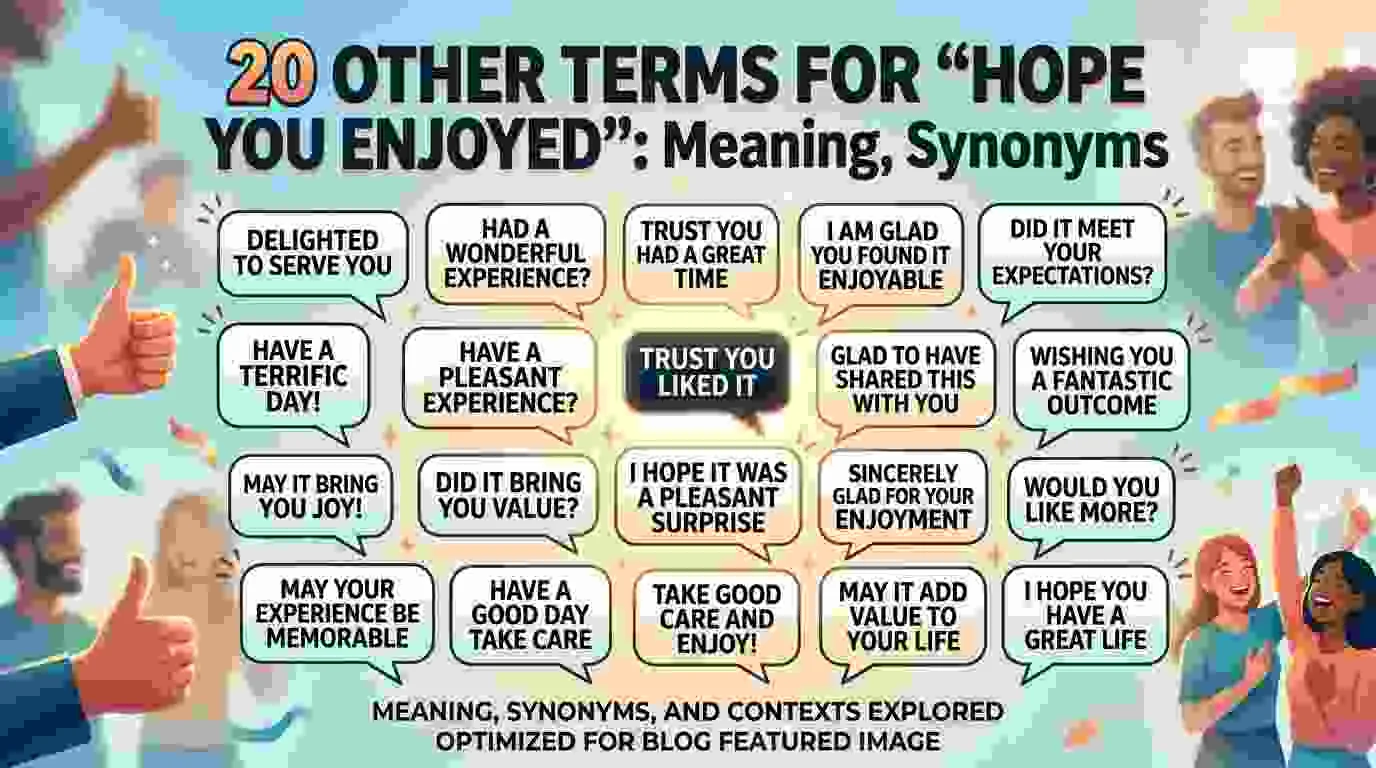
Choosing the right alternative can therefore make communication clearer, more professional, and more appropriate for its audience. This guide explains the meaning of “hope you enjoyed,” its tone, grammar, common uses, alternatives, regional differences, and practical examples for work, study, content creation, and everyday conversation.
What Does “Hope You Enjoyed” Mean?
“Hope you enjoyed” is a polite expression used to communicate that you wish someone had a pleasant or positive experience. It usually refers to something that has already happened, such as an event, meal, presentation, trip, video, lesson, or activity. It can be used in emails, conversations, follow-up messages, social media posts, and other informal or professional communication.
A fuller version is “I hope you enjoyed it” or “I hope you enjoyed the presentation.” In conversational English, the subject “I” is often omitted in short messages, producing “Hope you enjoyed it.”
One important grammar point is that “enjoy” normally takes an object. Therefore, “I hope you enjoyed” may sound unfinished when no object is understood from context. For example, “I hope you enjoyed the workshop” or “I hope you enjoyed it” is clearer than simply “I hope you enjoyed.”
Origin & History of “Hope You Enjoyed”
The phrase does not have a single documented historical origin as a fixed idiom. Instead, it is a straightforward combination of ordinary English words: hope, you, and the past-tense verb enjoyed.
The word hope has a long history in English and is used to express a desired or expected outcome. Enjoy developed from older French and Latin influences and eventually acquired its modern sense of taking pleasure or satisfaction from something.
The grammatical pattern “I hope + clause” has long been productive in English. It allows speakers to express a positive wish without directly demanding a response. When paired with the past tense “I hope you enjoyed…” the speaker is looking back at an experience that has already taken place.
Modern communication has made this construction particularly common in event follow-ups, customer communication, newsletters, online courses, presentations, social media, and workplace messages. Its flexibility is one reason it continues to be useful across different varieties of English.
The phrase has also developed a useful pragmatic function: rather than asking directly, “Did you enjoy it?”, the speaker can express goodwill while leaving the recipient free to respond. This makes it less demanding and often more socially comfortable.
Synonyms & Alternatives by Tone
Professional & Neutral Alternatives
- I hope you found it helpful.
- I hope you found it valuable.
- I hope it met your expectations.
- I trust you found it useful.
- I hope you had a positive experience.
- I hope the session was useful.
Polite & Supportive Alternatives
- I hope this was helpful.
- I hope you found this useful.
- I hope you had a good experience.
- I hope you got something useful from it.
Encouraging & Reassuring Alternatives
- I hope you feel better prepared.
- I hope this gave you what you needed.
- I hope you came away with something useful.
- I hope this made things a little easier.
Casual, Playful & Idiomatic Alternatives
- Hope you had fun.
- Hope you liked it.
- Glad you enjoyed it.
- Hope you loved it.
- Hope you had a great time.
The best alternative depends on what the person experienced and what you want to emphasize. Professional communication often benefits from words such as helpful, valuable, or useful, while personal messages can comfortably use fun, liked, or loved.
When Should You Use “Hope You Enjoyed”?
Professional settings
Use it when someone has completed or experienced something that can reasonably be described as enjoyable.
Examples include:
- A company webinar
- A training session
- A conference
- A team event
- A client experience
- A presentation
- A company dinner
- An online course
For example:
“Thank you for attending yesterday’s workshop. I hope you enjoyed the session and found the discussion useful.”
This is professional because the phrase is connected to a specific experience rather than being used as empty small talk.
Casual conversations
The expression works naturally after meals, trips, films, concerts, parties, visits, and other shared experiences.
“Hope you enjoyed the concert last night!”
In a text message, dropping “I” is perfectly natural because conversational English frequently uses shortened constructions.
Writing, presentations, and digital communication
Content creators often use the phrase at the end of:
- Blog posts
- Newsletters
- Videos
- Podcasts
- Presentations
- Online lessons
- Social media posts
For example:
“Thanks for reading. Hope you enjoyed this guide, and let me know which tip you found most useful.”
When it is especially effective
The phrase works best when:
- The experience has already happened.
- The recipient is likely to understand what “it” refers to.
- You want warmth without making a strong emotional assumption.
- You are closing or following up on an interaction.
When Should You Avoid “Hope You Enjoyed”?
There are situations where another expression is more accurate.
Overly formal situations
In highly formal correspondence, “I hope you enjoyed…” can sound slightly conversational.
For example, in a formal institutional report, “We trust that the materials met your requirements” may be more suitable.
Legal, academic, or sensitive contexts
Avoid framing serious or sensitive experiences around enjoyment.
For example, after discussing a difficult complaint, investigation, medical issue, or serious incident, “I hope you enjoyed…” would be inappropriate.
Instead, use wording that acknowledges the actual purpose:
“I hope the information provided was useful.”
Situations where nuance may be lost
A technical training session may not have been “enjoyable,” but it may have been extremely useful. In that case:
“I hope you found the training useful.”
is more precise than:
“I hope you enjoyed the training.”
Similarly, after sending instructions to a customer, “I hope this helped” may better match the purpose of the interaction.
Is “Hope You Enjoyed” Professional, Polite, or Casual?
“Hope you enjoyed” is best described as polite, flexible, and mildly conversational. It can work professionally, but it is not inherently formal.
| Feature | Assessment |
| Politeness | High |
| Professionalism | Moderate to high, depending on context |
| Formality | Neutral to semi-formal |
| Warmth | Moderate |
| Casualness | Moderate |
| Emotional intensity | Low |
| Directness | Indirect |
The phrase has a positive emotional subtext, but it does not strongly impose an emotion on the recipient. “I hope you enjoyed the workshop” expresses goodwill rather than demanding confirmation.
In a workplace, this can make it a safe closing. However, repeated use can make communication feel templated. When the actual goal is to emphasize learning, usefulness, satisfaction, or feedback, a more specific alternative can be stronger.
Pros and Cons of Using “Hope You Enjoyed”
Advantages
Clarity: The basic meaning is immediately understandable.
Efficiency: It communicates goodwill in only a few words.
Accessibility: ESL learners and native speakers generally recognize the structure easily.
Flexibility: It can work in professional, personal, educational, and digital contexts.
Low pressure: It expresses a positive wish without directly demanding feedback.
Potential Drawbacks
Oversimplification: Enjoyed may not accurately describe an educational, technical, or business experience.
Tone mismatch: The phrase can feel too casual for highly formal or sensitive communication.
Repetition: Using it after every presentation, newsletter, or event can make writing sound formulaic.
Limited feedback value: It does not directly ask what the recipient thought or whether something was useful.
Real-Life Examples of “Hope You Enjoyed” by Context
Emails
“Thanks again for joining the client workshop yesterday. I hope you enjoyed the session and found the examples relevant to your team.”
Meetings
“Thanks for making the time today. I hope you enjoyed the discussion. I’ll send the action points this afternoon.”
Presentations
“That brings us to the end of the presentation. I hope you enjoyed it, and I’m happy to take any final questions.”
Conversations
“Hope you enjoyed your weekend! Did you end up going hiking?”
Social media
“That wraps up our weekend in Lahore. Hope you enjoyed following along!”
The phrase becomes more effective when the surrounding sentence adds something specific. Instead of stopping at “Hope you enjoyed,” identify what the person experienced or add a useful next step.
“Hope You Enjoyed” vs Similar Expressions (Key Differences)
| Phrase | Meaning Difference | Tone Difference | Best Use Scenario |
| I hope this was helpful | Focuses on usefulness rather than pleasure | Professional, supportive | Advice, tutorials, customer support |
| I hope you liked it | Focuses on personal approval or preference | More casual | Friends, creative work, social media |
| I trust you found this useful | Expresses stronger confidence about usefulness | Formal, confident | Business communication |
| I hope it met your expectations | Focuses on whether a standard was reached | Professional, careful | Client service and projects |
| I hope you had a good time | Focuses on the overall experience | Warm, conversational | Events, trips, social occasions |
| Glad you enjoyed it | Responds to known positive feedback rather than expressing hope | Friendly, appreciative | Follow-up conversations |
Meaning differences
The central distinction is what aspect of the experience you are highlighting.
- Enjoyed focuses on pleasure or satisfaction.
- Helpful focuses on practical benefit.
- Useful focuses on function or value.
- Met your expectations focuses on standards.
- Had a good time focuses on the overall experience.
- Glad you enjoyed it confirms a positive reaction that has already been expressed.
Tone differences
The difference can be subtle but important. “I trust you found this useful” sounds more confident and formal than “Hope you enjoyed it.” Meanwhile, “Hope you had fun” is clearly more casual.
Best-use scenarios
Choose the expression that matches the purpose of the interaction. If the recipient attended a training course, helpful or valuable may be better. If they went to a party, had a good time is more natural. If they received a service, met your expectations can be more precise.
Common Mistakes & Misuse of “Hope You Enjoyed”
Overuse
Using the same closing after every interaction can make writing sound automated.
Instead of:
“I hope you enjoyed the webinar.”
every time, vary the emphasis:
“I hope you found the session useful.”
or:
“I’d love to hear which part of the webinar was most useful.”
Incorrect context
Do not use enjoyed when the experience was serious, difficult, or emotionally sensitive.
Contradictory usage
Avoid pairing the phrase with information that clearly suggests the opposite experience.
For example:
“I hope you enjoyed the training, even though most of the session was cancelled.”
A more honest formulation would acknowledge what actually happened.
Cultural misunderstandings
English learners sometimes assume that enjoyed always means “liked.” The two are related but not identical.
Enjoy usually refers to taking pleasure or satisfaction from an experience. Like can refer more broadly to preference or approval.
That distinction matters in professional writing.
Psychological Reasons People Prefer “Hope You Enjoyed”
Cognitive load reduction
Short expressions are easy to process. “Hope you enjoyed it” requires little interpretation when the context is obvious.
Trust and authority signals
A measured positive statement can make communication feel considerate without sounding overly demanding. In professional settings, that balance can help maintain rapport.
Attention economy
Modern readers often scan emails, messages, and online content rather than reading every sentence carefully. Short, recognizable expressions work efficiently as conversational transitions.
Modern communication habits
Digital communication has encouraged shorter constructions such as “Hope you enjoyed!”, particularly in captions, messaging apps, newsletters, and follow-up notes.
However, brevity should not come at the expense of accuracy. A specific sentence is usually more useful than a generic one.
US vs UK Usage of “Hope You Enjoyed”
The phrase is natural in both American and British English. There is no major difference in its basic meaning or grammatical function.
In American communication, it is common in friendly workplace emails, customer messages, educational content, and event follow-ups.
In British English, it is equally understandable and widely used. Depending on the organization and context, British writers may also choose somewhat more reserved expressions such as “I hope you found it useful” or “I trust you enjoyed it.”
The important distinction is not a strict US-versus UK grammar rule. Formality varies more by speaker, organization, audience, and situation than by nationality.
“Hope You Enjoyed” in Digital & Modern Communication
Emails
Email often benefits from the full version:
“I hope you enjoyed the workshop and found the discussion useful.”
This feels more polished than relying only on the shortened version.
Slack and WhatsApp
Shortened forms are especially natural:
“Hope you enjoyed the event!”
“Hope you enjoyed the trip!”
Social media
Creators frequently use the phrase after sharing content:
“That’s the end of today’s travel guide. Hope you enjoyed it!”
Linguistic & Communication Insight
Emotional weight & subtext
Native speakers generally hear “I hope you enjoyed…” as a friendly expression of goodwill. It carries a mild assumption that the experience was intended to be positive, but it does not strongly insist that the recipient actually enjoyed it.
That distinction matters.
Compare:
“I hope you enjoyed the event.”
with:
“You enjoyed the event.”
The first expresses a wish. The second makes a claim.
Direct vs indirect phrasing
“Did you enjoy the event?” is direct and explicitly requests an answer.
“I hope you enjoyed the event.” is indirect and socially softer.
That indirectness can be useful when you want to maintain warmth without putting someone on the spot. However, if you genuinely need feedback, the indirect expression may not be enough.
A stronger follow-up would be:
“I hope you enjoyed the event. What did you think of the final session?”
Professional communication perspective
At work, the phrase is generally safe when the experience was genuinely positive or neutral. But professionals often switch to “I hope you found this useful” when they want to emphasize value rather than entertainment.
That small change can make a message feel more intentional.
Pragmatic reasons for alternatives
Experienced communicators choose alternatives to achieve specific effects:
- “I hope this was helpful” emphasizes support.
- “I trust you found this useful” signals confidence.
- “I hope it met your expectations” emphasizes standards.
- “I hope you had a good time” emphasizes warmth.
- “Glad you enjoyed it” acknowledges established positive feedback.
The best wording is therefore not necessarily the most formal. It is the one that accurately reflects the relationship, purpose, and emotional situation.
Social signaling
Word choice tells readers how you view the interaction.
A customer who receives “I hope you enjoyed the service” may perceive a friendly brand voice. A client who receives “I hope the deliverables met your expectations” receives a more outcome-focused signal.
Neither is universally better.
Tone & context guidance
Use “hope you enjoyed” when warmth and simplicity matter. Choose something more specific when you need to emphasize value, satisfaction, preparation, performance, or feedback.
I Hope This Was Helpful
Meaning: This phrase expresses the hope that the information, advice, or assistance provided was useful to the recipient.
Why This Phrase Works: It focuses on practical benefit rather than whether the person enjoyed the experience.
Real-World Usage Insight: This is especially natural after answering a question or explaining a process.
Best Use: Customer support, tutoring, professional advice, instructions, and explanatory emails.
Avoid When: You are talking about a genuinely recreational experience where helpful would sound unnatural.
Tone: Friendly, professional, supportive.
US vs UK Usage: Common and natural in both American and British English.
Example (Email / Message / Meeting): “I’ve attached the revised checklist. I hope this was helpful, and please let me know if anything is unclear.”
I Hope You Found It Helpful
Meaning: This expresses a wish that the recipient gained practical assistance or value from something they received.
Why This Phrase Works: It connects the communication directly to usefulness and gives the recipient a clear sense of purpose.
Real-World Usage Insight: It works particularly well when following up after advice, training, or an explanation.
Best Use: Workplace emails, tutorials, consultations, and educational communication.
Avoid When: The experience was purely social or recreational.
Tone: Polite, professional, approachable.
US vs UK Usage: Widely used in both regions.
Example (Email / Message / Meeting): “Thanks for reviewing the draft with me this morning. I hope you found the feedback helpful.”
I Hope You Found It Valuable
Meaning: This indicates that you hope the recipient gained meaningful benefit, insight, or value.
Why This Phrase Works: It sounds more purposeful than simply referring to enjoyment.
Real-World Usage Insight: Speakers often use it after conferences, workshops, strategy sessions, and professional presentations.
Best Use: Business events, consulting, training, conferences, and executive communication.
Avoid When: Talking about a casual dinner, film, or personal outing.
Tone: Professional, positive, purposeful.
US vs UK Usage: Natural in both American and British English.
Example (Email / Message / Meeting): “Thank you for joining the strategy workshop. I hope you found it valuable and came away with a few ideas your team can use.”
I Hope You Had a Good Time
Meaning: This expresses a wish that someone experienced an enjoyable and pleasant occasion.
Why This Phrase Works: It sounds warmer and more personal than valuable or useful.
Real-World Usage Insight: It is particularly natural when discussing parties, holidays, dinners, concerts, and social events.
Best Use: Personal messages, social events, travel, celebrations, and informal workplace conversations.
Avoid When: Writing highly formal business or legal correspondence.
Tone: Warm, friendly, conversational.
US vs UK Usage: Common in both regions.
Example (Email / Message / Meeting): “Hope you had a good time at the team dinner last night. It was great catching up outside the office.”
I Hope It Met Your Expectations
Meaning: This asks or suggests that an experience, service, or result matched what the recipient expected.
Why This Phrase Works: It focuses on satisfaction and standards rather than simple enjoyment.
Real-World Usage Insight: It is useful when the recipient has paid for, requested, or commissioned something.
Best Use: Client work, hospitality, consulting, projects, and customer service.
Avoid When: Talking about an informal activity where expectations were never established.
Tone: Professional, careful, customer-focused.
US vs UK Usage: Common in both American and British professional communication.
Example (Email / Message / Meeting): “We’ve completed the website revisions. I hope the final version met your expectations.”
I Trust You Found This Useful
Meaning: This expresses confidence that the recipient benefited from the information or material provided.
Why This Phrase Works: Trust sounds more assured than hope and gives the sentence a more formal character.
Real-World Usage Insight: It can work well when communicating with clients or senior stakeholders, although it may sound too formal for close colleagues.
Best Use: Formal business emails, reports, professional correspondence.
Avoid When: Messaging friends or using a relaxed brand voice.
Tone: Formal, confident, polished.
US vs UK Usage: Familiar in both, with trust sometimes perceived as slightly more formal or traditional in British business writing.
Example (Email / Message / Meeting): “I trust you found this useful. Please contact me if you would like us to provide any additional information.”
I Hope You Had a Positive Experience
Meaning: This expresses a wish that someone’s overall interaction with a service, event, organization, or experience was satisfactory.
Why This Phrase Works: It is broader and more neutral than enjoyed.
Real-World Usage Insight: The expression is useful when an experience may have involved both practical and emotional elements.
Best Use: Customer service, healthcare administration, education, events, and professional follow-ups.
Avoid When: Writing to a close friend about a simple recreational activity.
Tone: Professional, considerate, neutral.
US vs UK Usage: Natural in both varieties of English.
Example (Email / Message / Meeting): “Thank you for visiting our office yesterday. I hope you had a positive experience and found the meeting useful.”
I Hope You Enjoyed the Experience
Meaning: This refers specifically to the recipient’s overall experience rather than one particular part of it.
Why This Phrase Works: Adding the experience makes the reference clearer and works well for services or events.
Real-World Usage Insight: Businesses often use this wording after a customer has interacted with several parts of a service.
Best Use: Hospitality, events, customer journeys, workshops, and service businesses.
Avoid When: The recipient experienced something extremely short or specific where the wording feels unnecessarily broad.
Tone: Polite, professional, warm.
US vs UK Usage: Common and understandable in both.
Example (Email / Message / Meeting): “Thank you for joining us for the open day. I hope you enjoyed the experience and had a chance to speak with the admissions team.”
I Hope You Liked It
Meaning: This expresses a wish that the recipient approved of or enjoyed something that was shared.
Why This Phrase Works: It is simple and natural, especially when discussing creative or personal things.
Real-World Usage Insight: People commonly use it after sending photographs, artwork, videos, gifts, recipes, or other personal creations.
Best Use: Messages, social media, creative work, friends, and informal email.
Avoid When: Writing a highly formal client communication.
Tone: Casual, friendly, personal.
US vs UK Usage: Very common in both.
Example (Email / Message / Meeting): “I finally finished the draft of the article and sent it over. Hope you liked it!”
Glad You Enjoyed It
Meaning: This shows that you are pleased because the other person has already indicated that they enjoyed something.
Why This Phrase Works: Unlike hope, glad responds to known feedback and therefore sounds more immediate.
Real-World Usage Insight: It is especially natural in conversations where someone has just said they liked something.
Best Use: Casual conversations, customer replies, social media comments, and personal messages.
Avoid When: You do not yet know whether the person enjoyed the experience.
Tone: Friendly, warm, appreciative.
US vs UK Usage: Common in both American and British English.
Example (Email / Message / Meeting): “Glad you enjoyed the workshop! Your question during the Q&A was a really good one.”
I Hope You Had Fun
Meaning: This expresses a wish that someone enjoyed themselves during an activity or event.
Why This Phrase Works: It is more relaxed and emotionally warm than the original phrase.
Real-World Usage Insight: It sounds particularly natural when talking to friends, family, students, or younger audiences.
Best Use: Parties, trips, concerts, celebrations, informal activities.
Avoid When: Addressing a senior client in a highly formal context.
Tone: Casual, cheerful, friendly.
US vs UK Usage: Very common in both.
Example (Email / Message / Meeting): “Hope you had fun at the festival! Send me your photos when you get a chance.”
I Hope You Came Away With Something Useful
Meaning: This expresses the hope that the recipient gained at least one practical idea, insight, or takeaway.
Why This Phrase Works: It acknowledges that an experience can be valuable even if it was not simply “enjoyable.”
Real-World Usage Insight: This wording feels natural after workshops, talks, seminars, and training sessions.
Best Use: Education, professional development, conferences, webinars, and presentations.
Avoid When: Discussing purely recreational experiences.
Tone: Thoughtful, encouraging, professional.
US vs UK Usage: Natural in both regions.
Example (Email / Message / Meeting): “Thanks for joining today’s workshop. I hope you came away with something useful that you can apply to your next project.”
I Hope You Feel Better Prepared
Meaning: This expresses the hope that information or training has increased someone’s readiness for a future task.
Why This Phrase Works: It connects communication directly to confidence and preparation.
Real-World Usage Insight: It is especially useful when the recipient is expected to apply what they learned.
Best Use: Training, onboarding, exams, interviews, workshops, and presentations.
Avoid When: There is no preparation or future task involved.
Tone: Supportive, reassuring, professional.
US vs UK Usage: Common in both American and British English.
Example (Email / Message / Meeting): “After today’s orientation, I hope you feel better prepared for your first week with the team.”
I Hope You Got Something Useful From It
Meaning: This expresses the hope that the recipient gained practical value from an experience or resource.
Why This Phrase Works: It sounds natural and conversational while still emphasizing usefulness.
Real-World Usage Insight: It works particularly well when you do not know exactly which part of a resource will benefit the recipient.
Best Use: Presentations, articles, workshops, advice, videos, and informal professional communication.
Avoid When: Writing highly formal correspondence where a more polished expression is expected.
Tone: Friendly, conversational, practical.
US vs UK Usage: Natural in both regions.
Example (Email / Message / Meeting): “Thanks for sticking around for the full session. I hope you got something useful from it.”
I Hope This Gave You What You Needed
Meaning: This expresses the hope that the information, service, or assistance adequately addressed the recipient’s needs.
Why This Phrase Works: It centers the recipient’s goal rather than the sender’s intention.
Real-World Usage Insight: This can sound especially considerate after helping someone solve a problem.
Best Use: Customer support, consulting, tutoring, workplace assistance, and service communication.
Avoid When: You cannot reasonably know whether the person’s needs were met.
Tone: Supportive, considerate, direct.
US vs UK Usage: Common in both varieties of English.
Example (Email / Message / Meeting): “I’ve included the pricing details and implementation timeline. I hope this gave you what you needed for your planning meeting.”
Hope You Loved It
Meaning: This expresses a strong wish that someone reacted very positively to something.
Why This Phrase Works: It creates more emotional energy than hope you enjoyed.
Real-World Usage Insight: It is especially effective for creative content, gifts, food, entertainment, lifestyle content, and social media.
Best Use: Personal messages, marketing, social media, creative work, and informal content.
Avoid When: Communicating with clients about serious business matters or sensitive situations.
Tone: Enthusiastic, playful, warm.
US vs UK Usage: Familiar in both, especially in informal digital communication.
Example (Email / Message / Meeting): “The new photos are finally live—hope you loved them as much as we did!”
Thank You for Taking the Time
Meaning: This expresses appreciation for someone’s time and attention rather than commenting on whether they enjoyed an experience.
Why This Phrase Works: It acknowledges a resource that is especially valuable in professional communication: the recipient’s time.
Real-World Usage Insight: It is often stronger than an enjoyment-based phrase after meetings, interviews, reviews, and consultations.
Best Use: Business emails, interviews, networking, meetings, client communication, and feedback requests.
Avoid When: You specifically need to comment on enjoyment or satisfaction with an event.
Tone: Respectful, professional, appreciative.
US vs UK Usage: Extremely common in both American and British English.
Example (Email / Message / Meeting): “Thank you for taking the time to review the proposal. I appreciate the detailed feedback and will incorporate the changes before Friday.”
Comparison Table of 10 Best Alternatives
The best alternative depends on what you want to communicate: enjoyment, usefulness, value, satisfaction, preparation, or appreciation. These ten options cover the most common professional, educational, personal, and digital situations.
| Phrase | Meaning | Best Use | Worst Use | Tone | US vs UK Usage |
| I hope this was helpful | Hopes the information provided practical assistance | Support, education, advice | Parties or entertainment | Friendly, professional | Common in both |
| I hope you found it helpful | Focuses on practical benefit | Training, emails, explanations | Casual celebrations | Professional, warm | Common in both |
| I hope you found it valuable | Emphasizes meaningful benefit | Workshops, conferences, business | Casual social events | Professional, purposeful | Common in both |
| I hope you had a good time | Hopes the person enjoyed an occasion | Social events, trips | Formal reports | Warm, conversational | Common in both |
| I hope it met your expectations | Focuses on standards and satisfaction | Clients, services, projects | Informal chats | Professional, careful | Common in both |
| I trust you found this useful | Shows confidence in the value provided | Formal business writing | Friends and casual chats | Formal, confident | Common in both |
| I hope you had a positive experience | Covers the overall interaction | Customer service, events | Close personal messages | Professional, considerate | Common in both |
| I hope you liked it | Hopes someone approved of something | Creative work, messages | Highly formal correspondence | Casual, friendly | Common in both |
| Glad you enjoyed it | Responds to known positive feedback | Conversations, replies | Before receiving feedback | Friendly, appreciative | Common in both |
| Thank you for taking the time | Expresses appreciation for attention | Meetings, interviews, reviews | When enjoyment is the main topic | Professional, respectful | Common in both |
Conclusion
“Hope you enjoyed” is a simple, polite expression that works across professional, personal, educational, and digital communication. Its meaning is clear: you are expressing a positive wish about someone’s experience. However, the best wording depends on what you actually want to communicate.
If the focus is usefulness, “I hope this was helpful” or “I hope you found it valuable” may be more precise. For social occasions, “I hope you had a good time” sounds natural and warm. In customer-focused communication, “I hope it met your expectations” emphasizes satisfaction rather than enjoyment.
Understanding these subtle differences helps your writing sound more intentional and natural. For ESL learners, students, professionals, and content writers, learning alternatives to “hope you enjoyed” also makes it easier to avoid repetition and choose language that fits the audience. Ultimately, effective communication is not about using the most sophisticated phrase; it is about choosing clear, appropriate wording that matches the situation, relationship, and purpose.
FAQs
Is “hope you enjoyed” grammatically correct?
Yes, “hope you enjoyed” is grammatically acceptable in informal communication when the object is understood from context. The more complete form is “I hope you enjoyed it” or “I hope you enjoyed the event.” In formal writing, including the subject and clearly identifying what was enjoyed can make the sentence sound more polished and complete.
Is “hope you enjoyed” professional?
Yes, “hope you enjoyed” can be professional, particularly in friendly workplace emails, event follow-ups, presentations, newsletters, and customer communication. However, it has a neutral-to-conversational tone rather than a highly formal one. For formal business situations, alternatives such as “I hope you found this useful” or “I hope it met your expectations” may be more precise.
What can I say instead of “hope you enjoyed”?
Good alternatives include “I hope this was helpful,” “I hope you found it valuable,” “I hope you had a good time,” “I hope it met your expectations,” and “I trust you found this useful.” Choose based on context: helpful suits advice or training, while had a good time works better for social events and entertainment.
What does “I hope you enjoyed it” mean?
“I hope you enjoyed it” means that the speaker wishes the other person had a pleasant, satisfying, or positive experience. The word it refers to something previously mentioned, such as a meal, presentation, movie, trip, event, or activity. The expression communicates goodwill without directly asking the person to confirm whether they enjoyed it.
Is “hope you enjoyed” casual or formal?
“Hope you enjoyed” is generally neutral to casual, although it can appear in professional communication. The shortened form without I is particularly common in messages, social media, and friendly emails. The full form, “I hope you enjoyed…”, sounds slightly more polished and is usually preferable when writing to clients, customers, colleagues, or professional contacts.
Should I say “hope you enjoyed” or “hope you enjoy”?
The choice depends on timing. Use “hope you enjoy” when the person is about to experience something or is currently beginning it, such as “I hope you enjoy the presentation.” Use “hope you enjoyed” after the experience has finished, such as “I hope you enjoyed the presentation.” The verb tense reflects when the experience occurred.
What is a polite way to say “hope you enjoyed”?
A polite option is “I hope you enjoyed the experience.” In professional settings, you can also say “I hope you found the session helpful,” “I hope you found it valuable,” or “I hope it met your expectations.” These alternatives are polite because they express goodwill while allowing the recipient to form their own opinion.
Can I use “hope you enjoyed” in an email?
Yes. “Hope you enjoyed” is suitable for many emails, especially informal or friendly professional follow-ups. For example: “I hope you enjoyed the workshop and found the discussion useful.” If you are writing a formal business email, a more specific expression such as “I hope you found the presentation valuable” may communicate your purpose more effectively.
What is the difference between “hope you enjoyed” and “hope you liked it”?
Both expressions communicate a positive wish, but “enjoyed” usually focuses on the experience, while “liked” often emphasizes personal approval or preference. “I hope you enjoyed the concert” sounds natural for an event, whereas “I hope you liked the design” is more natural when asking about someone’s reaction to creative work or a specific choice.
Is “glad you enjoyed it” the same as “hope you enjoyed it”?
No. “I hope you enjoyed it” expresses a wish when you do not necessarily know the person’s reaction. “Glad you enjoyed it” normally responds to information that the person actually enjoyed something. Therefore, hope looks toward an uncertain reaction, while glad acknowledges a positive reaction that has already been established.

Leave a Reply