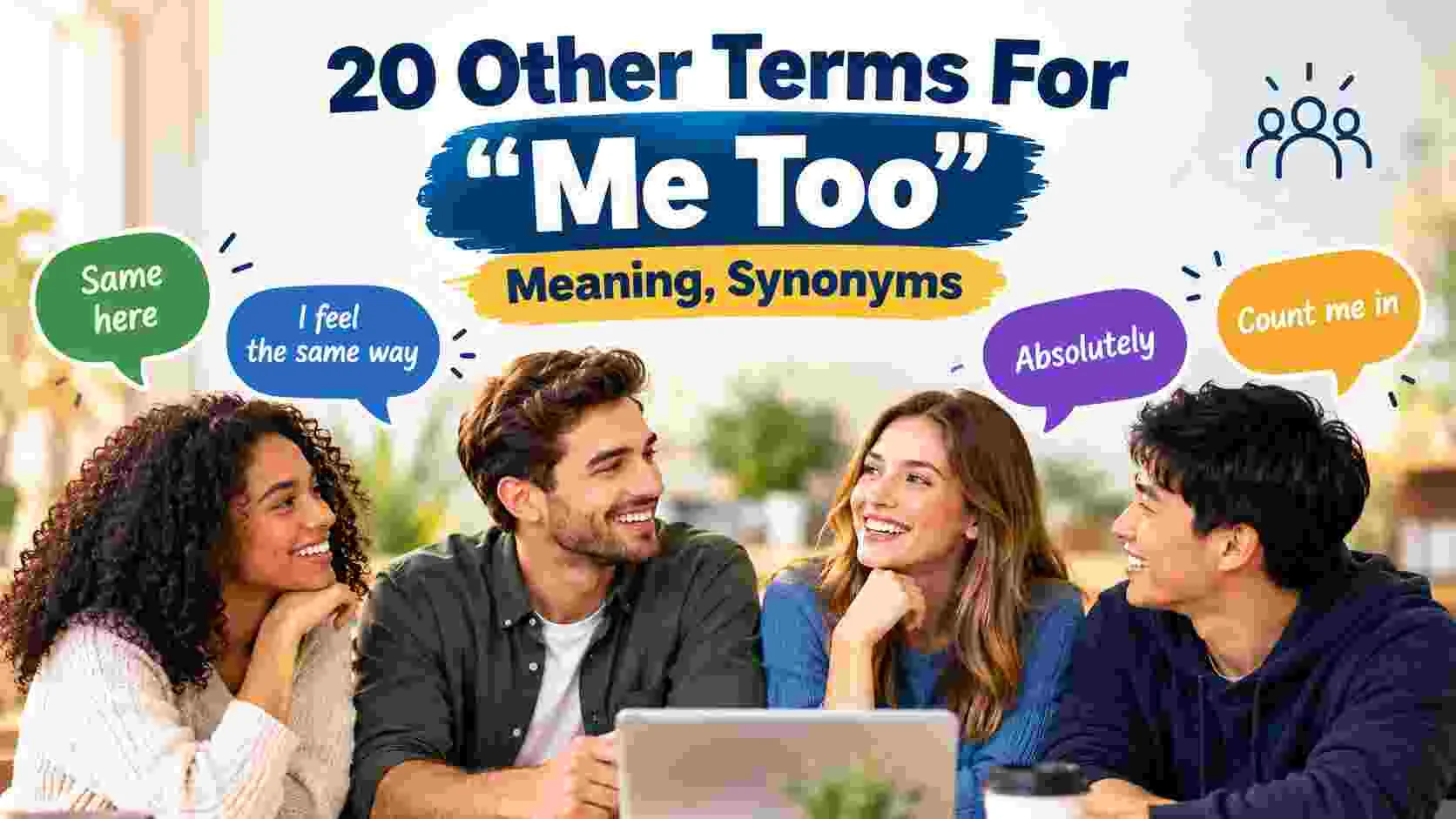
Imagine a colleague saying, “I’m looking forward to the long weekend,” and you immediately reply, “Me too.” Or a friend says, “I’m exhausted after that meeting,” and you answer, “Same here.” In both situations, you are agreeing without repeating the entire sentence.
“Me too” is a short, familiar expression used to show that you share another person’s feeling, experience, opinion, preference, or situation. Because it is so concise, it appears frequently in everyday conversations, workplace chats, emails, social media, and informal writing. However, the best alternative depends on what you are agreeing with and who you are speaking to.
In professional communication, replacing “me too” with a more specific expression such as “I feel the same way,” “I agree,” or “I’m in the same position” can make your response clearer and more polished. In casual conversations, however, “me too” is often exactly right because it sounds natural, friendly, and effortless.
Understanding these differences helps professionals, students, ESL learners, and content writers choose language that communicates agreement without sounding repetitive, vague, or unnecessarily formal.
What Does “Me Too” Mean?
“Me too” means that the speaker shares the same feeling, opinion, experience, preference, or situation just mentioned by another person. It is commonly used in conversations, messages, meetings, and informal writing to express agreement or similarity quickly. Depending on context, “me too” can communicate shared enthusiasm, frustration, preference, experience, or emotion.
Origin & History of “Me Too”
The expression “me too” is built from two very ordinary English words: the pronoun “me” and the adverb “too,” meaning “also” or “as well.” The word too comes from Old English tō, which originally carried meanings associated with addition or “also.” Over centuries, English speakers increasingly used short constructions such as “me too” as convenient responses to statements about personal feelings, experiences, and preferences.
There is no single confirmed moment when “me too” was invented as a fixed expression. Instead, it developed naturally from English grammar and the human tendency to shorten repeated information. Rather than saying, “I am also tired,” a speaker can simply say, “Me too.”
This makes “me too” an example of ellipsis, where words that can be understood from the surrounding context are left unstated. The listener supplies the missing meaning.
For example:
“I love working from home.”
“Me too.”
The second speaker does not need to repeat “I love working from home.” The context makes the intended meaning clear.
The phrase also has an important modern cultural association. #MeToo, written with a hashtag and capitalized as a movement name, became globally prominent in discussions about sexual harassment and sexual assault, particularly after 2017. The everyday expression “me too” and the #MeToo movement are linguistically related but should not automatically be treated as the same thing. Context determines which meaning is intended.
Today, ordinary “me too” remains one of the simplest ways to express shared experience or agreement in spoken and digital English.
Synonyms & Alternatives by Tone
Professional & Neutral Alternatives
- I agree.
- I feel the same way.
- I’m in the same position.
- I share that view.
- I have the same experience.
- I agree with that.
- I agree.
Polite & Supportive Alternatives
- I feel the same way.
- I understand completely.
- I can relate to that.
- I’m with you on that.
- I’ve experienced that too.
- I understand where you’re coming from.
Encouraging & Reassuring Alternatives
- You’re not alone.
- I’m with you.
- I feel the same.
- I’m right there with you.
- I understand.
- I’ve been there too.
Casual, Playful & Idiomatic Alternatives
- Same here.
- Same.
- Me as well.
- Ditto.
- So do I.
- So am I.
- Count me in.
- Right there with you.
When Should You Use “Me Too”?
“Me too” works best when the shared meaning is obvious and the conversation is relatively informal. It is particularly useful when repeating the original statement would sound unnecessary.
Professional settings
In workplaces, “me too” is acceptable in relaxed conversations, team chats, and informal messages. For example:
“I’m hoping we can finish early today.”
“Me too.”
However, in a formal email or client-facing message, “I agree,” “I feel the same way,” or a more specific response may sound more appropriate.
Casual conversations
This is where “me too” is most natural. Friends, family members, classmates, and coworkers often use it without giving the expression much thought.
“I’m craving pizza.”
“Me too.”
Writing, presentations, and digital communication
“Me too” works particularly well in text messages, social media comments, online discussions, and conversational writing. It can make a response feel immediate and approachable.
When it is especially effective
Use “me too” when:
- You genuinely share the other person’s experience or feeling.
- The meaning is already clear from context.
- You want a short, friendly response.
- Repeating the full sentence would be unnecessary.
- The audience is comfortable with conversational English.
When Should You Avoid “Me Too”?
Although “me too” is grammatically understandable and extremely common, it is not ideal in every situation.
Overly formal situations
A formal presentation, business proposal, official statement, or highly polished email may benefit from more precise wording.
Instead of:
“Me too.”
Consider:
“I share that perspective.”
Legal, academic, or sensitive contexts
In situations where exact meaning matters, “me too” can be too vague. A legal document, academic paper, research report, or formal statement should identify what exactly is being agreed with or shared.
Situations where nuance may be lost
Someone might say:
“I’m concerned about the way this decision was made.”
Responding with “me too” confirms shared concern, but it does not explain whether you agree about the decision, the process, the consequences, or all three.
A more precise response could be:
“I share your concern about the lack of consultation.”
This provides considerably more information.
Is “Me Too” Professional, Polite, or Casual?
“Me too” is primarily casual and conversational. It is not inherently rude, but its level of professionalism depends heavily on context.
In a relaxed workplace conversation, “me too” can sound perfectly natural. In a formal client email, it may sound overly brief or insufficiently specific.
Its emotional subtext is usually neutral to friendly. It signals shared experience, agreement, or identification without demanding much explanation.
Compare:
- “Me too.” — casual, quick, conversational
- “I agree.” — direct and professional
- “I feel the same way.” — personal and supportive
- “I share that view.” — formal and measured
- “Same here.” — relaxed and informal
- “I’m in the same position.” — specific and practical
The important distinction is not whether “me too” is universally professional or unprofessional. The real question is whether its brevity and informality match the situation.
Pros and Cons of Using “Me Too”
Advantages
Clarity: When the context is obvious, the meaning is immediately understandable.
Efficiency: Two words can replace an entire repeated sentence.
Accessibility: “Me too” is simple vocabulary that is easy for English learners and international audiences to understand.
Natural conversation: Native speakers frequently use it in everyday interactions.
Connection: It can quickly communicate that another person’s feeling or experience is shared.
Potential Drawbacks
Oversimplification: It may fail to explain exactly what you agree with.
Tone mismatch: It can sound too casual in formal communication.
Repetition: If used repeatedly in a conversation, it can make responses feel predictable.
Lack of detail: It may confirm agreement without adding anything useful to the discussion.
Possible ambiguity: In sensitive conversations, listeners may need more specific wording to understand exactly what you mean.
Real-Life Examples of “Me Too” by Context
Emails
Informal internal email:
“I’m looking forward to taking a few days off after this project.”
“Me too. It’s been a busy couple of weeks.”
For a formal client email, a fuller response would usually be better.
Meetings
“I think we should give the team another week to test the new process.”
“Me too. I’d rather catch the problems before launch.”
Here, “me too” is immediately followed by a specific reason, making the response more useful.
Presentations
During a conversational presentation:
“Many of us have probably struggled with managing notifications.”
“Me too.”
A presenter might use the phrase to create a moment of shared experience with an audience.
Conversations
“I could really use a quiet weekend.”
“Me too.”
This is one of the most natural environments for the expression.
Social media
“I could watch this series all over again.”
“Me too!”
The short response fits the fast, conversational nature of social platforms.
“Me Too” vs Similar Expressions: Key Differences
The following expressions overlap with “me too,” but they are not interchangeable in every situation.
| Phrase | Meaning Difference | Tone Difference | Best Use Scenario |
| Same here | Shares the same feeling, situation, or opinion | Casual and friendly | Texts, conversations, informal workplace chats |
| I agree | Explicitly confirms agreement with an idea or statement | Professional and direct | Meetings, emails, discussions |
| I feel the same way | Emphasizes shared feelings or personal reactions | Warm and supportive | Emotional or personal conversations |
| So do I | Grammatically agrees with an action or verb phrase | Conversational, slightly more structured | Spoken English and informal writing |
| Ditto | Means “the same applies to me” | Casual, playful, sometimes witty | Friendly conversations and informal messages |
| I’m with you | Signals agreement or support, sometimes emotionally | Supportive and conversational | Discussions, encouragement, teamwork |
Meaning differences
“Me too” is broad and can refer to feelings, preferences, experiences, or situations. “I agree” is more specifically about agreement with an idea or opinion. “I feel the same way” focuses more strongly on emotions. “So do I” generally follows the grammatical structure of the statement being answered.
Tone differences
“Me too” is highly conversational. “I agree” is more professional. “I feel the same way” sounds warmer. “Ditto” is playful, while “I’m with you” can communicate both agreement and support.
Best-use scenarios
Choose the expression based on what you are actually agreeing with. If someone states an opinion, “I agree” is often clearer. If someone expresses an emotion, “I feel the same way” can be more appropriate. If the interaction is casual, “me too” or “same here” usually sounds natural.
Common Mistakes & Misuse of “Me Too”
Overuse
Using “me too” after every statement can make a conversation feel repetitive. If someone shares an important idea, consider adding a reason or detail instead of simply confirming agreement.
Instead of:
“Me too.”
Try:
“I feel the same way, especially because the deadline is so close.”
Incorrect context
“Me too” should normally respond to something that can logically apply to you.
For example:
“I have three brothers.”
“Me too.”
This works if you also have three brothers, or if the intended meaning is that you have brothers in the relevant context. Otherwise, the response may be misleading.
Contradictory usage
Do not use “me too” when your actual position differs from the original statement.
“I don’t think the plan is ready.”
“Me too.”
This can technically mean “I also don’t think it is ready,” but learners may mistakenly interpret it as agreeing with the positive idea rather than the negative statement. In such cases, “I agree” or “I don’t think it’s ready either” is clearer.
Cultural misunderstandings
English learners sometimes assume that short agreement phrases have identical meanings. They do not. “Me too,” “same,” “I agree,” and “I’m with you” carry different levels of formality and emotional involvement.
Also remember that “me too” in ordinary conversation should not automatically be interpreted as the #MeToo movement. Capitalization, hashtags, and surrounding context usually make the intended meaning clear.
Psychological Reasons People Prefer “Me Too”
The popularity of “me too” is partly explained by how efficiently human conversation works.
Cognitive load reduction
People generally do not need to repeat information that their listener already understands. “Me too” removes unnecessary repetition while preserving the intended message.
Trust and authority signals
A short agreement can communicate social alignment quickly. However, in professional settings, simply agreeing is sometimes less valuable than explaining why you agree.
Attention economy
Modern digital communication rewards brevity. Messages on Slack, WhatsApp, social media, and other platforms often prioritize quick responses. “Me too” requires almost no processing time.
Modern communication habits
Texting and messaging have encouraged shorter conversational responses. Expressions such as “same,” “same here,” “me too,” and “I’m in” allow people to respond naturally without composing a complete sentence.
US vs UK Usage of “Me Too”
“Me too” is common in both American English and British English. There is no major regional difference in its basic meaning.
In both varieties, it is generally perceived as informal, conversational, and natural.
American speakers may frequently use alternatives such as “same,” “same here,” or “I’m with you” in casual digital communication. British speakers also use “same,” “same here,” and “me too,” although preferences vary significantly by individual, age, region, and social group.
The most important difference is not American versus British English but formal versus informal context. A professional audience in either country may prefer “I agree” or “I share that view” when precision and formality matter.
“Me Too” in Digital & Modern Communication
Emails
“Me too” is suitable for informal internal emails, especially among colleagues who already communicate casually.
Slack / WhatsApp
It is extremely natural in instant messaging:
“I’m going to grab coffee.”
“Me too.”
Because digital conversations move quickly, short responses are often preferred.
Social media
“Me too” can work as a comment or reply when users are identifying with another person’s experience.
“I need a vacation.”
“Me too!”
The expression creates a quick sense of shared experience.
AI-generated summaries
AI-generated summaries generally replace conversational expressions such as “me too” with more explicit language, such as “The participant agreed” or “The speaker expressed the same preference.”
This illustrates an important distinction: “me too” is efficient for human conversation because context supplies the missing information, whereas summaries often need to make that information explicit.
Linguistic & Communication Insight
Emotional weight & subtext
“Me too” contains very little literal information, but its conversational meaning can be richer than the two words suggest. Depending on context and delivery, it can communicate enthusiasm, sympathy, solidarity, frustration, agreement, or simple similarity.
For example:
“I’m nervous about tomorrow.”
“Me too.”
This can function as a small reassurance: the speaker is not alone in feeling nervous.
However, the same phrase can sound dismissive if someone shares a serious concern and the listener responds without acknowledging its importance.
Direct vs indirect phrasing
“Me too” is direct but incomplete. It directly signals similarity while leaving the exact nature of that similarity to context.
Compare:
“Me too.”
with:
“I share your concern about the deadline.”
The second version is more explicit and professional. It identifies both the shared position and the subject of agreement.
Softer alternatives can also reduce the possibility of sounding abrupt:
“I can understand that. I’ve felt the same way.”
Professional communication perspective
In workplace communication, “me too” is usually safe among familiar colleagues when the conversation is informal. It becomes less effective when decisions, disagreements, client relationships, or sensitive subjects are involved.
A useful rule is:
The more important the conversation, the more useful it is to explain what exactly you share or agree with.
Pragmatic reasons for alternatives
Experienced communicators often replace “me too” because they want to do more than agree. They may want to:
- demonstrate careful listening;
- clarify the exact point of agreement;
- show empathy;
- reduce defensiveness;
- add useful information;
- sound more professional;
- distinguish emotional support from intellectual agreement.
For example, “I understand where you’re coming from” does not necessarily mean “I agree with you.” That distinction can be extremely useful during disagreements.
Social signaling
Language also tells people how closely we are aligning ourselves with them. “Me too” creates quick similarity. “I agree” signals intellectual agreement. “I’m with you” can signal support. “I understand” signals recognition without necessarily endorsing the person’s position.
Choosing the right expression therefore affects how people perceive trust, warmth, confidence, and cooperation.
Tone & context guidance
Use “me too” when the relationship is comfortable, and the shared meaning is obvious. Choose a fuller alternative when the subject is serious, the audience is formal, or your response needs to demonstrate careful thought.
The goal is not to avoid “me too.” The goal is to use it where its simplicity helps rather than where its simplicity creates ambiguity.
Meaning, Usage & Examples for Each Alternative
I Agree
Meaning: “I agree” explicitly states that you share another person’s opinion, judgment, conclusion, or position.
Why This Phrase Works: It removes ambiguity. Unlike “me too,” it clearly identifies your response as agreement with an idea or viewpoint.
Real-World Usage Insight: This is one of the safest replacements for “me too” in professional communication. It works particularly well when someone has made a recommendation or expressed an opinion.
Best Use: Meetings, emails, presentations, workplace discussions, academic conversations.
Avoid When: You only share someone’s emotion or experience rather than agreeing with an opinion.
Tone: Professional, neutral, direct.
US vs UK Usage: Common and natural in both American and British English.
Example (Meeting):
“Given the customer feedback, I think we should simplify the sign-up process.”
“I agree. The current version asks for too much information upfront.”
I Feel the Same Way
Meaning: This phrase means that you experience the same emotion, reaction, or personal response as another person.
Why This Phrase Works: It is more emotionally precise than “me too” and makes it clear that you are sharing a feeling rather than necessarily agreeing with an argument.
Real-World Usage Insight: It is especially useful when someone talks about stress, excitement, disappointment, uncertainty, or another personal reaction.
Best Use: Personal conversations, supportive workplace discussions, sensitive topics.
Avoid When: You are agreeing with a technical fact or business proposal rather than expressing an emotion.
Tone: Warm, empathetic, conversational.
US vs UK Usage: Widely understood and natural in both varieties of English.
Example (Email):
“I was disappointed that we couldn’t present the project in person.”
“I feel the same way. I was really looking forward to meeting everyone.”
I’m in the Same Position
Meaning: This expression means that you are dealing with a similar circumstance or situation.
Why This Phrase Works: It provides more information than “me too” by emphasizing a shared situation rather than simply shared agreement.
Real-World Usage Insight: It is useful when colleagues or friends are facing similar practical problems.
Best Use: Workplace discussions, career conversations, practical situations.
Avoid When: You only share an opinion but are not actually in a similar situation.
Tone: Neutral, practical, professional.
US vs UK Usage: Natural in both American and British English.
Example (Meeting):
“I’m still waiting for the supplier to confirm the delivery date.”
“I’m in the same position. They haven’t replied to my last two emails either.”
I Share That View
Meaning: This means that you hold the same opinion or perspective as another person.
Why This Phrase Works: It sounds deliberate and professional while clearly communicating agreement.
Real-World Usage Insight: It is particularly useful when discussing strategy, policy, recommendations, or business decisions.
Best Use: Formal meetings, presentations, professional emails.
Avoid When: Talking casually with close friends, where it may sound unnecessarily formal.
Tone: Formal, measured, professional.
US vs UK Usage: Correct and understood in both, although it is more formal than everyday “me too.”
Example (Meeting):
“I think we should focus our budget on retaining existing customers.”
“I share that view. Our retention data supports the approach.”
I Have the Same Experience
Meaning: This phrase states that you have personally experienced something similar.
Why This Phrase Works: It distinguishes shared experience from simple agreement.
Real-World Usage Insight: It can help build credibility when someone describes a situation that you have also encountered.
Best Use: Professional discussions, mentoring, classroom conversations, personal exchanges.
Avoid When: You have not actually experienced the situation yourself.
Tone: Neutral, informative, conversational.
US vs UK Usage: Common and clear in both varieties.
Example (Conversation):
“I found the first few weeks in the new role surprisingly difficult.”
“I have the same experience. The systems take a while to learn.”
Same Here
Meaning: “Same here” means that the speaker is experiencing or thinking something similar to the person who spoke before them.
Why This Phrase Works: It is concise while sounding slightly more conversational than “I agree.”
Real-World Usage Insight: It is one of the most natural alternatives in casual workplace chats and everyday conversations.
Best Use: Text messages, Slack, casual conversations, informal team chats.
Avoid When: Writing highly formal correspondence.
Tone: Casual, friendly, relaxed.
US vs UK Usage: Very common in both American and British English.
Example (Social Media):
“I could seriously use a three-day weekend.”
“Same here. This week has been exhausting.”
So Do I
Meaning: “So do I” means that the speaker performs or feels the same action or has the same characteristic described in the previous statement.
Why This Phrase Works: It provides a grammatically structured way to agree with a positive statement.
Real-World Usage Insight: ESL learners often encounter this construction in conversation because it follows the auxiliary verb pattern of the original sentence.
Best Use: Spoken English, classroom practice, conversational writing.
Avoid When: The original sentence requires a different auxiliary structure, and you are unsure how to form the response.
Tone: Conversational, natural, moderately neutral.
US vs UK Usage: Standard and widely used in both varieties.
Example (Conversation):
“I really enjoy working early in the morning.”
“So do I. I get much more done before lunch.”
I’m With You
Meaning: “I’m with you” can mean that you agree with someone’s position or that you support them.
Why This Phrase Works: It communicates alignment while often adding a sense of solidarity.
Real-World Usage Insight: Context determines whether it means intellectual agreement, emotional support, or both.
Best Use: Team discussions, encouragement, disagreements, informal professional communication.
Avoid When: You need to make your exact position legally or technically precise.
Tone: Supportive, conversational, collaborative.
US vs UK Usage: Natural in both American and British English.
Example (Meeting):
“I think we should postpone the launch until the testing is complete.”
“I’m with you. A rushed launch could create bigger problems later.”
I Can Relate to That
Meaning: This phrase means that another person’s experience or feeling is familiar because you have experienced something similar.
Why This Phrase Works: It expresses empathy without necessarily claiming complete agreement.
Real-World Usage Insight: It is particularly useful when someone is sharing a personal difficulty, and you want to acknowledge it without taking over the conversation.
Best Use: Personal conversations, mentoring, supportive workplace exchanges.
Avoid When: You have no comparable experience or when a precise agreement is required.
Tone: Warm, empathetic, conversational.
US vs UK Usage: Common and natural in both varieties.
Example (Conversation):
“I always get nervous before giving presentations.”
“I can relate to that. I still get a little nervous before important ones.”
I’ve Experienced That Too
Meaning: This means that you have personally encountered the same or a similar situation.
Why This Phrase Works: It provides more detail than “me too” and clearly identifies the response as shared experience.
Real-World Usage Insight: This is useful when someone wants to know whether others have encountered the same problem.
Best Use: Workplace discussions, online communities, conversations about personal experiences.
Avoid When: Your experience is actually very different from the one being described.
Tone: Friendly, clear, supportive.
US vs UK Usage: Widely understood in both American and British English.
Example (Blog Comment):
“I struggled to stay focused when I first started working remotely.”
“I’ve experienced that too. Creating a fixed morning routine helped me a lot.”
You’re Not Alone
Meaning: “You’re not alone” tells someone that other people share their experience, difficulty, feeling, or situation.
Why This Phrase Works: It provides reassurance rather than merely confirming similarity.
Real-World Usage Insight: This expression is particularly effective when someone feels isolated or uncertain.
Best Use: Supportive conversations, mentoring, communities, personal messages.
Avoid When: The person has not expressed a problem or vulnerability.
Tone: Reassuring, empathetic, supportive.
US vs UK Usage: Common in both American and British English.
Example (Social Media):
“I’m finding it difficult to stay motivated while studying for exams.”
“You’re not alone. A lot of students struggle with motivation during exam season.”
I’m Right There With You
Meaning: This phrase means that you strongly share another person’s feeling, opinion, or experience.
Why This Phrase Works: It adds warmth and stronger identification than the very brief “me too.”
Real-World Usage Insight: It sounds natural when you want to emphasize solidarity rather than merely acknowledge similarity.
Best Use: Informal conversations, team discussions, supportive messages.
Avoid When: Writing highly formal documents.
Tone: Friendly, supportive, emphatic.
US vs UK Usage: Used in both varieties, with a strongly conversational feel.
Example (Meeting):
“I think we should stop adding features until we fix the existing problems.”
“I’m right there with you. The current version already has enough moving parts.”
Ditto
Meaning: “Ditto” means that the same statement, opinion, or sentiment applies to the speaker.
Why This Phrase Works: It is extremely concise and can add a playful or witty quality to a response.
Real-World Usage Insight: Because it can sound playful or slightly old-fashioned in some contexts, it should be used when the conversational style supports it.
Best Use: Informal conversations, humorous exchanges, friendly messages.
Avoid When: Formal emails, sensitive discussions, or situations requiring precise communication.
Tone: Casual, playful, sometimes humorous.
US vs UK Usage: Understood in both, although frequency varies by speaker and generation.
Example (Social Media):
“Coffee before the first meeting is non-negotiable.”
“Ditto.”
I Understand Where You’re Coming From
Meaning: This phrase means that you understand another person’s perspective, reasoning, or feelings.
Why This Phrase Works: It acknowledges someone’s position without necessarily saying that you completely agree with it.
Real-World Usage Insight: This distinction makes it especially valuable during disagreements.
Best Use: Workplace discussions, conflict resolution, sensitive conversations.
Avoid When: You actually want to state clear agreement and do not want to create uncertainty.
Tone: Respectful, diplomatic, empathetic.
US vs UK Usage: Common and natural in both American and British English.
Example (Meeting):
“I know the new process adds extra work, but I think it will reduce errors.”
“I understand where you’re coming from. My concern is whether we have enough staff to manage it.”
I’m With You on That
Meaning: This means that you agree with a particular idea, decision, or position.
Why This Phrase Works: It is more specific than simply saying “I’m with you” and makes the topic of agreement clearer.
Real-World Usage Insight: It works particularly well when several points are being discussed, and you want to show agreement with one specific point.
Best Use: Meetings, team chats, informal professional conversations.
Avoid When: A formal report or legal document requires highly precise language.
Tone: Conversational, supportive, collaborative.
US vs UK Usage: Natural in both varieties of English.
Example (Meeting):
“I think we should give the new employee another week to settle in.”
“I’m with you on that. They’re still learning the system.”
Comparison Table of 10 Best Alternatives
These ten alternatives cover the most useful situations, from formal workplace agreement to casual emotional support. The best choice depends on whether you are sharing an opinion, feeling, experience, or situation.
| Phrase | Meaning | Best Use | Worst Use | Tone | US vs UK Usage |
| I agree | Clearly confirms agreement | Professional discussions | When only sharing an emotion | Professional, direct | Common in both |
| I feel the same way | Shares a feeling or reaction | Personal or supportive conversations | Technical disagreements | Warm, empathetic | Common in both |
| I’m in the same position | Shares a similar situation | Workplace or practical problems | Simple opinions | Neutral, practical | Common in both |
| I share that view | Holds the same opinion | Formal workplace settings | Casual chats | Formal, measured | Common in both |
| Same here | Shares the same experience or feeling | Texts and informal conversations | Formal correspondence | Casual, friendly | Common in both |
| I have the same experience | Has experienced something similar | Professional or personal discussions | When experiences differ significantly | Neutral | Common in both |
| I’m with you | Shows agreement or support | Teamwork and discussions | Precise formal statements | Supportive | Common in both |
| I can relate to that | Identifies with another person’s experience | Empathetic conversations | When there is no comparable experience | Warm, conversational | Common in both |
| You’re not alone | Reassures someone that others share their experience | Sensitive or supportive conversations | Simple factual agreement | Reassuring | Common in both |
| I understand where you’re coming from | Recognizes another person’s perspective | Disagreement or diplomacy | When explicit agreement is required | Diplomatic, respectful | Common in both |
Conclusion
“Me too” is a simple, highly familiar expression that allows speakers to quickly communicate shared feelings, opinions, preferences, experiences, or situations. Its biggest strength is its clarity and efficiency, especially in everyday conversations, text messages, social media, and informal workplace communication. However, its shortness can sometimes make it too vague or casual for formal, sensitive, or high-stakes situations.
Choosing the right alternative depends on what you actually want to communicate. “I agree” is better for agreeing with an opinion, while “I feel the same way” emphasizes emotion. “Same here” works naturally in casual conversations, whereas “I share that view” provides a more professional tone. If you are describing a similar experience, “I’ve experienced that too” offers greater precision.
Ultimately, effective communication is not about avoiding “me too.” It is about understanding tone, context, audience, and intention and selecting the expression that conveys your meaning naturally and accurately.
FAQs
What does “me too” mean?
“Me too” means “I also feel, think, experience, want, or have the same thing.” It is commonly used as a short response when another person’s statement also applies to you. For example, if someone says, “I’m tired,” saying “Me too” means that you are tired as well.
Is “me too” grammatically correct?
Yes, “me too” is grammatically acceptable as a common conversational expression. It is an abbreviated response in which the rest of the meaning is understood from context. Instead of saying “I am tired too,” a speaker can simply say “Me too.” This type of shortened response is extremely common in natural spoken English.
Is “me too” formal or informal?
“Me too” is generally informal and conversational. It is natural in everyday speech, text messages, social media, and relaxed workplace communication. In formal emails, academic writing, business proposals, or official documents, alternatives such as “I agree,” “I share that view,” or “I feel the same way” may be more appropriate.
What is a professional way to say “me too”?
Professional alternatives include “I agree,” “I share that view,” “I feel the same way,” “I have the same experience,” and “I’m in the same position.” The best choice depends on the situation. Use “I agree” for opinions, “I feel the same way” for emotions, and “I’m in the same position” for similar circumstances.
What is another casual way to say “me too”?
Common casual alternatives include “same here,” “same,” “ditto,” “so do I,” and “I’m right there with you.” “Same here” is particularly common in conversations and messaging. “Ditto” can sound playful, while “I’m right there with you” usually communicates stronger emotional or personal agreement.
What is the difference between “me too” and “same here”?
“Me too” and “same here” both indicate that something applies to the speaker as well. However, “same here” often emphasizes a similar situation or experience, while “me too” has broader uses. Both are informal and work particularly well in conversations, text messages, social media, and casual workplace chats.
Can “me too” mean “I agree”?
Yes, “me too” can mean “I agree” when the preceding statement expresses an opinion or preference that you share. However, “me too” can also indicate a shared feeling or experience. When you specifically want to confirm agreement with an idea, “I agree” is clearer and more professional.
Can “me too” be used in a professional email?
Yes, but its suitability depends on the relationship and tone of the email. It can work in a relaxed internal exchange between colleagues. For clients, senior professionals, or formal correspondence, a fuller response such as “I agree” or “I feel the same way” generally sounds more polished and specific.
What is the difference between “me too” and “I feel the same way”?
“Me too” can express shared opinions, preferences, experiences, or emotions. “I feel the same way” specifically focuses on feelings or personal reactions. For example, “I’m worried about the deadline” can naturally receive “I feel the same way,” while an opinion such as “The proposal needs more detail” is usually better answered with “I agree.”
Is “me too” the same as the #MeToo movement?
No. The ordinary expression “me too” means that you share another person’s feeling, experience, preference, or opinion. #MeToo refers to a social movement focused on raising awareness of sexual harassment and sexual assault. Context, capitalization, and the hashtag generally distinguish the movement from ordinary conversational use.

Leave a Reply