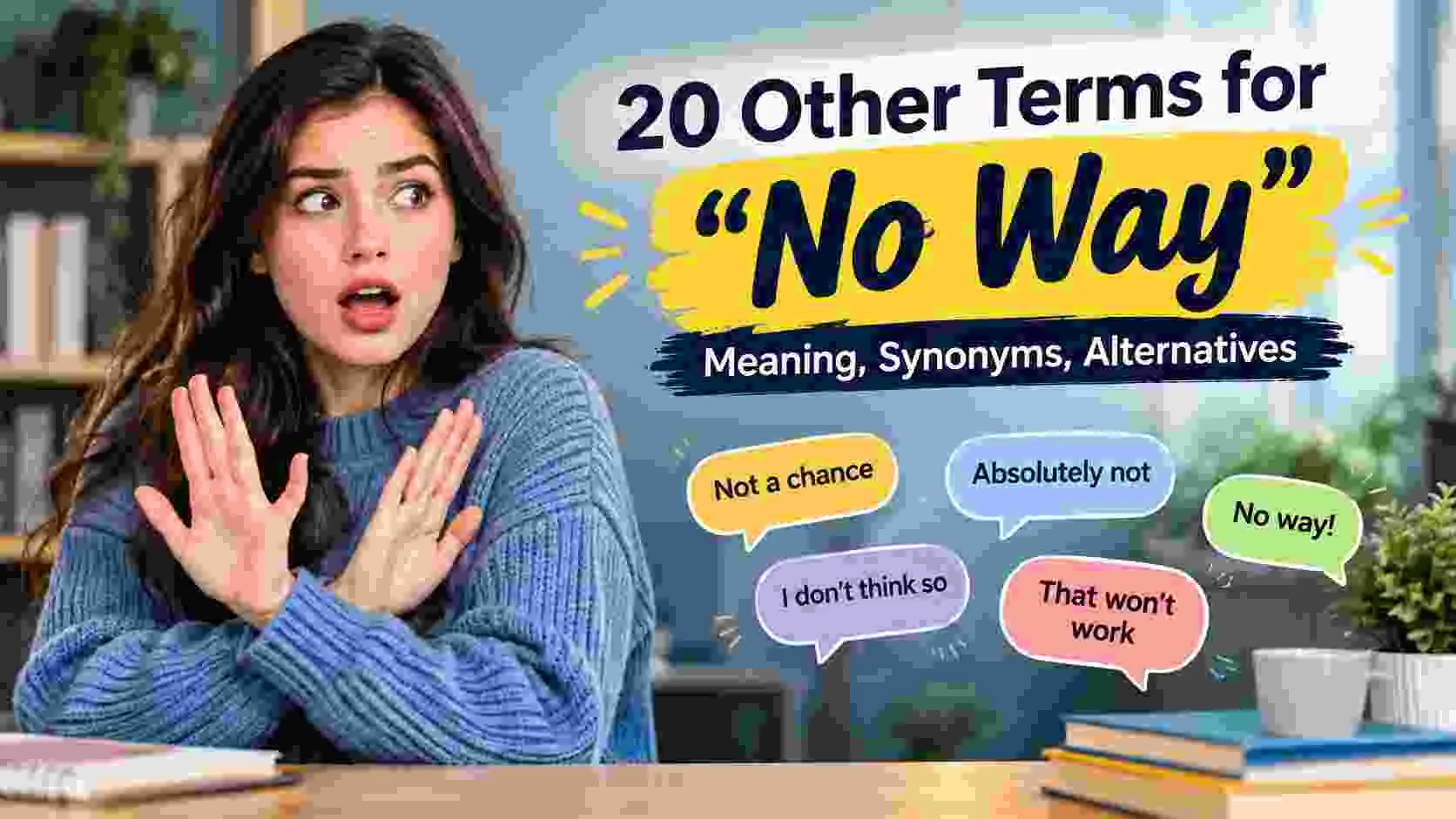
Imagine a colleague suggesting that your team finish a major project by tomorrow morning, even though several important tasks are still unfinished. You might instinctively respond, “No way we need more time.” In another situation, a friend might tell you they just won a competition, and you could say, “No way! That’s amazing.”
These two examples show why “no way” is such an interesting English expression. Depending on context, voice, punctuation, and relationship, it can express strong refusal, impossibility, disbelief, surprise, or emphatic disagreement.
The phrase is widely used in everyday English, including conversations, text messages, social media, and informal workplace communication. However, its suitability depends on the context. For instance, using “No way” in a formal email may sound abrupt or unprofessional. Instead, you can say “Unfortunately, that won’t be possible” to communicate the same boundary more respectfully and professionally.
Understanding “no way” therefore involves more than memorizing a synonym. The key is knowing what the speaker intends, how the listener may interpret the tone, and which alternative fits the situation.
What Does “No Way” Mean?
“No way” is an informal expression used to strongly reject an idea, indicate that something is impossible or unlikely, or express surprise and disbelief. It can mean “absolutely not,” “under no circumstances,” or “I can’t believe it,” depending on context. It commonly appears in conversations, informal messages, reactions, and emphatic statements.
Cambridge Dictionary identifies the expression as informal and notes both its use for forceful refusal and for expressing surprise.
The Two Main Meanings of “No Way”
The meaning usually falls into two broad categories:
1. Refusal or impossibility
“Can you work this weekend?”
“No way. I already have plans.”
Here, the speaker means absolutely not.
2. Surprise or disbelief
“I got the job!”
“No way! Congratulations!”
Here, the speaker is not refusing anything. Instead, “no way” means something like “Really?” or “I can’t believe it!”
This distinction is essential for ESL learners because the same two words can communicate completely different intentions.
Origin & History of “No Way”
The modern idiomatic expression “no way” is relatively recent compared with the much older individual words no and way. Dictionary.com dates the colloquial expression to the mid-20th century, with its modern idiomatic use recorded around 1965–1970. Collins similarly gives an American English origin period of 1965–70.
However, the underlying construction is much older. The expression developed naturally from the literal and adverbial idea of there being “no way” to accomplish something. Older forms such as “noway” meaning “not at all,” “in no respect,” or “by no means” have been documented much earlier. Dictionary.com traces this older form to the medieval period.
Over time, “no way” became increasingly useful as a compact conversational response. Instead of saying:
“There is absolutely no possibility that I will do that.”
a speaker could simply say:
“No way.”
Additionally, the expression developed a second conversational function: reacting to surprising information.
“You met the author personally?”
“No way!”
That use demonstrates how spoken English often turns ordinary phrases into flexible conversational signals.
Why Did “No Way” Become So Common?
Its popularity is partly explained by its brevity and flexibility. It can communicate a strong reaction without requiring a complete sentence.
The phrase can stand alone:
“No way!”
It can introduce an emphatic clause:
“No way am I agreeing to that.”
Or it can appear inside a longer construction:
“There’s no way we can finish this today.”
The related expression “No way, José” is an American slang variant that adds a rhyming name to the shorter expression. Research into its history suggests that the exact origin is uncertain, with documented examples appearing by the 1960s and 1970s.
Synonyms & Alternatives by Tone
The best alternative depends on whether you want to sound professional, polite, firm, reassuring, casual, or playful.
Professional & Neutral Alternatives
- That won’t be possible.
- That isn’t feasible.
- I’m afraid not.
- Unfortunately, we can’t do that.
- That’s not an option.
- We’re unable to accommodate that.
- I don’t think that will work.
- There isn’t a practical way to do that.
- That may not be possible.
- I would not recommend that approach.
Polite & Supportive Alternatives
- I’m afraid that won’t work.
- I’m sorry, but we can’t.
- Unfortunately, that isn’t possible.
- I understand your request, but we can’t accommodate it.
- I’m not sure that will be possible.
- I appreciate the suggestion, but we may need another option.
- I see your point, but I don’t think that will work.
- Perhaps we could consider another approach.
- Let’s look at another possibility.
- I understand, but we may need to find a different solution.
Encouraging & Reassuring Alternatives
- There’s still a way to make this work.
- Let’s see what we can do.
- We can find another solution.
- Don’t worry; we’ll figure it out.
- Let’s explore our options.
- I’m sure we can find a workable approach.
- There may be another way.
- Let’s try a different approach.
- We have some alternatives.
- We can work through this.
Casual, Playful & Idiomatic Alternatives
- Absolutely not.
- Not a chance.
- No chance.
- Not happening.
- Not in a million years.
- Are you kidding?
- You’re kidding!
- Seriously?
- You’ve got to be kidding.
- No way, José.
- Forget it.
- Uh-uh.
- Nope.
- Not even close.
- No chance whatsoever.
When Should You Use “No Way”?
“No way” works best when the situation calls for a direct, informal, and emotionally clear reaction. It is especially natural in spoken English and casual digital communication.
Professional Settings
In professional communication, use it selectively.
A close colleague might say:
“Should we postpone the presentation?”
You might naturally answer:
“No way—we’ve already delayed it twice.”
But with a client, manager, customer, or external partner, a softer construction is generally clearer:
“I’m afraid postponing it again may not be possible.”
The issue is not grammatical correctness. “No way” is grammatically natural, but its directness can create a tone problem.
Casual Conversations
This is where the phrase feels most natural.
“Want to go hiking at 5 a.m.?”
“No way.”
It can also express excitement:
“I got tickets to the final!”
“No way! That’s incredible.”
Writing and Presentations
In informal writing, “no way” can create an energetic, conversational style:
“There’s no way we can ignore these numbers.”
In a formal report, however, consider:
“The available evidence does not support that conclusion.”
Digital Communication
In texts, WhatsApp, Slack, and social media, “No way!” is extremely efficient because the reader usually understands the intended emotion from context and punctuation.
When Should You Avoid “No Way”?
Avoid the expression when precision, diplomacy, or formal neutrality is more important than conversational impact.
Overly Formal Situations
A legal notice, official business letter, academic paper, or formal proposal generally benefits from precise language.
Instead of:
“No way can we approve this.”
write:
“This proposal cannot be approved in its current form.”
Legal, Academic, or Sensitive Contexts
Strong conversational language can introduce ambiguity.
Instead of:
“There’s no way this happened.”
a professional investigation might say:
“The available evidence does not establish that this occurred.”
Situations Where Nuance May Be Lost
“No way” can sound absolute even when you only mean “I don’t think that is practical.”
Compare:
“No way can we finish today.”
with:
“It may be difficult to finish today.”
The second leaves room for new information or negotiation.
Is “No Way” Professional, Polite, or Casual?
“No way” is primarily casual and informal. Its exact effect depends heavily on context.
| Factor | Typical effect |
| Formality | Informal |
| Directness | High |
| Emotional intensity | Moderate to high |
| Politeness | Context-dependent |
| Professional suitability | Limited |
| Casual suitability | Very high |
| Digital suitability | High |
| Academic suitability | Usually low |
The expression can be perfectly friendly between people who know each other well.
“No way! You actually finished it?”
But it can sound dismissive when directed at someone whose proposal deserves careful consideration.
“Can we discuss the budget again?”
“No way.”
The second example may communicate more than disagreement. It can suggest impatience, resistance, or unwillingness to negotiate.
Pros and Cons of Using “No Way”
Advantages
Clarity: The listener immediately understands that the speaker is strongly rejecting something or reacting with surprise.
Efficiency: Two words can replace a much longer explanation.
Accessibility: It is common, easy to understand, and widely recognized by English speakers.
Emotional expression: It can communicate surprise, excitement, disbelief, or firm refusal.
Natural conversation: It sounds authentic in informal spoken English.
Potential Drawbacks
Oversimplification: It may make a complicated issue sound completely black and white.
Tone mismatch: In formal settings, it can sound abrupt or dismissive.
Repetition: Frequent use can make a speaker sound predictable or overly reactive.
Reduced collaboration: A firm “No way” may close down discussion before alternatives are considered.
Ambiguity: Without context, the listener may not know whether you mean refusal or surprise.
Real-Life Examples of “No Way” by Context
Emails
Informal internal email:
“No way we can launch on Friday; the testing still isn’t finished. Let’s discuss a realistic date in tomorrow’s meeting.”
For a client, use a more diplomatic version:
“Unfortunately, a Friday launch won’t be possible because testing is still underway.”
Meetings
“Can we finish all six campaigns by Monday?”
“No way. We still need approval from legal.”
Here, the phrase emphasizes the speaker’s assessment that the proposed deadline is unrealistic.
Presentations
“There’s no way this strategy can succeed without addressing customer retention.”
In this structure, the phrase emphasizes strong conviction rather than casual surprise.
Conversations
“I just found out that Maya is moving to Canada.”
“No way! When did you hear?”
Here, it expresses surprise rather than refusal.
Social Media
“No way! This restaurant just got a Michelin star.”
The expression makes the reaction sound spontaneous and conversational.
“No Way” vs Similar Expressions: Key Differences
The following expressions overlap with “no way”, but their meaning, emotional force, and appropriate context are not identical.
| Phrase | Meaning Difference | Tone Difference | Best Use Scenario |
| Absolutely not | Strongly rejects a request or idea | Firm, direct, serious | Clear refusal |
| Not a chance | Says something is extremely unlikely or will not happen | Firm, conversational | Informal disagreement |
| No chance | Emphasizes lack of possibility | Direct, neutral-to-casual | Predicting impossibility |
| That’s impossible | Focuses on impossibility rather than personal refusal | More factual, less conversational | Practical discussions |
| I’m afraid not | Gives a negative answer more politely | Polite, restrained | Workplace or customer communication |
| That won’t be possible | Communicates a practical limitation | Professional, neutral | Emails and business conversations |
Meaning Differences
“No way” is unusually flexible. It can mean refusal, impossibility, or surprise.
“Absolutely not” is much more clearly a refusal.
“Not a chance” often communicates that something will not happen, while “that’s impossible” focuses more directly on feasibility.
“I’m afraid not” softens disagreement and therefore works better in professional situations.
Common Mistakes & Misuse of “No Way”
Overuse
Using “no way” for every disagreement can make your communication sound unnecessarily dramatic.
Instead of:
“No way”
“No way”
“No way”
try distinguishing between:
“I’m not sure.”
“That may be difficult.”
“I disagree.”
“That won’t work for me.”
Incorrect Context
The expression may be grammatically correct but socially inappropriate.
“No way. Your proposal is terrible.”
This is unnecessarily blunt in a professional discussion.
A better option:
“I see some challenges with the proposal. Could we consider another approach?”
Contradictory Usage
Be careful when “no way” could mean either surprise or refusal.
“You got the promotion? No way!”
This normally means surprise.
But:
“You want me to take the promotion? No way!”
means refusal.
Punctuation and context make the intended meaning clearer.
Cultural Misunderstandings
Learners may interpret “no way!” as purely negative. Native speakers frequently use it positively to express surprise.
“I won the scholarship.”
“No way! That’s fantastic.”
The listener must therefore consider the situation and intonation, not just the dictionary meaning.
Psychological Reasons People Prefer “No Way”
Cognitive Load Reduction
Short expressions reduce the amount of language required to communicate a familiar reaction. Instead of constructing a full sentence, speakers can immediately signal rejection or surprise.
Trust and Authority Signals
A decisive phrase can make a speaker sound certain. However, certainty is not the same as accuracy. In professional communication, excessive certainty can sometimes weaken credibility when the situation is genuinely uncertain.
Attention Economy
Modern communication often rewards brevity. Text messages, workplace chats, notifications, and social platforms encourage compact responses.
“No way!” instantly communicates a strong reaction without explanation.
Modern Communication Habits
Digital conversations have also increased the importance of short reaction phrases:
- No way!
- Seriously?
- Really?
- Absolutely!
- Not a chance.
- You’re kidding!
These expressions function almost like conversational signals, helping people quickly show emotional engagement.
US vs UK Usage of “No Way”
“No way” is used in both American and British English, and the core meanings are broadly similar. Cambridge lists it as an informal expression for impossibility, forceful refusal, and surprise.
Collins distinguishes some grammatical and usage patterns between American and British English. In American English, the expression is also documented as a slangy or emphatic reaction, while British English dictionaries similarly identify it as an informal forceful refusal or expression of impossibility.
Popularity
The phrase is widely recognizable in both varieties.
Tone Perception
In both countries, a standalone “No way!” can sound casual and emphatic. Context determines whether it feels humorous, enthusiastic, surprised, or confrontational.
Regional Preferences
Differences are more noticeable in surrounding expressions than in “no way” itself. American English may favor certain emphatic slang variants, while British speakers have their own informal alternatives.
For ESL learners, the safest conclusion is simple: “No way” is broadly understood in both US and UK English, but it remains informal.
“No Way” in Digital & Modern Communication
Emails
Use it mainly in relaxed internal communication.
“No way we can get this approved today. Finance still needs to review it.”
For external communication:
“Unfortunately, we won’t be able to obtain approval today.”
Slack / WhatsApp
This is one of the most natural environments:
“The meeting got canceled.”
“No way 😂”
or:
“No way I just got the same email.”
Social Media
The phrase is useful for showing immediate emotional reaction:
“No way! This is actually happening.”
Its brevity makes it suitable for comments and captions.
AI-Generated Summaries
AI-generated business summaries generally replace highly conversational expressions with explicit language.
For example:
Original:
“No way are we ready for launch.”
Summary:
“The team believes the product is not yet ready for launch.”
This demonstrates an important distinction: human conversation often favors emotional shorthand, while summaries prioritize explicit meaning.
Linguistic & Communication Insight
Emotional Weight & Subtext
The literal meaning of “no way” is only part of what listeners hear.
When someone says:
“No way.”
the listener may perceive certainty, resistance, disbelief, surprise, excitement, or even humor.
Intonation is especially important. A falling, firm tone can communicate refusal:
“No way.”
A rising, excited tone can communicate surprise:
“No way?!”
Written communication tries to reproduce these differences through punctuation, capitalization, emojis, and surrounding words.
Direct vs Indirect Phrasing
“No way” is highly direct.
Compare:
“No way. We’re not doing that.”
with:
“I’m not sure that approach will work.”
The first establishes a firm boundary. The second leaves more space for discussion.
Neither is universally better. The appropriate choice depends on whether your goal is to reject, negotiate, reassure, question, or collaborate.
Professional Communication Perspective
At work, language needs to accomplish two things simultaneously: communicate the message and maintain the relationship.
“No way” succeeds at the first but can sometimes weaken the second.
A project manager rejecting an unrealistic deadline might say:
“There’s no way we can complete all of this by Friday.”
A more collaborative version is:
“I don’t think Friday is realistic. Could we discuss Monday as an alternative?”
The second version still protects the speaker’s position while inviting problem-solving.
Pragmatic Reasons for Alternatives
Experienced communicators often choose alternatives because they want to reduce defensiveness.
Instead of:
“No way.”
they might say:
“I don’t think that will work.”
This communicates disagreement without making the other person’s suggestion sound foolish.
Social Signaling
Word choice communicates social information beyond literal meaning.
“Absolutely not” can signal firmness.
“I’m afraid not” can signal politeness.
“Not a chance” can signal casual confidence.
“Let’s find another solution” can signal collaboration.
The words you choose therefore help shape how listeners perceive your attitude, openness, confidence, and willingness to cooperate.
Tone & Context Guidance
Use “no way” when informality and strong reaction are appropriate.
Be cautious when:
- speaking to senior stakeholders;
- responding to customers;
- rejecting someone’s work;
- discussing sensitive subjects;
- writing formal documents;
- dealing with disagreement that requires negotiation.
A useful rule is:
The stronger the relationship or the more informal the setting, the more natural “no way” becomes. The higher the stakes, the more useful a precise alternative may be.
Meaning, Usage & Examples for Each Alternative
Absolutely Not
Meaning: “Absolutely not” expresses a very firm refusal. Unlike “no way,” it normally has little ambiguity: the speaker is clearly rejecting a request, suggestion, possibility, or proposal.**
Why This Phrase Works: It is concise and unmistakable. It communicates a strong boundary without requiring a long explanation.
Real-World Usage Insight: It is common when someone wants to make their position unmistakably clear, especially when compromise is not currently being considered.
Best Use: Firm refusals, boundaries, direct conversations, and situations where clarity matters more than softness.
Avoid When: You need to preserve a highly diplomatic tone or encourage negotiation.
Tone: Firm, decisive, direct.
US vs UK Usage: Widely understood and natural in both American and British English.
Example (Meeting): “Absolutely not—we can’t remove the testing stage just to meet the deadline.”
Not a Chance
Meaning: “Not a chance” means that something is extremely unlikely or that the speaker strongly rejects the possibility of doing it.
Why This Phrase Works: It communicates confidence and finality while sounding more conversational than “that is impossible.”
Real-World Usage Insight: It often appears in friendly disagreement and informal predictions.
Best Use: Casual conversations, friendly debates, and informal decisions.
Avoid When: You are giving a formal explanation to a client or writing an official document.
Tone: Casual, confident, emphatic.
US vs UK Usage: Commonly understood in both varieties of English.
Example (Social Media): “Not a chance I’m waking up at 4 a.m. for that flight.”
No Chance
Meaning: “No chance” emphasizes that an event is not expected to happen or that an option is unavailable.
Why This Phrase Works: It focuses more directly on possibility than personal emotion.
Real-World Usage Insight: It can describe either a personal decision or an assessment of circumstances.
Best Use: Predictions, informal assessments, and discussions about possibility.
Avoid When: The situation contains significant uncertainty and absolute wording could be misleading.
Tone: Direct, informal, confident.
US vs UK Usage: Natural in both American and British English.
Example (Conversation): “Do you think the train will arrive before six?” “No chance—it’s already forty minutes late.”
That’s Impossible
Meaning: “That’s impossible” states that something cannot happen, cannot be achieved, or conflicts with known facts or conditions.
Why This Phrase Works: It focuses on the feasibility of an idea rather than simply rejecting the person proposing it.
Real-World Usage Insight: It is stronger and more factual-sounding than “no way,” although it should still be used carefully when the evidence is incomplete.
Best Use: Practical discussions, technical explanations, and situations involving genuine constraints.
Avoid When: You have not checked whether an alternative solution exists.
Tone: Direct, factual, strong.
US vs UK Usage: Standard and widely understood in both varieties.
Example (Meeting): “That’s impossible with the current system. We’ll need to change the workflow first.”
I’m Afraid Not
Meaning: “I’m afraid not” is a polite way of giving a negative answer or refusing a request.
Why This Phrase Works: It softens the negative response and reduces the abruptness associated with a direct “no.”
Real-World Usage Insight: It is especially useful when you want to communicate a limitation without sounding confrontational.
Best Use: Customer service, workplace conversations, formal requests, and polite disagreement.
Avoid When: You want a very casual or energetic reaction.
Tone: Polite, restrained, diplomatic.
US vs UK Usage: Common in both varieties, with a particularly familiar association with British polite speech.
Example (Email): “I’m afraid not, we’ve already reached the maximum number of attendees for this session.”
That Won’t Be Possible
Meaning: “That won’t be possible” communicates that a requested action or proposed outcome cannot realistically be accommodated.
Why This Phrase Works: It clearly communicates a limitation without making the response unnecessarily personal or emotional.
Real-World Usage Insight: It is one of the safest professional alternatives when you need to say no while maintaining a respectful tone.
Best Use: Emails, client communication, workplace discussions, scheduling, and service responses.
Avoid When: You actually have a solution and simply have not explored it yet.
Tone: Professional, neutral, diplomatic.
US vs UK Usage: Widely natural in both American and British professional English.
Example (Email): “Unfortunately, that won’t be possible this week, but I can arrange it for Monday.”
Not Happening
Meaning: “Not happening” means that the speaker does not expect or intend something to happen.
Why This Phrase Works: It is short, energetic, and clearly communicates resistance.
Real-World Usage Insight: It is especially common in spoken English and informal online communication.
Best Use: Friends, colleagues with established relationships, casual messages, and humorous reactions.
Avoid When: You need diplomatic language or are speaking to someone unfamiliar with you.
Tone: Casual, firm, sometimes playful.
US vs UK Usage: Recognized and used in both varieties.
Example (Conversation): “Another three-hour meeting without an agenda?” “Not happening.”
I Don’t Think That Will Work
Meaning: “I don’t think that will work” expresses disagreement while leaving room for discussion or a different solution.
Why This Phrase Works: It separates the idea from the person and avoids sounding like a personal rejection.
Real-World Usage Insight: It is particularly effective in collaborative environments where disagreement needs to lead to problem-solving.
Best Use: Meetings, teamwork, feedback, planning, and professional discussions.
Avoid When: An immediate and unequivocal refusal is required.
Tone: Polite, collaborative, measured.
US vs UK Usage: Natural in both American and British English.
Example (Meeting): “I don’t think that will work with our current budget, but we could reduce the initial scope.”
Absolutely Not an Option
Meaning: “Absolutely not an option” communicates that a particular choice cannot be considered under the current circumstances.
Why This Phrase Works: It establishes a clear boundary while focusing attention on the decision rather than the person.
Real-World Usage Insight: It is useful when certain constraints are non-negotiable.
Best Use: Planning, management, policy discussions, and operational decisions.
Avoid When: You are still open to negotiation or have not considered alternatives.
Tone: Firm, professional, decisive.
US vs UK Usage: Understandable and natural in both English varieties.
Example (Meeting): “Cutting quality checks is absolutely not an option for this release.”
Unfortunately, That Isn’t Possible
Meaning: This expression politely communicates that a requested action or outcome cannot currently be provided or achieved.
Why This Phrase Works: “Unfortunately” acknowledges the negative outcome, while the explanation that follows clarifies the limitation and helps the reader understand the reason for the decision.
Real-World Usage Insight: It is particularly useful when saying no to customers, clients, students, or colleagues.
Best Use: Professional emails, customer service, scheduling, and formal communication.
Avoid When: You are simply expressing surprise or disbelief.
Tone: Polite, professional, considerate.
US vs UK Usage: Widely used in both American and British English.
Example (Email): “Unfortunately, that isn’t possible because registration closed yesterday. However, we can place you on the waiting list.”
No Chance Whatsoever
Meaning: “No chance whatsoever” strongly emphasizes that there is no realistic possibility of something happening.
Why This Phrase Works: “Whatsoever” intensifies the negative meaning and makes the speaker’s position especially emphatic.
Real-World Usage Insight: It can sound stronger than necessary in everyday situations, so it should be reserved for circumstances where emphasis is genuinely intended.
Best Use: Strong informal reactions, emphatic statements, and clear assessments.
Avoid When: You want to sound tentative or diplomatic.
Tone: Very emphatic, direct, somewhat dramatic.
US vs UK Usage: Understandable in both varieties, though context determines how natural the emphasis feels.
Example (Conversation): “There’s no chance whatsoever that I’m buying another laptop before this one stops working.”
Not Even Close
Meaning: “Not even close” means that something falls substantially short of a required standard, expectation, amount, or result.
Why This Phrase Works: It clearly communicates a significant gap without necessarily rejecting the entire idea.
Real-World Usage Insight: It is often useful when evaluating estimates, results, or guesses.
Best Use: Performance discussions, informal comparisons, estimates, and feedback.
Avoid When: The person may interpret strong criticism personally or when a softer explanation is needed.
Tone: Casual, blunt, evaluative.
US vs UK Usage: Commonly understood in both American and British English.
Example (Meeting): “Are we close to the target?” “Not even close;e we’re still about thirty percent below it.”
Seriously?
Meaning: “Seriously?” asks whether information is genuine and can express surprise, disbelief, annoyance, or doubt.
Why This Phrase Works: It allows the speaker to react strongly while leaving the exact emotional interpretation to context and tone.
Real-World Usage Insight: Its meaning changes dramatically with intonation. A cheerful “Seriously?” can show excitement, while a flat version can signal irritation.
Best Use: Casual conversation, messages, reactions, and friendly exchanges.
Avoid When: A precise professional response is required.
Tone: Highly context-dependent, usually casual.
US vs UK Usage: Very common in both varieties.
Example (Message): “Seriously? You actually found tickets for tonight?”
You’ve Got to Be Kidding
Meaning: “You’ve got to be kidding” expresses great surprise, disbelief, or annoyance about something that seems difficult to believe.
Why This Phrase Works: It communicates emotional reaction more vividly than a neutral question such as “Really?”
Real-World Usage Insight: The phrase can be humorous among friends but may sound irritated when used during a disagreement.
Best Use: Casual conversations, surprising news, humorous reactions, and informal messages.
Avoid When: The other person is delivering serious or sensitive information.
Tone: Casual, expressive, sometimes humorous.
US vs UK Usage: Widely understood in both American and British English.
Example (Social Media): “You’ve got to be kiddi; ng we waited two hours, and the event was canceled?”
Let’s Find Another Solution
Meaning: “Let’s find another solution” acknowledges that the current proposal may not work while immediately shifting attention toward solving the problem.
Why This Phrase Works: It replaces outright rejection with collaboration and forward movement.
Real-World Usage Insight: It is particularly effective when preserving a working relationship matters as much as rejecting the original idea.
Best Use: Team meetings, management, negotiations, customer service, and problem-solving.
Avoid When: You need to communicate that an option is legally, technically, or practically impossible without ambiguity.
Tone: Collaborative, constructive, reassuring.
US vs UK Usage: Natural and professional in both varieties.
Example (Meeting): “That deadline won’t work with the current resources. Let’s find another solution that the whole team can support.”
Comparison Table of 10 Best Alternatives
The most useful alternative depends on how strong your refusal needs to be, how formal the situation is, and whether you want to leave room for discussion. The table below focuses on practical distinctions rather than treating one expression as universally better.
| Phrase | Meaning | Best Use | Worst Use | Tone | US vs UK Usage |
| Absolutely not | Strong refusal | Firm boundaries | Sensitive negotiations | Direct, firm | Common in both |
| Not a chance | Very unlikely or impossible | Casual disagreement | Formal business writing | Casual, emphatic | Common in both |
| No chance | Little or no possibility | Informal assessments | Uncertain situations | Direct | Common in both |
| That’s impossible | Cannot realistically happen | Practical constraints | Situations with unknown alternatives | Factual, strong | Common in both |
| I’m afraid not | Polite negative answer | Workplace and customer communication | Casual excitement | Polite, restrained | Common in both |
| That won’t be possible | Practical limitation | Professional emails | Informal reactions | Professional, neutral | Common in both |
| Not happening | Strong rejection | Casual conversation | Formal communication | Casual, firm | Common in both |
| I don’t think that will work | Polite disagreement | Collaboration and meetings | Situations needing absolute refusal | Diplomatic | Common in both |
| Unfortunately, that isn’t possible | Polite refusal or limitation | Client communication | Surprise or excitement | Formal, considerate | Common in both |
| Let’s find another solution | Rejects an approach while encouraging alternatives | Teamwork and problem-solving | Situations where no alternative exists | Collaborative | Common in both |
Final Takeaway
“No way” is a short, flexible, and highly expressive English phrase that can mean “absolutely not,” “that is impossible,” or “I can’t believe it,” depending on context. Its biggest strength is its efficiency: two simple words can communicate a strong reaction immediately.
At the same time, that efficiency is exactly why context matters.
In a casual conversation, “No way!” can sound natural, friendly, enthusiastic, or humorous. However, the same expression may seem dismissive or overly absolute during a workplace disagreement. For formal writing, alternatives such as “That won’t be possible,” “I’m afraid not,” or “Unfortunately, that isn’t possible” often communicate the message with greater precision and diplomacy.
For ESL learners and professionals, the most important lesson is not simply learning synonyms. It is understanding when to be direct, when to soften a refusal, and when to leave room for collaboration. Choose “no way” when a strong informal reaction fits the relationship and situation. Choose a more measured alternative when accuracy, professionalism, or negotiation matters more than emotional impact.
Conclusion
“No way” is a short but highly versatile English expression that can communicate strong refusal, impossibility, surprise, or disbelief. Its meaning depends heavily on context, punctuation, and tone. In casual conversations, texts, social media, and relaxed workplace exchanges, it can sound natural, energetic, and emotionally expressive. However, its directness can make it less suitable for formal, sensitive, or highly professional situations.
For clearer workplace communication, alternatives such as “That won’t be possible,” “I’m afraid not,” “I don’t think that will work,” or “Unfortunately, that isn’t possible” can communicate disagreement while leaving more room for professionalism and collaboration. ESL learners should also remember that “No way!” does not always mean refusal; it can express genuine surprise, as in “No way! You got the job?”
Ultimately, choosing the right expression depends on your audience, relationship, purpose, and desired tone. Understanding these subtle differences helps you sound more natural, precise, and confident in modern English communication.
FAQs About
What does “no way” mean?
“No way” commonly means “absolutely not,” “that is impossible,” or “under no circumstances.” It can also express surprise or disbelief. For example, “No way am I doing that” shows refusal, while “No way! You won?” expresses surprise. The intended meaning is determined by the surrounding words, situation, punctuation, and speaker’s tone.
Is “no way” formal or informal?
“No way” is an informal expression. It is especially common in everyday conversations, text messages, social media, and relaxed communication between colleagues or friends. It is generally less appropriate for formal reports, academic writing, legal documents, and highly professional correspondence, where more precise alternatives such as “That won’t be possible” may be preferable.
Is saying “no way” rude?
“No way” is not inherently rude, but it can sound blunt or dismissive depending on the situation. Among friends, it may sound playful or enthusiastic. In professional conversations, however, it can appear confrontational if used to reject someone’s suggestion. A softer alternative such as “I don’t think that will work” can preserve the message while reducing tension.
Can “no way” express surprise?
Yes. “No way!” can express great surprise, excitement, or disbelief rather than refusal. For example, if someone says, “I got the promotion,” replying “No way!” usually means “Really?” or “I can’t believe it!” In this use, facial expression, punctuation, and intonation help distinguish surprise from a negative response.
What is a professional alternative to “no way”?
Common professional alternatives include “That won’t be possible,” “Unfortunately, that isn’t possible,” “I’m afraid not,” and “I don’t think that will work.” These phrases allow you to communicate a negative answer without sounding unnecessarily abrupt. The best option depends on whether you need to establish a firm boundary or encourage further discussion.
What is a polite way to say “no way”?
A polite way to replace “no way” is “I’m afraid not” or “Unfortunately, that won’t be possible.” If you want to keep the conversation collaborative, say “I don’t think that will work, but perhaps we could try another approach.” These alternatives soften the refusal while keeping the meaning clear.
Is “no way” common in American English?
Yes. “No way” is widely used in American English as an informal expression of refusal, impossibility, surprise, or disbelief. It is especially common in spoken conversation and informal digital communication. Its conversational nature makes it effective for quick reactions, although more neutral wording may be appropriate in formal professional settings.
Is “no way” used in British English?
Yes. “No way” is also widely understood and used in British English. Its main meanings are similar to American English: it can indicate strong refusal, impossibility, surprise, or disbelief. The expression is generally informal in both varieties, although surrounding expressions and regional preferences can influence how strong or casual it sounds.
What is the difference between “no way” and “absolutely not”?
Both expressions can communicate strong refusal, but “absolutely not” is more specifically associated with rejection, while “no way” can also express surprise. “Absolutely not” often sounds firm and serious, whereas “no way” is generally more conversational and emotionally expressive. Context determines whether either expression sounds friendly, humorous, or confrontational.
Can “no way” be used in professional emails?
It can be used in very informal internal emails, but it should be used cautiously in professional correspondence. With clients, customers, senior colleagues, or external partners, phrases such as “That won’t be possible” or “Unfortunately, we cannot accommodate that request” usually provide a more diplomatic and professional tone.

Leave a Reply