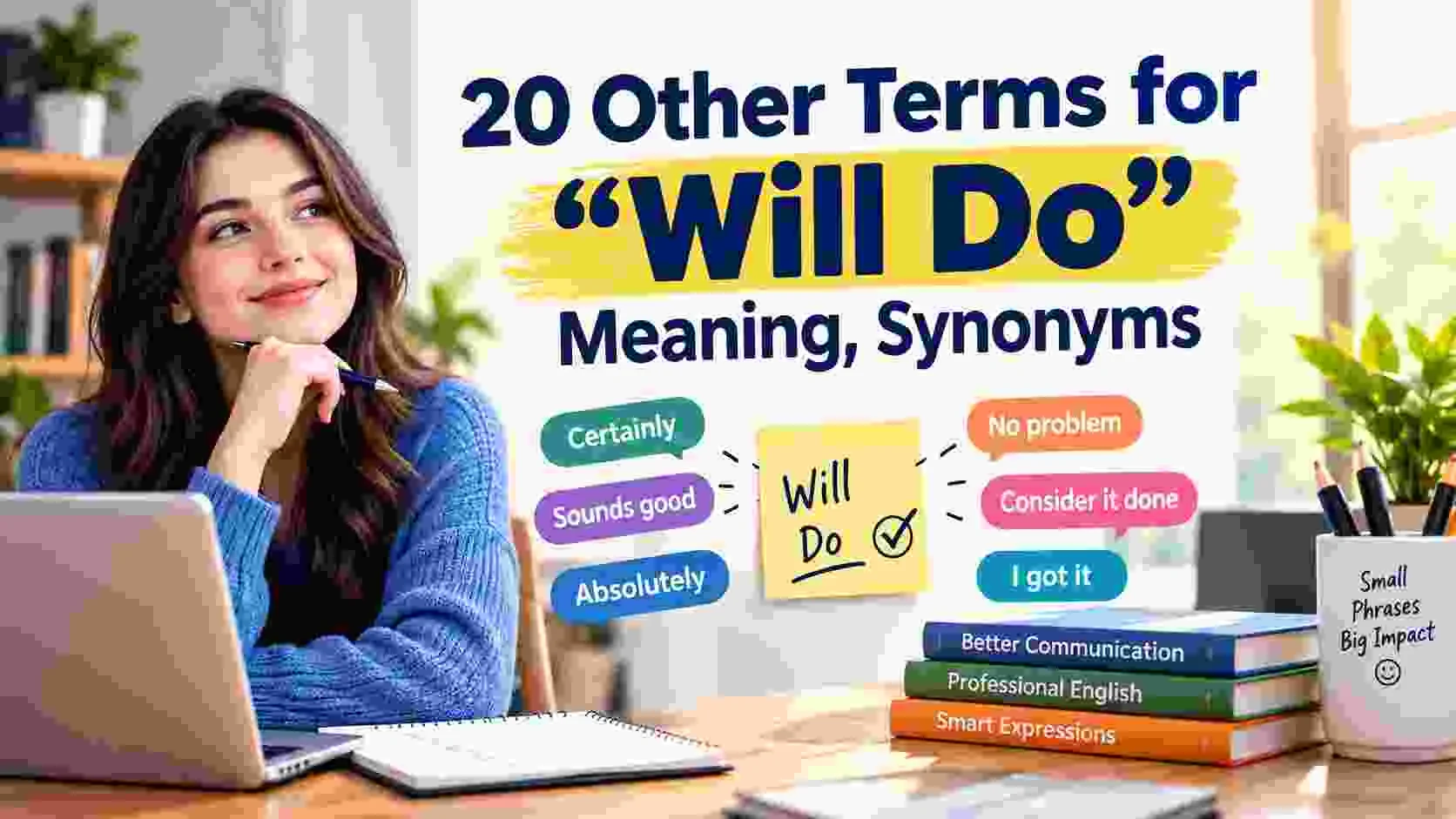
Imagine your manager sends a quick message: “Please update the client spreadsheet before 4 p.m.” You reply, “Will do.” The message is only two words, but it communicates something important: you understand the request and intend to complete it.
The phrase “will do” is common in everyday English, workplace communication, emails, meetings, and digital messages. It is useful because it is short, direct, and easy to understand. However, it can sound slightly different depending on the situation. In a friendly conversation, it may feel warm and cooperative; in a formal email, a more specific response such as “I’ll take care of it” or “I’ll complete this by 4 p.m.” may sound more polished.
Knowing alternatives to “will do” helps you choose language that matches your audience, relationship, and purpose. Whether you are a professional, student, ESL learner, writer, or someone trying to communicate more naturally in English, understanding these subtle differences can make your messages clearer and more effective.
What Does “Will Do” Mean?
“Will do” means that the speaker agrees to carry out a request, instruction, or task. It is a shortened form of saying that the person will do what has been asked. The phrase commonly appears in workplace conversations, emails, text messages, meetings, customer service exchanges, and casual discussions when confirming an intended action.
Origin & History of “Will Do”
The expression “will do” does not have a single known inventor or a separate historical origin like many idioms. Its development comes from ordinary English grammar: “will” expresses future intention or willingness, while “do” refers to carrying out an action.
The word “will” has very old Germanic roots and has long been associated with desire, intention, willingness, and future action. Over centuries, English increasingly used will as a way to express future events and deliberate action.
The word “do” is also ancient, descending from Old English dōn, meaning to perform or carry out an action.
As spoken English became increasingly economical, “will do” could function as a shortened answer to a request. Instead of saying, “Yes, I will do what you have asked,” speakers could simply say, “Will do.”
Today, the expression is especially common in fast-paced communication. Email, workplace chat, texting, and messaging platforms have made concise confirmations even more valuable. Its modern meaning remains straightforward: “I understand, and I intend to take care of it.”
Synonyms & Alternatives by Tone
Professional & Neutral Alternatives
- I’ll take care of it.
- I’ll handle it.
- I’ll get it done.
- I’ll take care of that.
- I’ll complete it.
- I’ll proceed with that.
- I’ll attend to it.
- I’ll make sure it’s done.
Polite & Supportive Alternatives
- Certainly, I’ll take care of it.
- I’d be happy to.
- Absolutely, I can do that.
- I’ll be glad to help.
- I’ll take care of that for you.
- I’ll make sure it gets done.
Encouraging & Reassuring Alternatives
- Consider it handled.
- I’ve got it.
- Leave it with me.
- I’ll make sure it’s taken care of.
- I’ll get right on it.
Casual, Playful & Idiomatic Alternatives
- Got it.
- You got it.
- Sure thing.
- No problem.
- On it.
- I’ve got you.
- Done.
- Sounds good.
When Should You Use “Will Do”?
“Will do” works best when the other person has already made the request clear. Because the phrase assumes shared context, it is particularly effective when you do not need to repeat the task.
Professional settings
In workplaces, “will do” is useful for short internal communications.
For example:
“Please send the revised proposal to Sarah before lunch.”
“Will do.”
This works well between colleagues who already understand the task. For an important client or senior executive, however, a slightly more explicit response may be preferable.
Casual conversations
The phrase is completely natural in everyday speech.
“Can you pick up some bread on your way home?”
“Will do.”
Here, the expression sounds cooperative and uncomplicated.
Writing, presentations, and digital communication
In formal writing, “will do” is less useful unless it appears in dialogue or informal correspondence. In Slack, WhatsApp, Teams, text messages, and similar platforms, it is highly practical because those channels favor concise responses.
When it is especially effective
Use “will do” when:
- The request is already clear.
- You want to confirm agreement quickly.
- The relationship is reasonably informal or familiar.
- You want to avoid unnecessary repetition.
- The task does not require additional explanation.
If timing matters, however, add the deadline:
“Will do. I’ll have it ready by 3 p.m.”
That version provides considerably more useful information.
When Should You Avoid “Will Do”?
Although “will do” is correct and natural, it is not suitable for every situation.
Overly formal situations
For highly formal correspondence, a fuller response can communicate greater care.
Instead of:
“Will do.”
Consider:
“Certainly. I’ll complete the requested revisions and send the updated document this afternoon.”
Legal, academic, or sensitive contexts
When accuracy, accountability, or documentation matters, “will do” may be too vague. It does not specify exactly what will happen, who will do it, or when it will be completed.
For example, a legal or compliance-related request may require explicit wording such as:
“I will review the document and provide my comments by Friday.”
Situations where nuance may be lost
A short “will do” can sometimes sound dismissive, especially when someone has spent considerable time explaining a complicated issue.
If the person needs reassurance, acknowledge the concern first:
“I understand the concern. I’ll review the figures and get back to you tomorrow.”
The best communication is not always the shortest communication. Clarity should come before brevity when the stakes are high.
Is “Will Do” Professional, Polite, or Casual?
“Will do” is generally neutral-to-casual rather than highly formal. It can be perfectly professional in the right workplace context, particularly in quick internal communication.
Its emotional subtext is usually cooperative. It tells the listener that the speaker has accepted the task rather than resisting or questioning it.
However, tone depends heavily on context. A friendly:
“Will do, thanks!”
feels warmer than a bare:
“Will do.”
The second response can occasionally sound abrupt if the surrounding conversation is formal or sensitive.
For professionals, the key question is not simply whether “will do” is professional, but whether it provides enough information for the situation. With a colleague, it often does. With a client, customer, executive, or formal stakeholder, a more specific response may demonstrate greater attention and accountability.
Pros and Cons of Using “Will Do”
Advantages
- Clarity: It clearly signals agreement with a request.
- Efficiency: Two words can replace a much longer confirmation.
- Accessibility: ESL learners and native speakers generally understand it immediately.
- Naturalness: It sounds normal in everyday spoken and digital English.
- Cooperation: It usually communicates willingness to help.
- Speed: It is useful when several messages are being exchanged quickly.
Potential Drawbacks
- Oversimplification: It may not identify the specific task.
- Tone mismatch: It can sound too casual in highly formal communication.
- Repetition: Frequent use can make responses feel mechanical.
- Ambiguity: It does not necessarily communicate a deadline.
- Limited accountability: It may be inadequate when precise commitments need to be documented.
Real-Life Examples of “Will Do” by Context
Emails
“Hi James, could you add the latest sales figures to the presentation before tomorrow’s meeting? Will do. I’ll update slides 6–8 and send the revised version tonight.”
The first sentence is informal but natural for internal communication. The second version is stronger because it confirms exactly what will be completed.
Meetings
“Could you send the notes to everyone after the meeting?”
“Will do.”
This is efficient when the responsibility is already obvious.
Presentations
A presenter might respond to a last-minute request:
“Please remove the old pricing slide before the client call.”
“Will do.”
The phrase confirms action without interrupting the flow of preparation.
Conversations
“Can you remind me to call Mom tonight?”
“Will do.”
This sounds completely natural in everyday English.
Social media
A creator responding to a follower might write:
“I’ll add captions to the next video.”
“Will do! Thanks for suggesting it.”
The warmer version is more appropriate for public-facing communication.
“Will Do” vs Similar Expressions: Key Differences
The following expressions are close in meaning, but they do not always communicate the same attitude.
| Phrase | Meaning Difference | Tone Difference | Best Use Scenario |
| I’ll take care of it | Promises responsibility for the task | Professional, reassuring | Workplace requests and responsibilities |
| I’ll handle it | Emphasizes taking control of the task | Confident, direct | Problems, assignments, or urgent work |
| I’ve got it | Indicates that the speaker understands and can manage the task | Casual, confident | Informal workplace or personal conversations |
| Consider it handled | Strongly reassures the listener that action will be taken | Confident, sometimes slightly polished | Customer service or reassuring communication |
| I’d be happy to | Accepts the request while emphasizing willingness | Warm, polite | Customer service, professional requests, favors |
| Absolutely | Signals strong agreement rather than specifically describing the action | Positive, enthusiastic | Conversations and friendly workplace communication |
Meaning differences
“Will do” primarily confirms intended action. “I’ll take care of it” adds responsibility, while “I’ve got it” suggests confidence. “I’d be happy to” focuses more on willingness than completion.
Tone differences
“Will do” is concise and neutral. “Absolutely” sounds enthusiastic. “I’ll handle it” is more assertive. “I’d be happy to” is warmer and more courteous.
Best-use scenarios
Choose the expression according to what you want the listener to notice: agreement, responsibility, confidence, enthusiasm, or courtesy.
Common Mistakes & Misuse of “Will Do”
Overuse
Using “will do” after every request can make your communication sound repetitive.
Instead of:
“Will do.”
“Will do.”
“Will do.”
Vary your responses naturally:
“Absolutely.”
“I’ll take care of it.”
“Got it.”
“I’ll have that ready by noon.”
Incorrect context
Avoid using the phrase when the request is unclear.
If someone says:
“Can you deal with the issue?”
A better response may be:
“Sure. Which part would you like me to handle?”
A quick “will do” could create confusion because you do not know what action is expected.
Contradictory usage
Do not say “will do” when you actually cannot complete the task.
If you need more time, say:
“I can do that, but I’ll need until tomorrow.”
This creates a realistic commitment instead of an empty confirmation.
Cultural misunderstandings
English learners sometimes assume that every short confirmation has the same level of politeness. It does not. “Will do” can be friendly among colleagues but may feel too brief when responding to a customer, professor, executive, or someone discussing a sensitive matter.
Psychological Reasons People Prefer “Will Do”
Cognitive load reduction
Short responses require less mental effort to produce and process. When a task is already understood, repeating the entire instruction adds little value.
Trust and authority signals
A concise confirmation can suggest confidence because the speaker does not appear uncertain about the task. However, confidence becomes more credible when the commitment includes useful details.
Attention economy
Modern communication involves constant notifications, meetings, emails, and messages. Short confirmations help people move through routine exchanges without unnecessary text.
Modern communication habits
Messaging platforms have normalized compact responses such as “Got it,” “On it,” “Sure,” and “Will do.” Their popularity reflects a broader shift toward conversational workplace communication.
Still, shorter is not automatically better. When accountability matters, specificity builds more trust than brevity.
US vs UK Usage of “Will Do”
“Will do” is understood and used in both American and British English. There is no major difference in its basic meaning.
In both varieties, it commonly functions as a concise confirmation of a request.
In American workplace communication, it can sound especially natural in quick exchanges:
“Can you send that over?”
“Will do.”
British speakers use it similarly, although the perceived friendliness or formality can vary according to workplace culture, relationship, and regional style.
The important distinction is not really US versus UK grammar. Context matters more than geography. In both varieties, a more formal environment may favor a complete sentence.
“Will Do” in Digital & Modern Communication
Emails
“Will do” is useful in internal emails when the task is simple and understood.
“Can you review the attached file?”
“Will do.”
For external business communication, consider adding the expected timing.
Slack / WhatsApp
This is one of the strongest environments for “will do.” Messaging is fast, conversational, and context-rich.
“Can you update the ticket when you have a minute?”
“Will do.”
Social media
The phrase can work well in replies, especially when a creator or business wants to acknowledge a suggestion.
“Can you make a video about interview questions?”
“Will do!”
AI-generated summaries
AI-generated summaries may use phrases such as “will do,” “will handle,” “will complete,” or “agreed to” when representing action items. For professional records, however, explicit wording is generally more useful:
“Action item: Maria will update the report by Friday.”
This is clearer than simply recording “Will do.”
Linguistic & Communication Insight
Emotional weight & subtext
Literally, “will do” communicates future action. Socially, it often communicates something more: acceptance, cooperation, and readiness to act.
Native speakers usually interpret it as a low-friction response. There is little emotional drama attached to it. That makes it useful for routine requests.
However, a bare “will do” can also appear detached when the situation calls for empathy.
Compare:
“Will do.”
with:
“I understand. I’ll take care of that.”
The second response recognizes both the task and the interpersonal context.
Direct vs indirect phrasing
“Will do” is relatively direct. It does not soften the commitment with unnecessary qualifiers.
Compare:
“Will do.”
with:
“I’ll see what I can do.”
The second expression introduces uncertainty. It may be appropriate when the speaker cannot guarantee the result, while “will do” communicates stronger intention.
Likewise:
“I’ll take a look when I get a chance.”
is softer but less definite than:
“Will do. I’ll review it this afternoon.”
Professional communication perspective
In professional settings, “will do” is most effective when speed matters more than ceremony. It works particularly well among teammates who have established rapport.
For clients, formal stakeholders, or important commitments, adding the action and timing usually creates a stronger impression:
“Absolutely. I’ll review the contract and send my comments by 2 p.m.”
This gives the recipient confidence that the request has been understood.
Pragmatic reasons for alternatives
Experienced communicators choose alternatives because different phrases signal different relationships.
“I’ll handle it” signals ownership.
“I’d be happy to” signals willingness.
“I’ve got it” signals confidence.
“I’ll take care of it” signals responsibility and reassurance.
“Let me take care of that” can sound more supportive.
The best alternative depends on what the listener needs to hear—not simply on whether the grammar is correct.
Social signaling
Word choice influences how people perceive cooperation, competence, warmth, and confidence.
A concise “will do” may signal efficiency. A warmer response can signal attentiveness. A detailed response can signal accountability.
Strong communicators adjust the wording according to the social purpose of the message.
Tone & context guidance
Use “will do” when:
- The request is clear.
- The relationship is familiar.
- The task is straightforward.
- Speed matters.
- A concise confirmation is enough.
Consider an alternative when:
- The recipient expects formal communication.
- The request involves a sensitive matter.
- A deadline needs confirmation.
- The task has multiple parts.
- The commitment needs to be documented.
I’ll Take Care of It
Meaning: “I’ll take care of it” means that you accept responsibility for completing or resolving something that has been requested. It is slightly more explicit than “will do” because it emphasizes ownership of the task.
Why This Phrase Works: It reassures the listener that the matter has been assigned to someone who intends to manage it. It is particularly effective when the other person wants confidence that they no longer need to worry about the task.
Real-World Usage Insight: In workplace English, this expression often sounds more polished than “will do” without becoming excessively formal. It can also work well in customer service because it communicates responsibility.
Best Use: Workplace requests, customer support, project responsibilities, and routine professional communication.
Avoid When: You cannot actually take responsibility for the entire matter or when another person must make the final decision.
Tone: Professional, reassuring, responsible, and cooperative.
US vs UK Usage: Common and natural in both American and British English, with no significant difference in meaning.
Example (Email / Message / Meeting):
“Thanks for flagging the missing figures, Priya. I’ll take care of it and send you the corrected spreadsheet before the client call.”
I’ll Handle It
Meaning: “I’ll handle it” means that you will take responsibility for dealing with a particular task, problem, or situation.
Why This Phrase Works: It communicates confidence and ownership. Unlike the more neutral “will do,” it suggests that the speaker is capable of managing the situation without needing much additional assistance.
Real-World Usage Insight: The phrase is particularly useful when something has gone wrong or needs immediate attention. It can quickly reassure colleagues that someone has accepted responsibility.
Best Use: Problems, urgent requests, workplace responsibilities, operational tasks, and situations requiring initiative.
Avoid When: The situation requires collaboration and saying “I’ll handle it” might imply that others should not participate.
Tone: Direct, confident, capable, and professional.
US vs UK Usage: Widely used in both US and UK English.
Example (Email / Message / Meeting):
“Customer Support has already escalated the billing issue. I’ll handle it with Finance and update the team once we know what happened.”
I’ll Get It Done
Meaning: “I’ll get it done” communicates a firm intention to complete a task or achieve a result.
Why This Phrase Works: It focuses on completion rather than simply acknowledging a request. The expression can therefore sound more determined than “will do.”
Real-World Usage Insight: This wording is common when someone wants to reassure others that a deadline or deliverable will not be overlooked.
Best Use: Deadlines, projects, assignments, and situations where completion matters.
Avoid When: The outcome depends on factors outside your control and a firm promise could be misleading.
Tone: Determined, confident, practical, and slightly informal.
US vs UK Usage: Natural in both varieties of English.
Example (Email / Message / Meeting):
“The report is longer than expected, but I’ll get it done tonight and leave the final version in the shared folder before tomorrow’s meeting.”
I’ve Got It
Meaning: “I’ve got it” means that you understand the task and are prepared to manage it yourself.
Why This Phrase Works: It is short and reassuring while also conveying confidence. It often tells the other person that they do not need to explain further.
Real-World Usage Insight: Native speakers frequently use this in fast workplace exchanges and everyday conversations. It is especially natural when the person has already explained the task.
Best Use: Informal workplaces, conversations, teamwork, and straightforward requests.
Avoid When: Writing to a highly formal recipient or documenting a serious professional commitment.
Tone: Casual, confident, friendly, and efficient.
US vs UK Usage: Common in both American and British English, although exact levels of informality vary by workplace.
Example (Email / Message / Meeting):
“Can you upload the final images once Marketing approves them?”
“I’ve got it. I’ll upload everything after lunch.”
Consider It Handled
Meaning: “Consider it handled” means that the speaker is confidently assuring someone that the requested matter will be dealt with.
Why This Phrase Works: It provides strong reassurance. The expression does more than acknowledge the request; it tells the listener that they can regard the matter as under control.
Real-World Usage Insight: This phrase is often more polished than “will do” and can sound particularly effective in service-oriented communication.
Best Use: Customer service, management, workplace reassurance, and situations requiring confidence.
Avoid When: You are uncertain whether you can complete the task or when the matter requires shared responsibility.
Tone: Confident, reassuring, polished, and moderately formal.
US vs UK Usage: Understood in both regions. It may sound slightly more idiomatic in American business communication.
Example (Email / Message / Meeting):
“Thanks for pointing out the incorrect invoice. Consider it handled—I’ve asked Accounts to issue the corrected version today.”
I’d Be Happy To
Meaning: “I’d be happy to” expresses willingness to perform a requested action while emphasizing a positive attitude toward helping.
Why This Phrase Works: It adds warmth that “will do” does not necessarily provide. It is useful when the relationship or situation calls for courtesy.
Real-World Usage Insight: This phrase is especially effective when responding to customers, clients, teachers, colleagues, or people making a polite request.
Best Use: Customer service, professional favors, helpful offers, and courteous workplace communication.
Avoid When: The situation is extremely urgent, and a more direct commitment is needed.
Tone: Warm, polite, supportive, and professional.
US vs UK Usage: Very common in both American and British English.
Example (Email / Message / Meeting):
“Would you be able to walk me through the new reporting dashboard?”
“I’d be happy to. I’m free for 20 minutes after the team meeting.”
Absolutely
Meaning: “Absolutely” is a strong affirmative response that communicates clear agreement, approval, or willingness.
Why This Phrase Works: It adds enthusiasm and confidence. It can make a short response sound more energetic than “will do.”
Real-World Usage Insight: The phrase is useful when you want the other person to feel that their request is welcome rather than merely accepted.
Best Use: Friendly professional communication, conversations, customer service, and positive responses.
Avoid When: You need to specify the exact action or deadline.
Tone: Positive, enthusiastic, confident, and friendly.
US vs UK Usage: Common in both varieties of English.
Example (Email / Message / Meeting):
“Could you include the accessibility notes in the next draft?”
“Absolutely. I’ll add them before I send the update.”
I’ll Make Sure It’s Done
Meaning: “I’ll make sure it’s done” emphasizes that the speaker will ensure the requested task reaches completion.
Why This Phrase Works: It provides more reassurance than “will do” because it focuses on ensuring the final result rather than merely expressing intention.
Real-World Usage Insight: This is useful when a manager, client, or colleague needs confidence that a task will not be forgotten.
Best Use: Deadlines, project management, follow-ups, and important workplace tasks.
Avoid When: You cannot reasonably control whether the task will be completed.
Tone: Responsible, reassuring, professional, and confident.
US vs UK Usage: Natural in both American and British English.
Example (Email / Message / Meeting):
“I know the supplier needs the updated purchase order today. I’ll make sure it’s done before 4 p.m.”
I’ll See to It
Meaning: “I’ll see to it” means that you will take responsibility for dealing with or completing something.
Why This Phrase Works: It communicates attention and responsibility while sounding somewhat more formal than “will do.”
Real-World Usage Insight: The expression is natural but less common in casual digital messaging than “I’ll handle it” or “I’ve got it.” It can work well in professional or service-oriented contexts.
Best Use: Professional communication, formal conversations, customer service, and situations requiring reassurance.
Avoid When: You want an especially casual or conversational tone.
Tone: Professional, responsible, slightly formal.
US vs UK Usage: Used in both regions, although some speakers may perceive it as somewhat traditional.
Example (Email / Message / Meeting):
“Thank you for bringing the scheduling issue to my attention. I’ll see to it and confirm the revised time shortly.”
I’ll Take Care of That
Meaning: “I’ll take care of that” means that the speaker agrees to manage a particular request or task.
Why This Phrase Works: The word “that” refers directly to something already discussed, making the response concise while still emphasizing responsibility.
Real-World Usage Insight: It is particularly natural when someone has just identified a small task that needs to be completed.
Best Use: Workplace conversations, emails, customer interactions, and routine requests.
Avoid When: The listener may not know which task “that” refers to.
Tone: Professional, helpful, reassuring, and conversational.
US vs UK Usage: Common in both US and UK English.
Example (Email / Message / Meeting):
“Could you update the contact name on the invoice?”
“Sure. I’ll take care of that before I resend it.”
Leave It With Me
Meaning: “Leave it with me” means that the speaker is asking the other person to let them take responsibility for a task or problem.
Why This Phrase Works: It sounds reassuring and collaborative without being overly formal. It can reduce the listener’s concern by making responsibility clear.
Real-World Usage Insight: The expression is especially natural in British English but is also understood in American English.
Best Use: Professional conversations, service situations, teamwork, and requests requiring reassurance.
Avoid When: You cannot realistically take ownership of the task.
Tone: Reassuring, friendly, capable, and conversational.
US vs UK Usage: Used in both, but it is particularly associated withthe British workplace and everyday speech.
Example (Email / Message / Meeting):
“The client is worried about the missing confirmation.”
“Leave it with me. I’ll call the supplier and find out what’s happening.”
Got It
Meaning: “Got it” means that the speaker understands what has been said or requested. It can also imply acceptance of an instruction.
Why This Phrase Works: It is extremely concise and natural in modern conversation. It confirms understanding without repeating the entire request.
Real-World Usage Insight: “Got it” confirms understanding more strongly than completion. If you need to promise action, “I’ve got it” or “Will do” may be clearer.
Best Use: Chats, meetings, conversations, instructions, and informal workplace communication.
Avoid When: The recipient needs confirmation that the task will definitely be completed.
Tone: Casual, direct, friendly, and efficient.
US vs UK Usage: Very common in both American and British English.
Example (Email / Message / Meeting):
“Please use the latest version of the template, not the one from last month.”
“Got it. I’ll use the new one.”
Sure Thing
Meaning: “Sure thing” is an informal way of saying yes or agreeing to a request.
Why This Phrase Works: It sounds friendly and cooperative. It is less focused on formal responsibility and more focused on an easy, positive acceptance.
Real-World Usage Insight: It is particularly common in casual conversations and friendly workplace environments.
Best Use: Texting, informal conversations, friendly colleagues, and everyday requests.
Avoid When: Writing highly formal business correspondence or communicating a serious commitment.
Tone: Casual, warm, upbeat, and friendly.
US vs UK Usage: Common in American English and understood in British English, though the exact frequency can vary.
Example (Email / Message / Meeting):
“Can you grab a copy of the agenda for me?”
“Sure thing. I’ll bring one to the meeting.”
No Problem
Meaning: “No problem” communicates agreement, reassurance, or acceptance of a request. It can also mean that the speaker does not consider the task troublesome.
Why This Phrase Works: It reduces social friction and makes the requester feel that their request is acceptable.
Real-World Usage Insight: The phrase is extremely common in everyday English, although some professional settings prefer “Certainly” or “Happy to help” because they can sound more polished.
Best Use: Casual conversations, friendly workplaces, customer interactions, and routine favors.
Avoid When: Responding to serious complaints where “no problem” could unintentionally minimize someone’s concern.
Tone: Casual, reassuring, friendly, and relaxed.
US vs UK Usage: Widely understood in both US and UK English.
Example (Email / Message / Meeting):
“Sorry for the late request. Could you resend the attachment?”
“No problem. I’ve just sent it over.”
On It
Meaning: “On it” means that the speaker has started or is about to start working on the requested task.
Why This Phrase Works: It is even more immediate than “will do.” It suggests that action is happening now rather than merely being planned.
Real-World Usage Insight: This phrase is particularly common in workplace messaging because it provides a fast status signal.
Best Use: Slack, Teams, WhatsApp, text messages, and fast-moving work environments.
Avoid When: Communicating formally with clients or documenting detailed responsibilities.
Tone: Very concise, energetic, informal, and action-oriented.
US vs UK Usage: Common and easily understood in both varieties.
Example (Email / Message / Meeting):
“Can someone check whether the webinar link is working?”
“On it. I’m testing it now.”
You Got It
Meaning: “You got it” is an informal expression meaning yes, certainly, or I will do that.
Why This Phrase Works: It combines agreement with a friendly attitude. It often makes the interaction feel more personal than a neutral “will do.”
Real-World Usage Insight: The phrase is particularly common in conversational American English and informal service interactions.
Best Use: Friendly conversations, casual customer service, informal workplace communication, and everyday requests.
Avoid When: Writing formal academic, legal, or executive correspondence.
Tone: Friendly, casual, positive, and confident.
US vs UK Usage: Very common in American English and understood in British English, although it can feel more distinctly American to some British speakers.
Example (Email / Message / Meeting):
“Can you save me a seat near the front?”
“You got it. I’ll get there a few minutes early.”
Comparison Table of 10 Best Alternatives
The best alternative depends on whether you want to emphasize responsibility, confidence, warmth, urgency, or simple agreement. The table below provides a quick way to choose language that matches the situation.
| Phrase | Meaning | Best Use | Worst Use | Tone | US vs UK Usage |
| I’ll take care of it | Accepts responsibility for a task | Professional requests | When ownership is unclear | Professional, reassuring | Common in both |
| I’ll handle it | Promises to manage something | Problems and responsibilities | Collaborative tasks needing shared ownership | Confident, direct | Common in both |
| I’ll get it done | Promises completion | Deadlines and deliverables | Uncertain outcomes | Determined, confident | Common in both |
| I’ve got it | Shows understanding and confidence | Informal workplace exchanges | Highly formal communication | Casual, capable | Common in both |
| Consider it handled | Strongly assures completion | Customer service and management | Uncertain commitments | Polished, confident | Both; somewhat business-oriented |
| I’d be happy to | Shows willingness to help | Polite requests | Very urgent instructions | Warm, courteous | Common in both |
| Absolutely | Gives strong agreement | Positive professional exchanges | When action details are necessary | Enthusiastic | Common in both |
| Got it | Confirms understanding | Chats and instructions | When completion must be guaranteed | Casual, direct | Common in both |
| Sure thing | Friendly agreement | Informal conversations | Formal business writing | Casual, upbeat | More common in US English |
| On it | Signals immediate action | Fast-paced digital communication | Formal correspondence | Informal, energetic | Common in both |
Conclusion
Understanding “will do” is useful because this short phrase can communicate agreement, willingness, and an intention to complete a task without unnecessary explanation. Its simplicity makes it especially effective in everyday conversations, workplace chats, emails, meetings, and other fast-paced forms of communication. However, its level of formality and emotional impact depends on the audience and context.
For professional situations, alternatives such as “I’ll take care of it,” “I’ll handle it,” or “I’ll make sure it’s done” can provide greater clarity and accountability. In friendly conversations, expressions such as “Got it,” “Sure thing,” or “You got it” may sound more natural and approachable. The important point is to choose language that reflects your intention rather than relying on the same response every time.
Ultimately, “will do” is correct, natural, and versatile, but it is not universally appropriate. Understanding its alternatives helps professionals, students, ESL learners, and writers communicate with greater precision, confidence, and awareness of tone.
FAQs
What does “will do” mean?
“Will do” means “I will do what you have asked.” It is a concise way to confirm that you understand a request and intend to complete it. The phrase is commonly used in conversations, workplace messages, emails, meetings, and informal communication when the requested task is already clear from the context.
Is “will do” grammatically correct?
Yes, “will do” is grammatically correct. It is an abbreviated response in which the rest of the sentence is understood from context. For example, after someone says, “Please send me the report,” replying “Will do” means “I will send you the report.” It is natural in conversational and informal professional English.
Is “will do” professional?
“Will do” can be professional, particularly in quick communication between colleagues or team members. However, it is relatively informal and may be too brief for highly formal correspondence. In client-facing or important business communication, “I’ll take care of it” or “I’ll complete this by Friday” can provide a more polished and specific response.
Is “will do” polite?
Yes, “will do” is generally polite and cooperative when used in an appropriate context. It confirms willingness to follow through on a request. However, a very brief response can sometimes feel abrupt, particularly when someone has raised a sensitive issue. Adding “Certainly,” “Absolutely,” or a specific commitment can make the response warmer.
What are the best synonyms for “will do”?
Useful alternatives include “I’ll take care of it,” “I’ll handle it,” “I’ll get it done,” “I’ve got it,” “I’d be happy to,” “Consider it handled,” “Got it,” and “On it.” The best choice depends on the desired tone. Some emphasize responsibility, while others communicate friendliness, confidence, or immediate action.
Can I use “will do” in an email?
Yes, you can use “will do” in emails, especially when communicating with colleagues or people you know well. For formal or client-facing emails, a more specific response is often better. For example, instead of “Will do,” you could write, “Certainly. I’ll review the document and send the revised version by 3 p.m.”
Is “will do” formal or informal?
“Will do” is generally neutral to informal. It is more conversational than highly formal expressions such as “I will attend to the matter.” Its suitability depends on the relationship and communication channel. It works naturally in workplace chats and everyday conversations but may be less appropriate for legal, academic, or highly formal documents.
What is the difference between “will do” and “I’ll take care of it”?
Both phrases indicate that you intend to complete a requested task, but “I’ll take care of it” emphasizes responsibility and ownership more strongly. “Will do” is shorter and more conversational, while “I’ll take care of it” can sound more reassuring and professional, particularly when someone wants confirmation that a matter is under control.
Is “will do” used in American and British English?
Yes. “Will do” is used and understood in both American and British English. There is no major difference in its basic meaning. Some alternatives may have different regional preferences—for example, “sure thing” can sound particularly American, while “leave it with me” is especially familiar in British English—but “will do” is broadly understood.
What should I say instead of “will do” in a formal email?
For a formal email, consider “Certainly, I’ll take care of this,” “I’ll complete the requested task,” or “I’ll review this and provide an update by [time/date].” These alternatives make your response more precise and professional. When deadlines or responsibilities matter, mentioning the specific action and timing is usually better than using a short confirmation alone.

Leave a Reply