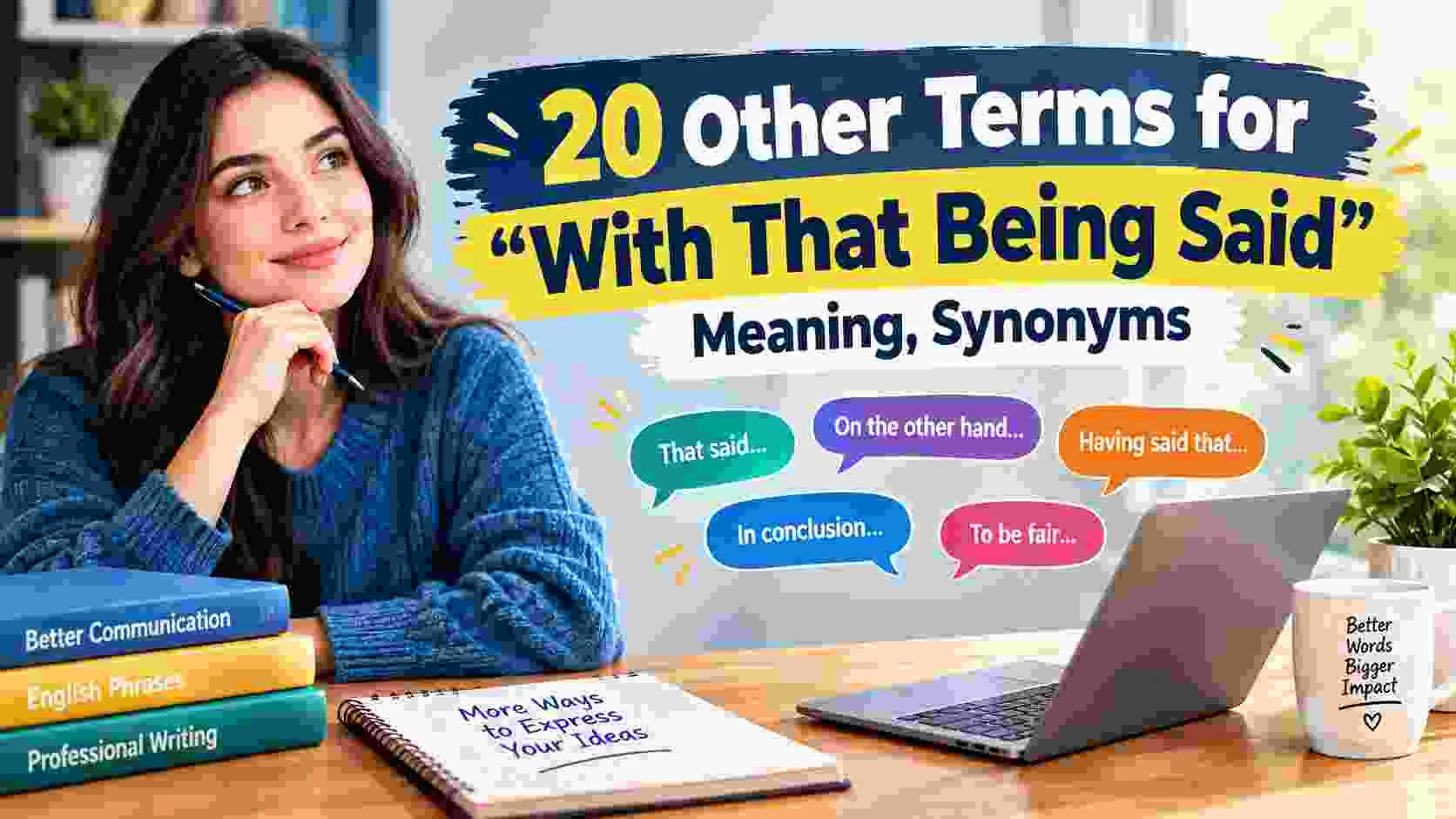
Imagine you are in a team meeting. You have just explained why a project deadline may need to move, but you also want everyone to understand that the work is still progressing well. You might say, “The schedule is tight. With that being said, we are still on track to finish the most important tasks this week.”
The phrase “with that being said” is commonly used when someone wants to acknowledge a previous point before introducing another thought, qualification, exception, or contrasting idea. It helps speakers and writers move from one point to another without making the transition sound abrupt.
However, it is not always the best choice. In a professional email, a shorter expression such as “however,” “that said,” or “at the same time” may sound cleaner. In a friendly conversation, “still” or “even so” may feel more natural.
Understanding these differences matters because effective communication is not only about choosing words that are grammatically correct. The same idea can sound professional, cautious, warm, direct, or conversational depending on the transition you use.
What Does “With That Being Said” Mean?
“With that being said” is a transition used to acknowledge or accept a previous point before introducing another point, often one that qualifies, contrasts with, or adds to what was just stated. It is common in conversations, professional communication, presentations, essays, and online writing when the speaker wants to shift direction without completely rejecting the earlier idea.
In simple terms, “with that being said” means “considering what I just said, here is another point you should also consider.”
For example:
The new software is more expensive than our current system. With that being said, it offers several features that could reduce manual work.
The first sentence presents one fact. The second sentence introduces another fact that changes or balances how the first point should be understood.
The expression can therefore serve several purposes:
- Introducing a qualification
- Adding a contrasting point
- Balancing criticism with a positive observation
- Moving from one argument to another
- Softening a change in direction
- Showing that two ideas can be true at the same time
Origin & History of “With That Being Said”
The exact phrase does not have a single documented inventor or a specific historical event associated with its creation. Instead, it developed naturally from older English patterns involving “that being said,” “having said that,” and similar constructions used to acknowledge a preceding statement before moving to another point.
The structure is closely related to the grammatical use of participial phrases such as “that being said” and “having said that.” These constructions allow speakers to refer back to something already expressed while preparing the listener for a new statement.
Over time, the expression became increasingly common in spoken English, business communication, interviews, presentations, blogs, and online discussions. Its modern function is largely pragmatic: it tells the audience that the next statement should be considered alongside the previous one.
The phrase became particularly noticeable in contemporary professional and conversational English because modern communication frequently requires people to balance competing considerations. A manager may praise an employee while identifying an area for improvement. A writer may recognize a criticism before presenting a counterargument. A customer-service representative may acknowledge a problem while explaining a solution.
There is also a practical reason for its continued popularity: it gives speakers a ready-made transition between related ideas. However, because it is now so familiar, frequent repetition can make writing sound formulaic.
Synonyms & Alternatives by Tone
There is no perfect synonym for every situation. The best alternative depends on whether you want to sound neutral, formal, supportive, conversational, or strongly contrasting.
Professional & Neutral Alternatives
- However
- That said
- Having said that
- Nevertheless
- Nonetheless
- At the same time
- On the other hand
- With this in mind
- Even so
- Despite that
- All things considered
Polite & Supportive Alternatives
- That being said
- At the same time
- With this in mind
- Even so
- Still
- Having said that
Encouraging & Reassuring Alternatives
- Even so
- Still
- At the same time
- With this in mind
- All things considered
- That said
Casual, Playful & Idiomatic Alternatives
- Still
- Even so
- Then again
- That said
- On the other hand
- At the same time
- Be that as it may
20 useful alternatives at a glance
- However
- That said
- Having said that
- Nevertheless
- Nonetheless
- Even so
- Still
- On the other hand
- At the same time
- With this in mind
- Despite that
- That notwithstanding
- All things considered
- Be that as it may
- Notwithstanding this
- Then again
- In contrast
- By the same token
- Conversely
- Yet
When Should You Use “With That Being Said”?
The expression works best when two related ideas need to coexist. It is especially useful when you do not want your second point to completely cancel the first.
Professional settings
You can use it in workplace conversations when acknowledging a concern before adding another perspective.
Example:
The first proposal is easier to implement. With that being said, the second proposal gives us more flexibility over the long term.
It can work well in meetings, presentations, internal messages, and less formal business writing.
Casual conversations
In everyday speech, the phrase can introduce a qualification naturally.
I don’t love the new restaurant. With that being said, the desserts were excellent.
However, casual speakers may simply say “still,” “but,” “even so,” or “that said.”
Writing and presentations
The expression can help organize an argument when a writer wants to recognize one side before moving toward another.
It is particularly useful in:
- Opinion articles
- Blog posts
- Business reports
- Presentations
- Reviews
- Explanatory writing
- Interviews
- Long-form discussions
Digital communication
In emails, Slack messages, and social media posts, it can signal that the writer is not ignoring the previous point.
Use it especially when the transition itself matters. If the relationship between the two sentences is obvious, a shorter word such as “however” may be more efficient.
When Should You Avoid “With That Being Said”?
Although grammatically acceptable, the phrase is not suitable for every situation.
Overly formal situations
Highly formal writing may benefit from a more precise transition. Academic or technical prose often works better with “however,” “nevertheless,” “in contrast,” or a direct statement of the relationship between ideas.
Legal, academic, or sensitive contexts
In legal or highly technical writing, vague transitions can sometimes obscure exactly how two statements relate.
Instead of:
With that being said, the agreement remains valid.
A more precise sentence might be:
However, the agreement remains valid under the conditions stated above.
Precision matters more than conversational smoothness in these contexts.
Situations where nuance may be lost
Avoid the expression if the second point does not actually qualify, contrast with, or meaningfully extend the first.
For example:
The meeting starts at 10 a.m. With that being said, please bring your laptop.
There is no meaningful relationship between the two statements. A simple transition—or no transition at all—would be clearer.
Is “With That Being Said” Professional, Polite, or Casual?
“With that being said” is generally neutral to moderately conversational. It is not inherently informal, rude, or unprofessional.
Its tone depends heavily on context.
| Situation | Perceived Tone |
| Workplace meeting | Professional and conversational |
| Business email | Neutral to moderately conversational |
| Academic essay | Acceptable but sometimes wordier than necessary |
| Casual conversation | Natural but somewhat deliberate |
| Social media | Conversational |
| Legal writing | Usually less precise than preferred |
| Presentation | Clear and transitional |
The phrase often carries a subtle message: “I recognize what I just said, but there is another side worth considering.”
That can make it sound diplomatic.
However, if used repeatedly, it may begin to sound rehearsed. Experienced communicators often vary their transitions rather than relying on one familiar expression.
Pros and Cons of Using “With That Being Said”
Advantages
Clarity: It signals that the speaker is moving from one point to another.
Efficiency: It provides a quick way to connect two related ideas.
Accessibility: Most fluent English speakers understand its purpose immediately.
Balance: It can prevent a second point from sounding like a complete rejection of the first.
Diplomacy: It can soften disagreement by acknowledging the preceding statement.
Potential Drawbacks
Oversimplification: The phrase does not always explain exactly how two ideas are connected.
Tone mismatch: It may sound too conversational in highly formal or technical writing.
Repetition: Frequent use can make content feel formulaic.
Wordiness: In some sentences, “however,” “still,” or “that said” communicates the same relationship more efficiently.
Weak transitions: If the ideas are not genuinely connected, the phrase can feel like filler.
Real-Life Examples of “With That Being Said” by Context
Emails
Thanks for walking us through the revised proposal. The budget looks manageable. With that being said, I’d like us to review the maintenance costs before we approve it.
This sounds professional without being excessively formal.
Meetings
We’ve made good progress on the redesign. With that being said, we’re still behind on mobile testing.
The phrase helps the speaker recognize progress while raising a concern.
Presentations
Customer satisfaction increased by 12% this quarter. With that being said, response times remain an area we need to improve.
Here, the transition creates a balanced interpretation rather than presenting the results as entirely positive.
Conversations
I enjoyed the movie. With that being said, I thought the ending felt rushed.
The expression works when the speaker wants to give a mixed opinion.
Social media
Working from home gives me much more flexibility. With that being said, I’ve realized I need to be much more intentional about separating work from personal time.
This style is common in reflective online writing.
“With That Being Said” vs Similar Expressions
The alternatives below overlap in meaning, but they are not interchangeable in every sentence.
| Phrase | Meaning Difference | Tone Difference | Best Use Scenario |
| However | Introduces a direct contrast or qualification | Professional, concise | Business and academic writing |
| That said | Acknowledges the previous point before adding another | Natural, polished | Emails, articles, conversations |
| Having said that | Similar to acknowledging a previous statement | Conversational and thoughtful | Discussion and informal writing |
| Nevertheless | Introduces a point that remains true despite what came before | More formal | Reports, essays, formal arguments |
| Even so | Shows that the second point remains true despite the first | Conversational | Everyday speech and informal writing |
| On the other hand | Presents a different side or alternative perspective | Neutral and explanatory | Comparisons and balanced arguments |
The key distinction is that “however” usually creates a sharper contrast, while “that said” and “having said that” often sound more conversational. “Nevertheless” is more formal, while “even so” tends to sound more natural in everyday conversation.
Common Mistakes & Misuse of “With That Being Said”
Overuse
Using the expression every few paragraphs can make an article, report, or presentation sound repetitive.
Instead of:
The service is affordable. With that being said, the interface is dated. With that being said, the support team is responsive.
Vary the transitions:
The service is affordable. However, the interface is dated. Fortunately, the support team is responsive.
Incorrect context
The phrase should connect ideas that have some logical relationship.
If the second sentence has nothing to do with the first, the transition feels artificial.
Contradictory usage
The phrase does not automatically mean “but.” Sometimes the following statement is an addition rather than a contradiction.
Compare:
The laptop is expensive. With that being said, it has excellent battery life.
This works because the second fact qualifies the first.
Cultural misunderstandings
ESL learners may assume that the phrase is a direct synonym for “but.” That is not always accurate.
“But” can introduce a simple contrast:
I wanted to go, but I was busy.
“With that being said” usually refers back to a previous idea and frames the next statement as an additional consideration.
Psychological Reason People Prefer “With That Being Said”
People often prefer this expression because it makes conversational transitions predictable.
Cognitive load reduction
Listeners do not have to work as hard to understand that the speaker is changing direction. The phrase acts as a familiar signal that another perspective is coming.
Trust and authority signals
Acknowledging a previous point before introducing a qualification can make communication sound balanced. A manager who says:
The team has done excellent work. With that being said, we need to address the missed deadline.
sounds different from someone who immediately says:
We missed the deadline.
The first version explicitly recognizes both sides.
Attention economy
Modern communication often involves short attention spans and rapid shifts between topics. Familiar transition phrases help readers follow the structure of an argument quickly.
Modern communication habits
Podcasts, presentations, meetings, social media posts, interviews, and business videos frequently use transitional language. As a result, expressions like this have become recognizable conversational tools.
The important point is that a familiar phrase is useful only when it adds structure. If it merely fills space, removing it usually improves the sentence.
US vs UK Usage of “With That Being Said”
The expression is understood in both American and British English. There is no major difference in its basic meaning between the two varieties.
Popularity
It appears regularly in American and British workplace communication, online writing, interviews, and conversation.
Tone perception
American speakers may use it naturally in presentations, business discussions, and informal explanations. British speakers also understand and use it, although alternatives such as “having said that,” “that said,” “however,” and “nevertheless” may appear depending on the speaker and context.
Regional preferences
The differences are generally matters of individual style rather than strict regional grammar rules.
For ESL learners, the safest approach is simple: focus on context and tone rather than trying to assign the phrase exclusively to American or British English.
“With That Being Said” in Digital & Modern Communication
Emails
In professional emails, the phrase can soften a transition between praise and criticism.
The campaign performed better than expected. With that being said, we should review the cost per acquisition before increasing the budget.
For short emails, “however” or “that said” may be more concise.
Slack and WhatsApp
Digital messaging often favors shorter expressions.
Instead of:
With that being said, I can join after 3.
A colleague might naturally write:
That said, I can join after 3.
Or simply:
I can join after 3, though.
Social media
The phrase is common in reflective posts where someone presents a balanced opinion.
The job has been challenging. With that being said, I’ve learned more this year than I expected.
AI-generated summaries
AI-generated writing frequently uses transitions such as “with that being said,” “however,” and “that said.” Because these expressions are common in polished explanatory writing, excessive use can sometimes make generated content feel repetitive.
For human writers, the best practice is to choose the transition based on the exact relationship between ideas rather than automatically inserting a familiar phrase.
Linguistic & Communication Insight
Emotional Weight & Subtext
The literal meaning of the phrase is relatively simple, but native speakers often perceive an additional social message.
It can suggest:
“I am not ignoring the previous point.”
That matters when discussing criticism, disagreement, uncertainty, or mixed results.
For example:
The employee needs to improve their reporting. With that being said, they have handled several difficult clients exceptionally well.
The transition makes the criticism feel more balanced because the speaker deliberately acknowledges another side.
However, the phrase can sometimes sound like a warning that a disagreement is coming. Depending on delivery, listeners may mentally prepare for a qualification.
Direct vs Indirect Phrasing
Consider these versions:
The proposal is too expensive, but the strategy is promising.
The proposal is too expensive. With that being said, the strategy is promising.
The proposal is too expensive. However, the strategy is promising.
The first is direct. The second is more conversational and deliberately transitional. The third is concise and professional.
This difference matters because communication is not only about information. It is also about how the listener receives the information.
Professional Communication Perspective
In the workplace, the phrase can be useful when discussing mixed outcomes or sensitive feedback.
It can support collaboration because it signals that the speaker is considering more than one perspective.
Still, experienced professionals often replace it with a more specific transition when precision matters.
For example:
- However = direct contrast
- At the same time = two truths coexist
- With this in mind = the next point follows from the previous information
- Nevertheless = the next point remains true despite an obstacle
- That said = conversational acknowledgment before a new point
Pragmatic Reasons for Alternatives
Professionals may choose alternatives because they want to communicate a precise relationship between ideas.
A project manager might say “however” when correcting an assumption.
A consultant might use “with this in mind” when turning evidence into a recommendation.
A colleague might use “that said” to disagree without sounding confrontational.
An academic writer might prefer “nevertheless” because it fits a formal argument.
The choice therefore depends on the communicative goal.
Social Signaling
Word choice influences how readers perceive confidence, openness, authority, and cooperation.
A blunt:
You’re wrong.
creates a very different social signal from:
I understand your point. That said, I see the situation differently.
The second version does not necessarily change the disagreement, but it changes how the disagreement is presented.
Tone & Context Guidance
Use the expression when:
- You want to acknowledge a previous idea.
- You are introducing a qualification.
- You want to balance criticism with another observation.
- The audience benefits from a visible transition.
- The communication is conversational or moderately professional.
Consider an alternative when:
- The writing is highly formal.
- The connection between ideas needs to be exact.
- You are using the phrase repeatedly.
- A shorter transition would be clearer.
- The second statement does not actually relate to the first.
Meaning, Usage & Examples for Each Alternative
However
Meaning: “However” introduces a contrast, exception, or qualification to a previous statement.
Why This Phrase Works: It is concise and immediately tells the reader that the next idea differs from or limits the previous one.
Real-World Usage Insight: In professional writing, “however” is often preferable when you want clarity without the conversational length of “with that being said.”
Best Use: Business emails, reports, academic writing, presentations, and formal explanations.
Avoid When: You are not actually presenting a contrast or qualification.
Tone: Professional, neutral, direct.
US vs UK Usage: Very common in both American and British English.
Example (Email / Message / Meeting):
The vendor can deliver the equipment by Friday. However, installation will probably take another two days.
That Said
Meaning: “That said” acknowledges the previous statement before introducing another consideration.
Why This Phrase Works: It is shorter and more natural than many longer transition phrases.
Real-World Usage Insight: It is especially useful when you want to sound thoughtful without making your writing overly formal.
Best Use: Emails, meetings, articles, reviews, and everyday professional communication.
Avoid When: A highly formal document requires a more precise logical connector.
Tone: Polished, conversational, professional.
US vs UK Usage: Common and easily understood in both varieties of English.
Example (Email / Message / Meeting):
The first draft still needs some work. That said, the overall structure is much stronger than the previous version.
Having Said That
Meaning: “Having said that” refers back to something already stated before introducing a qualification or different perspective.
Why This Phrase Works: It clearly signals that the speaker has considered the earlier point rather than abandoning it.
Real-World Usage Insight: It sounds natural when someone is thinking through a mixed opinion or carefully balancing two sides.
Best Use: Conversations, interviews, meetings, opinion writing, and reflective posts.
Avoid When: You need a very concise transition.
Tone: Conversational, thoughtful, moderately professional.
US vs UK Usage: Widely understood and used in both American and British English.
Example (Email / Message / Meeting):
The training was longer than I expected. Having said that, I found the practical exercises genuinely useful.
Nevertheless
Meaning: “Nevertheless” means that something remains true despite a previous fact, problem, or objection.
Why This Phrase Works: It establishes a stronger relationship of contrast and persistence.
Real-World Usage Insight: It is useful when you want to emphasize that an obstacle does not change the conclusion.
Best Use: Formal reports, essays, professional analysis, and structured arguments.
Avoid When: The context is highly casual and conversational.
Tone: Formal, authoritative, precise.
US vs UK Usage: Standard in both American and British English.
Example (Email / Message / Meeting):
The first test revealed several problems. Nevertheless, the team decided to proceed with the pilot.
Nonetheless
Meaning: “Nonetheless” introduces a statement that remains valid despite what was previously mentioned.
Why This Phrase Works: It creates a clear contrast while maintaining a professional tone.
Real-World Usage Insight: It is especially useful when the writer wants to emphasize resilience, continuation, or an outcome that was not prevented by an earlier difficulty.
Best Use: Reports, essays, presentations, business writing, and formal commentary.
Avoid When: Writing an extremely casual message to a friend.
Tone: Formal, polished, confident.
US vs UK Usage: Common and accepted in both forms of English.
Example (Email / Message / Meeting):
The rollout required more support than expected. Nonetheless, customer feedback has been encouraging.
Even So
Meaning: “Even so” means that the following point remains true despite the previous information.
Why This Phrase Works: It communicates contrast without sounding excessively formal.
Real-World Usage Insight: Native speakers often use it when responding to a concern while maintaining a positive or independent conclusion.
Best Use: Conversations, informal emails, reviews, and personal writing.
Avoid When: A highly formal argument requires exact terminology.
Tone: Conversational, relaxed, clear.
US vs UK Usage: Natural and understandable in both American and British English.
Example (Email / Message / Meeting):
The commute is longer than I’d like. Even so, I really enjoy working with the team.
Still
Meaning: “Still” can mean that something remains true despite what has just been said.
Why This Phrase Works: It is short, natural, and highly flexible.
Real-World Usage Insight: In everyday communication, “still” often sounds more spontaneous than a longer transitional phrase.
Best Use: Conversations, messages, informal emails, and casual professional communication.
Avoid When: The meaning could be confused with “still” meaning “without movement.”
Tone: Casual, natural, direct.
US vs UK Usage: Extremely common in both American and British English.
Example (Email / Message / Meeting):
We didn’t get as many responses as expected. Still, the people who replied gave us useful feedback.
On the Other Hand
Meaning: “On the other hand” introduces another side, option, or perspective.
Why This Phrase Works: It clearly tells the audience that the discussion is shifting toward a different consideration.
Real-World Usage Insight: It works particularly well when comparing advantages and disadvantages.
Best Use: Comparisons, reviews, discussions, essays, presentations, and decision-making.
Avoid When: The second statement is simply an addition rather than an alternative perspective.
Tone: Neutral, explanatory, balanced.
US vs UK Usage: Common in both varieties.
Example (Email / Message / Meeting):
The downtown office is easier to reach. On the other hand, the suburban location gives us considerably more space.
At the Same Time
Meaning: “At the same time” shows that two facts, perspectives, or conditions can exist together.
Why This Phrase Works: It avoids suggesting that one statement completely cancels the other.
Real-World Usage Insight: This is especially effective when discussing complicated workplace decisions where there is no simple right-or-wrong answer.
Best Use: Meetings, management communication, presentations, essays, and discussions.
Avoid When: The second idea is a strong contradiction rather than a simultaneous consideration.
Tone: Balanced, collaborative, professional.
US vs UK Usage: Widely used in both.
Example (Email / Message / Meeting):
The change should reduce operating costs. At the same time, we need to make sure customers do not experience longer wait times.
With This in Mind
Meaning: “With this in mind” means that the next statement should be considered based on the information just discussed.
Why This Phrase Works: It creates a clear connection between evidence and the decision or recommendation that follows.
Real-World Usage Insight: It is often better than “with that being said” when the second point is a consequence or recommendation rather than a contrast.
Best Use: Reports, presentations, business recommendations, instructions, and strategic communication.
Avoid When: The next statement does not depend on the preceding information.
Tone: Professional, deliberate, analytical.
US vs UK Usage: Common in both American and British English.
Example (Email / Message / Meeting):
Sales tend to slow down during August. With this in mind, I’d recommend scheduling the campaign for September.
Despite That
Meaning: “Despite that” introduces something that remains true even though the previous fact might suggest otherwise.
Why This Phrase Works: It makes the contrast explicit and easy to understand.
Real-World Usage Insight: It works well when the writer wants a straightforward alternative to more formal words such as “nevertheless.”
Best Use: Everyday writing, professional messages, explanations, and conversations.
Avoid When: The previous statement is not actually an obstacle or contrasting condition.
Tone: Neutral, direct, conversational.
US vs UK Usage: Used and understood in both.
Example (Email / Message / Meeting):
The schedule was changed at short notice. Despite that, everyone managed to arrive prepared.
That Notwithstanding
Meaning: “That notwithstanding” means that the previous fact does not change the validity of the following statement.
Why This Phrase Works: It creates a strong formal contrast.
Real-World Usage Insight: This expression is considerably more formal than everyday alternatives and should be used deliberately.
Best Use: Formal documents, legal-style writing, policy discussions, and highly formal prose.
Avoid When: Writing a casual email, text, or social media post.
Tone: Very formal, authoritative, somewhat old-fashioned.
US vs UK Usage: Understood in both, although relatively uncommon in everyday speech.
Example (Email / Message / Meeting):
The proposal presents several operational challenges. That notwithstanding, the board approved the plan.
All Things Considered
Meaning: “All things considered” introduces a conclusion formed after taking several relevant factors into account.
Why This Phrase Works: It signals that the speaker is weighing multiple pieces of information rather than reacting to only one.
Real-World Usage Insight: It works especially well when moving from a detailed discussion toward a final judgment.
Best Use: Reviews, recommendations, decisions, essays, and reflective writing.
Avoid When: You are simply adding one unrelated point.
Tone: Thoughtful, balanced, moderately formal.
US vs UK Usage: Common in both American and British English.
Example (Email / Message / Meeting):
The software costs more upfront and will require training. All things considered, I still think it is the better long-term option.
Be That as It May
Meaning: “Be that as it may” acknowledges a previous point while stating that another fact or conclusion still stands.
Why This Phrase Works: It creates a strong concession and transition.
Real-World Usage Insight: Although grammatically valid, it can sound literary, old-fashioned, or deliberately formal in modern everyday communication.
Best Use: Formal writing, essays, rhetorical commentary, or situations where a traditional expression fits the voice.
Avoid When: Writing casual workplace messages or modern conversational copy.
Tone: Formal, literary, slightly old-fashioned.
US vs UK Usage: Understood in both, but uncommon in ordinary conversation.
Example (Email / Message / Meeting):
The original plan would certainly have been simpler. Be that as it may, the revised approach gives us greater flexibility.
Notwithstanding This
Meaning: “Notwithstanding this” means that the next point remains valid despite the preceding information.
Why This Phrase Works: It creates a direct formal concession.
Real-World Usage Insight: It is most useful when the writing deliberately requires a formal register and a clear sense of qualification.
Best Use: Formal reports, policy documents, legal-style writing, and official communication.
Avoid When: Writing for a general audience that benefits from plain, conversational English.
Tone: Formal and authoritative.
US vs UK Usage: Recognized in both varieties, although less common in everyday American and British conversation.
Example (Email / Message / Meeting):
The initial forecast was considerably more optimistic. Notwithstanding this, the current figures remain within an acceptable range.
Then Again
Meaning: “Then again” introduces another thought that causes the speaker to reconsider or qualify an earlier point.
Why This Phrase Works: It sounds natural when someone is weighing two possibilities in real time.
Real-World Usage Insight: Unlike some formal alternatives, it often conveys personal reflection rather than structured argument.
Best Use: Conversations, informal writing, reviews, opinions, and casual discussions.
Avoid When: Writing formal academic or legal material.
Tone: Casual, reflective, conversational.
US vs UK Usage: Common in both American and British English.
Example (Email / Message / Meeting):
I could take the earlier train and get home sooner. Then again, the later one is usually much quieter.
In Contrast
Meaning: “In contrast” directly highlights a difference between two things, ideas, groups, or situations.
Why This Phrase Works: It tells readers exactly what relationship they should notice.
Real-World Usage Insight: It is often better than a conversational transition when the goal is factual comparison.
Best Use: Reports, academic writing, research summaries, presentations, and comparisons.
Avoid When: The second idea is not genuinely different from the first.
Tone: Formal, objective, precise.
US vs UK Usage: Standard in both American and British English.
Example (Email / Message / Meeting):
The first branch saw steady growth throughout the year. In contrast, the second branch experienced a decline in sales.
By the Same Token
Meaning: “By the same token” means that a similar principle or reasoning applies to another situation.
Why This Phrase Works: It connects two ideas through a shared logic rather than simply contrasting them.
Real-World Usage Insight: It is useful when making a related argument, although it can sound more formal than “similarly.”
Best Use: Essays, professional discussions, persuasive writing, and analytical explanations.
Avoid When: The second point is merely a contrast or unrelated addition.
Tone: Professional, analytical, moderately formal.
US vs UK Usage: Understood in both, with usage varying by individual style.
Example (Email / Message / Meeting):
We expect the sales team to document customer complaints carefully. By the same token, the support team should record recurring technical issues.
Conversely
Meaning: “Conversely” introduces an idea that is opposite or reversed in relation to the previous statement.
Why This Phrase Works: It provides a precise signal that the relationship between two points is essentially reversed.
Real-World Usage Insight: It is particularly effective when comparing two outcomes or conditions rather than simply adding a qualification.
Best Use: Reports, analytical writing, academic work, business presentations, and comparisons.
Avoid When: The relationship is only a mild qualification.
Tone: Formal, precise, analytical.
US vs UK Usage: Standard in both American and British English.
Example (Email / Message / Meeting):
Customers who use the mobile app tend to complete purchases quickly. Conversely, customers using the older desktop process are more likely to abandon their carts.
Yet
Meaning: “Yet” introduces a contrast showing that something remains true despite what has just been stated.
Why This Phrase Works: It is extremely concise and can make a sentence sound natural without adding unnecessary wording.
Real-World Usage Insight: “Yet” is especially effective when a short contrast is enough and a longer transition would interrupt the flow.
Best Use: Articles, conversations, presentations, reviews, and general professional writing.
Avoid When: The intended relationship is not contrastive.
Tone: Neutral, concise, flexible.
US vs UK Usage: Very common in both.
Example (Email / Message / Meeting):
The product has received mixed reviews, yet sales continue to increase.
Comparison Table of 10 Best Alternatives
The strongest alternative depends on what you are trying to communicate. Some options emphasize contrast, while others highlight balance, persistence, comparison, or a logical consequence.
| Phrase | Meaning | Best Use | Worst Use | Tone | US vs UK Usage |
| However | Introduces contrast or qualification | Business and academic writing | Unrelated ideas | Professional, concise | Common in both |
| That said | Acknowledges a previous point before adding another | Emails and discussions | Extremely formal documents | Polished, conversational | Common in both |
| Having said that | Refers back to an earlier statement before qualifying it | Conversations and reflective writing | Very concise messages | Thoughtful, conversational | Common in both |
| Nevertheless | Shows that something remains true despite an obstacle | Formal arguments and reports | Casual texting | Formal, authoritative | Common in both |
| Nonetheless | Maintains a point despite previous information | Business and analytical writing | Casual conversation | Formal, polished | Common in both |
| Even so | Indicates that a point remains true despite the previous one | Everyday conversation | Highly formal writing | Relaxed, natural | Common in both |
| Still | Shows that something remains true | Messages and conversation | Situations requiring technical precision | Casual, direct | Very common in both |
| On the other hand | Introduces another side or perspective | Comparisons and decisions | Simple additions | Balanced, explanatory | Common in both |
| At the same time | Shows that two ideas can coexist | Workplace communication | Strongly opposing arguments | Collaborative, balanced | Common in both |
| With this in mind | Connects earlier information to a conclusion or action | Recommendations and presentations | Unrelated transitions | Professional, deliberate | Common in both |
Conclusion
Understanding “with that being said” can help you communicate transitions more naturally and choose wording that matches your audience. The phrase is commonly used to acknowledge a previous statement before introducing a contrasting, qualifying, or additional point. It works well in conversations, meetings, emails, presentations, blogs, and other forms of modern communication. However, it is not always the most concise or precise choice.
Depending on your purpose, alternatives such as “however,” “that said,” “having said that,” “nevertheless,” “even so,” and “at the same time” can provide a better fit. Formal writing may benefit from precise transitions, while casual communication often sounds more natural with shorter expressions such as “still” or “even so.” The key is to consider the relationship between your ideas rather than replacing one phrase mechanically with another. By matching your transition to the tone, context, and intended meaning, you can make your English clearer, more professional, and more natural.
FAQs
What does “with that being said” mean?
“With that being said” means that the speaker acknowledges something previously mentioned before introducing another point, often a qualification, contrast, or additional consideration. It is similar to “that said” or “having said that.” The expression commonly appears in conversations, workplace communication, presentations, emails, articles, and other situations where ideas need to be connected smoothly.
Is “with that being said” grammatically correct?
Yes, “with that being said” is grammatically acceptable and widely understood in modern English. It functions as a transitional expression rather than a complete sentence by itself. However, it can sometimes sound wordy when a simpler alternative such as “however,” “still,” or “that said” communicates the same relationship more efficiently.
Is “with that being said” professional?
Yes, “with that being said” can sound professional, particularly in meetings, presentations, business conversations, and moderately formal emails. However, it is somewhat conversational and may be less suitable for highly formal academic, legal, or technical writing. In those contexts, alternatives such as “however,” “nevertheless,” or “with this in mind” may provide greater precision.
What is a shorter way to say “with that being said”?
The most common shorter alternatives are “that said,” “however,” “still,” and “even so.” The best choice depends on the intended meaning. “However” emphasizes contrast, “that said” acknowledges the previous point, while “still” and “even so” often sound more conversational. Choosing the shortest accurate transition usually makes writing clearer.
Is “that said” the same as “with that being said”?
“That said” and “with that being said” have very similar meanings, and both can acknowledge a previous point before introducing another consideration. “That said” is shorter and generally sounds cleaner in modern writing. “With that being said” is slightly longer but remains natural in speech, presentations, informal professional communication, and explanatory writing.
What are the best synonyms for “with that being said”?
Useful alternatives include “however,” “that said,” “having said that,” “nevertheless,” “nonetheless,” “even so,” “still,” “on the other hand,” “at the same time,” and “with this in mind.” They are not exact substitutes in every sentence because each expresses a slightly different relationship, such as contrast, persistence, comparison, or consequence.
Can I use “with that being said” in an email?
Yes, you can use “with that being said” in an email, especially when acknowledging one point before introducing another. For example: “The proposal looks promising. With that being said, I’d like to review the projected costs.” In short business emails, “however” or “that said” may sound more concise and efficient.
Is “with that being said” formal or informal?
The phrase is best described as neutral to moderately conversational. It is not strongly formal or informal. It can appear in professional settings, but it may sound less formal than “nevertheless” or “notwithstanding this.” In casual conversations, shorter alternatives such as “still,” “even so,” or “that said” may sound more natural.
What is the difference between “with that being said” and “however”?
“However” usually creates a direct contrast or qualification, while “with that being said” more explicitly refers back to the previous statement before introducing another consideration. “However” is shorter and often preferred in formal writing. “With that being said” sounds more conversational and can make the transition feel more deliberate.
Should I avoid using “with that being said” in academic writing?
You do not necessarily need to avoid it, but more precise alternatives are often preferable in academic writing. Depending on the relationship between ideas, “however,” “nevertheless,” “in contrast,” or “with this in mind” may communicate the intended logic more clearly. Academic writing generally benefits from transitions that precisely explain how one statement relates to another.

Leave a Reply